










Cipla Plans 45-50 Complex North America Filings in Three Years
Key highlights
- Cipla plans 45 to 50 complex North America product filings over the next three years, versus roughly 10 filings on average historically.
- Cipla has 4 biosimilar assets under internal development and previously indicated it could add 1 to 2 biosimilar assets annually.
- Cipla expects FY27 R&D spending to remain within 6% to 7% of revenue.
- Cipla’s FY27 EBITDA-margin guidance remains 18.5% to 20%, with sequential improvement expected in the remaining 2 quarters.
powered by IRIS
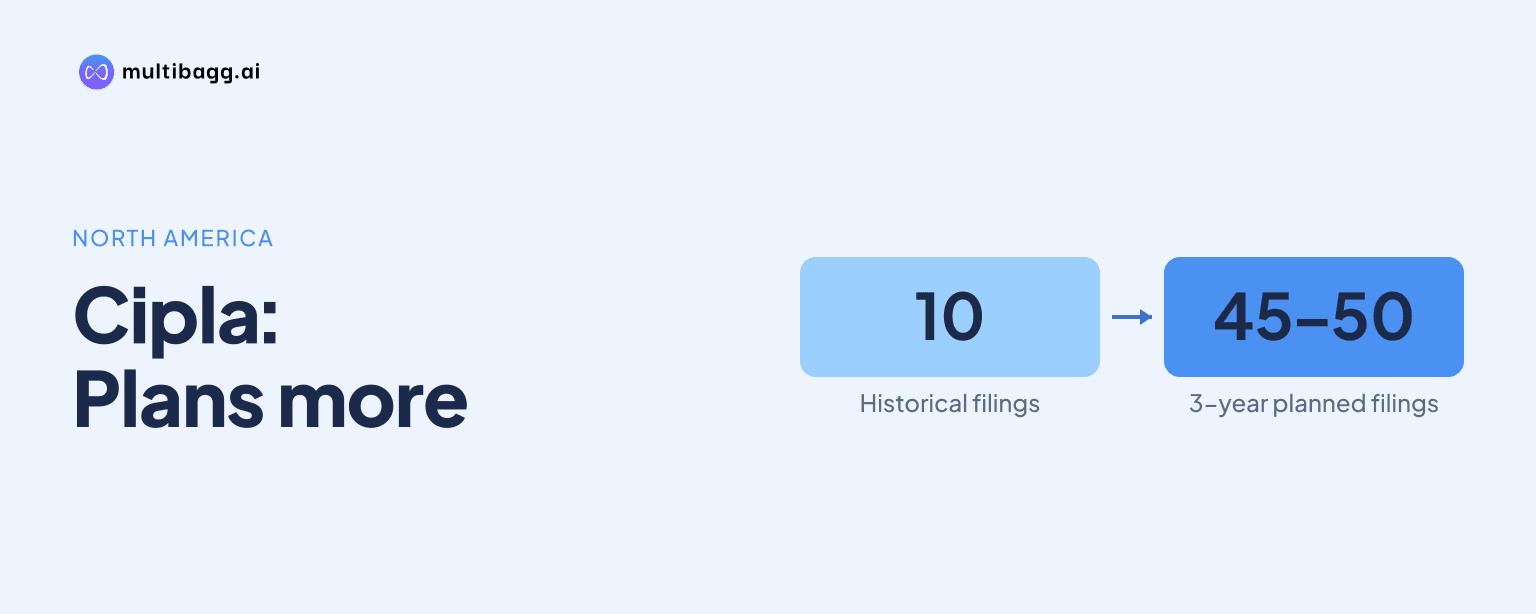
Cipla plans to make 45 to 50 complex-product filings in North America during the next three years, compared with roughly 10 filings on average historically. Management said the pipeline contains no plain-vanilla generics and will be supported by four biosimilars under development, selective in-licensing and potential acquisitions of differentiated assets.
Know Cipla inside out
Results, valuation, peers and who's buying, in one view.
What is Cipla planning for North America filings?
Cipla is targeting 45 to 50 North America product filings over the next three years, with every planned filing described by management as a complex asset. The target compares with roughly 10 filings on average in the past, raising the planned filing pace substantially. Management said it has no plain-vanilla generic products in the relevant pipeline.
The higher filing target forms part of Cipla’s plan to increase differentiated products as a proportion of its overall portfolio. Management identified complex generics, biosimilars and externally sourced assets as the principal levers. North America is the central market for the filing programme, while Europe was also identified as a market where the company is evaluating complex or differentiated acquisition opportunities.
The filing target does not establish the timing or revenue contribution of each asset. Management said the North America outcome will depend partly on approval timing for new products, alongside the ramp-up of assets that are already approved. It said that combination provides multiple pathways to its North America objective.
How will Cipla build its differentiated pipeline?
Cipla plans to build its differentiated pipeline through complex generic filings, four internally developed biosimilars and limited in-licensing. Management said it had previously indicated that it would add one or two biosimilar assets each year. It also plans to selectively in-license a few products, including Pembro, to add nearer-term pipeline coverage.
For India and other emerging markets with branded operations, Cipla is pursuing innovative, patent-protected opportunities through partnerships. Management cited its announced CTTQ deal for breast-cancer antibody-drug conjugate products and bispecific antibody-drug conjugates. This is distinct from the North America approach, which management described principally in terms of complex generics and biosimilars.
Cipla said transactions involving certain differentiated developed-market assets would probably be more acquisition-led than licensing-led. Management’s rationale was that an acquisition can bring a commercial front end and marketing experience for the acquired products. It did not identify a target, disclose a transaction timetable or announce a developed-market acquisition on the call.
What supports Cipla’s North America growth plan?
Cipla said the ramp-up of approved products and the approval of new assets together support its North America plan. Management identified Ventolin as a large opportunity that could cover much of the gap between the current exit rate and the targeted rate. It did not provide product-level revenue forecasts because approval timing and individual product contributions can vary.
Respiratory products are one mechanism behind the planned ramp-up. Management said its current respiratory assets include metered-dose inhalers, while an Ellipta-franchise opportunity would come later. On Symbicort, management said respiratory products are classified as complex by the US Food and Drug Administration, or FDA, and can have entry barriers that limit the number of participants.
Management said it was not anticipating ramp-up issues for products awaiting approval in the second half. However, it declined to discuss individual product goal dates or complete response letters because of competition sensitivity. Its view on Symbicort also depends on competitive dynamics not changing dramatically before Cipla enters the market.
Got a follow-up? Ask IRIS
How does Cipla plan to fund product development?
Cipla expects research and development, or R&D, spending to remain within 6% to 7% of revenue in the current FY27 financial year. Management said the percentage framework means the absolute amount available for development can increase as revenue rises. It said it would provide more detailed guidance with next year’s numbers if the R&D outlook changes.
For biosimilars, management said investment is focused on product development, Phase I studies and bioequivalence work. It said there is general acceptance in the US that most biosimilar products can receive a Phase III waiver. For Cipla’s first lead biosimilar under development, management said it had consulted the FDA and does not expect a Phase III trial to be required.
Cipla is using Aspergen, its joint venture with manufacturer Kemwell, for biosimilar capabilities. Management said Cipla has majority ownership of Aspergen, which gives the company access to a facility that is scaling up. The arrangement supports the four internal biosimilar programmes without management disclosing a separate new-facility construction plan.
What could affect Cipla’s delivery of this strategy?
Cipla’s planned North America delivery depends on approval timing, product launches and the market position of individual complex assets. Management said it has sufficient visibility to remain confident in its objective, but it also said the exact contribution from each product is difficult to specify. It did not provide details on the three pending approvals raised by an analyst.
North America also matters for profitability because management said much of Cipla’s R&D expenditure is directed toward developed markets such as the US. It said a revenue swing in North America affects North America earnings before interest, taxes, depreciation and amortisation, or EBITDA, more than India. Management described India as delivering steady double-digit growth over the last several quarters.
Management expects sequential margin improvement in the remaining two quarters of FY27, citing the planned US business ramp-up. Its FY27 EBITDA-margin guidance remains 18.5% to 20%, while guidance for the following year is due at the start of next year. Approval outcomes and the speed of product ramp-up therefore remain relevant to both the filing strategy and the FY27 margin range.
Conclusion
Cipla’s strategy shifts its North America pipeline from roughly 10 historical filings on average to 45 to 50 complex filings over three years. The plan combines complex generics, four internally developed biosimilars, selective in-licensing and possible acquisitions, rather than relying on plain-vanilla generic launches.
The next developments to watch are approval timing for pending products, the ramp-up of approved respiratory assets including Ventolin, and progress toward adding one or two biosimilars each year. Management has also said it will provide next-year guidance at the start of the following year while keeping FY27 R&D spending within 6% to 7% of revenue.