










CITIUS TransNet sees Rs 5,90,000 crore road opportunity
Key highlights
- CITIUS TransNet estimates about Rs 5,90,000 crore of road monetisation potential through FY30.
- NMP 2.0 estimates Rs 4,14,000 crore for roads in FY26-FY30, including Rs 35,000 crore in FY27.
- CITIUS TransNet identifies 99 NHAI-MoRTH HAM projects worth more than Rs 3,10,000 crore for potential acquisition.
- Private developer toll and annuity road monetisation is shown at more than Rs 1,00,000 crore for FY27-28P, versus Rs 54,000 crore in FY25-26.
powered by IRIS
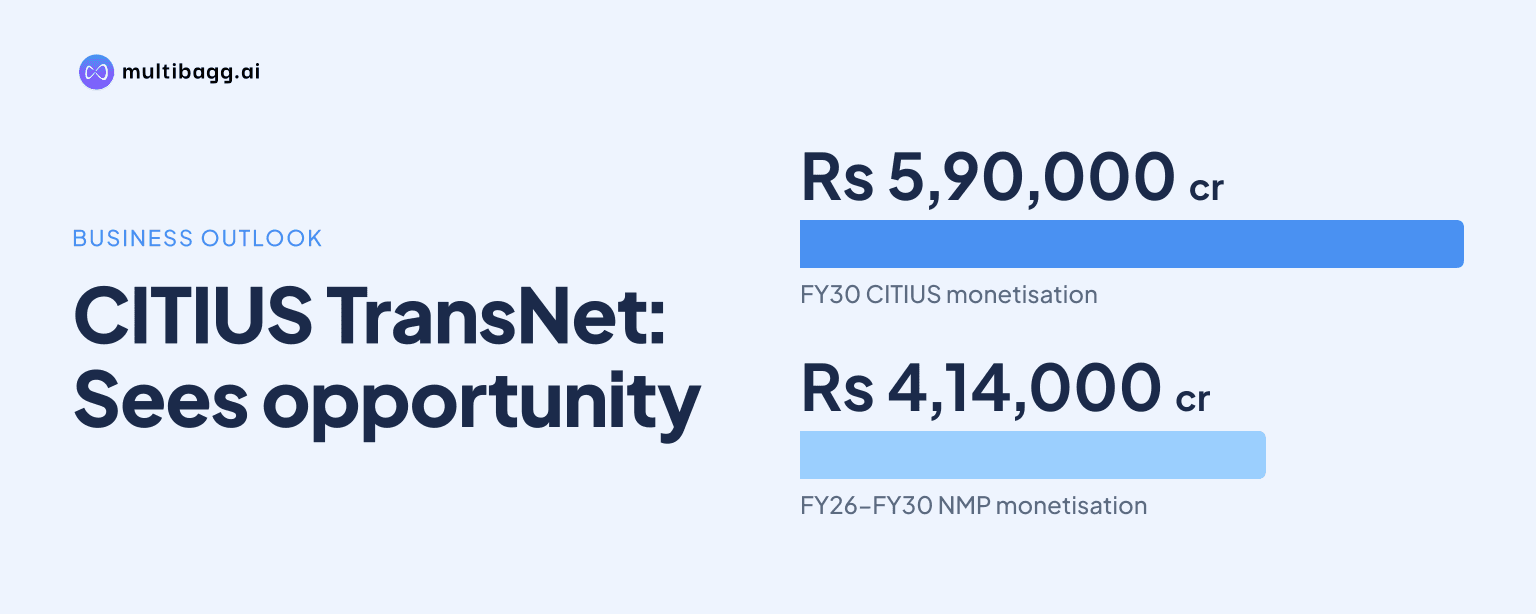
CITIUS TransNet identifies about Rs 5,90,000 crore of road-asset monetisation potential through FY30, with 99 Hybrid Annuity Model projects worth more than Rs 3,10,000 crore in the National Highways Authority of India and Ministry of Road Transport and Highways pipeline expected to be available for acquisition. The presentation frames this as an opportunity pool rather than announced transaction value.
Know Citius Transnet Investment Trust inside out
Results, valuation, peers and who's buying, in one view.
What is included in CITIUS TransNet’s road monetisation opportunity?
CITIUS TransNet states that road assets offer about Rs 5,90,000 crore of monetisation potential until fiscal 2030 through private-developer asset divestments, government monetisation and upcoming projects. The presentation does not disclose a calculation reconciling each category to the Rs 5,90,000 crore total, so the figure should be read as its overall market-opportunity estimate.
Government monetisation is a major identified channel. The National Monetisation Pipeline 2.0 estimate for roads is Rs 4,14,000 crore for FY26-FY30, including Rs 35,000 crore for FY27. Separately, CITIUS TransNet says expected National Monetisation Pipeline 2.0 assets across highways, multimodal logistics and ropeways are valued at about Rs 4,42,000 crore for FY25-FY30, placing roads at the centre of that wider programme.
Private developer sales form another channel through toll and annuity roads, including Hybrid Annuity Model, or HAM, assets. CITIUS TransNet says HAM monetisation by developers accelerated in the last two fiscals and is expected to continue. Its figures show a material increase between the earlier and later periods.
The stated value for FY25-26 is Rs 40,000 crore higher than the Rs 14,000 crore shown for FY22-24. For FY27-28P, where P denotes projected, CITIUS TransNet shows more than Rs 1,00,000 crore. These are grouped fiscal periods, not single-year transaction totals, and the presentation does not say the categories can be added without overlap.
How large is the HAM project supply behind potential acquisitions?
CITIUS TransNet identifies 99 HAM projects worth more than Rs 3,10,000 crore in the National Highways Authority of India, or NHAI, and Ministry of Road Transport and Highways, or MoRTH, pipeline that are expected to be available for acquisition. It does not provide asset-by-asset timing, bidder lists or transaction terms for those projects.
The potential supply also reflects the recent award base. More than 42,000 kilometres of HAM projects were awarded between FY22 and FY25, at a cost of more than Rs 16,80,000 crore, according to the presentation. Awarded project cost does not establish the value of assets that will be sold, but the comparison indicates that the Rs 3,10,000 crore prospective acquisition pipeline represents only one identified part of a larger recent project-award base.
A separate NHAI Build-Operate-Transfer, or BOT, pipeline comprises 53 projects worth Rs 2,10,000 crore and is described as a long-term pipeline. CITIUS TransNet also cites 28 fresh projects in FY27 under HAM or BOT formats. Its identified opportunity routes include developer portfolios, government Toll-Operate-Transfer, or TOT, transactions, and newly offered HAM or BOT projects.
Got a follow-up? Ask IRIS
What policy change could affect HAM asset-sale timing?
The September 27, 2026 revision to the model concession agreement reduced the developer lock-in period after the commercial operations date, or COD, to six months from two years. CITIUS TransNet says the revised terms could enable enhanced private investor interest and potentially increase future opportunities for infrastructure investment trusts, or InvITs.
The National Highways Authority of India policy circular also changed construction support payments to 10 granular instalments from five earlier. For delays arising from authority-related issues or political force majeure events, the presentation says a prolongation cost equal to 8% of the incomplete work’s value is to be paid to the concessionaire.
The revision also mandates digital monitoring systems at construction sites and includes a provision for harmonious substitution. The presentation says this provision applies where an uncured authority default involving land or clearances delays a project, where a concessionaire fails to mobilise funds, or where a concessionaire seeks to exit after COD. These terms may matter for the availability and timing of future HAM transactions, but CITIUS TransNet does not quantify their financial impact.
How does the road opportunity compare with other transport sectors?
Roads represent the largest component of CITIUS TransNet’s Rs 42,00,000 crore to Rs 45,00,000 crore transport-infrastructure investment potential for FY25-FY30, at Rs 33,00,000 crore to Rs 35,00,000 crore. Metro rail is shown at Rs 3,00,000 crore to Rs 3,50,000 crore, logistics at Rs 2,00,000 crore to Rs 3,00,000 crore, ropeways at Rs 1,00,000 crore to Rs 1,50,000 crore, and airports at Rs 1,00,000 crore to Rs 1,20,000 crore.
The funding mix in the presentation assigns 53% to the central government, 32% to states and 15% to private sources. That mix is consistent with CITIUS TransNet’s identification of both public monetisation programmes and private developer divestments as routes through which road opportunities may emerge.
The National Infrastructure Pipeline comprised 14,928 projects with a total project cost of Rs 2,16,02,000 crore as of February 2026. CITIUS TransNet also cites 20,000 kilometres of six-to-eight-lane high-speed corridors planned over the next five years. The National Logistics Policy targets logistics costs below 10% of gross domestic product by 2030, providing the presentation’s policy context for multimodal transport development.
Conclusion
CITIUS TransNet’s Rs 5,90,000 crore estimate places road monetisation within a transport investment outlook of Rs 42,00,000 crore to Rs 45,00,000 crore through FY30. The stated opportunity spans developer asset sales, the Rs 4,14,000 crore National Monetisation Pipeline 2.0 roads estimate, and potential projects under HAM, BOT and TOT structures.
What to watch next is whether the 99 HAM projects worth more than Rs 3,10,000 crore become available on the terms CITIUS TransNet anticipates, alongside development of the 53-project BOT pipeline worth Rs 2,10,000 crore and the 28 fresh FY27 projects. The six-month post-COD lock-in introduced in September 2026 may also affect when developers can pursue exits.