










Cosmo Films maintains its 59% specialty BOPP volume mix in Q2 FY27
Key highlights
- Cosmo Films reported a 59% specialty and semi-specialty BOPP volume mix in Q2 FY27, versus 61% in Q1 FY27.
- Specialty-film contribution was 62 per kg in Q2 FY27, compared with 29 per kg for base films.
- Packaging-films sales rose 48% year on year to Rs 1,232 crore in Q2 FY27, while EBITDA rose 33% to Rs 171 crore.
- Cosmo Films had BOPP capacity of 2.77 lakh MT per annum and utilisation above 90% in Q2 FY27.
powered by IRIS
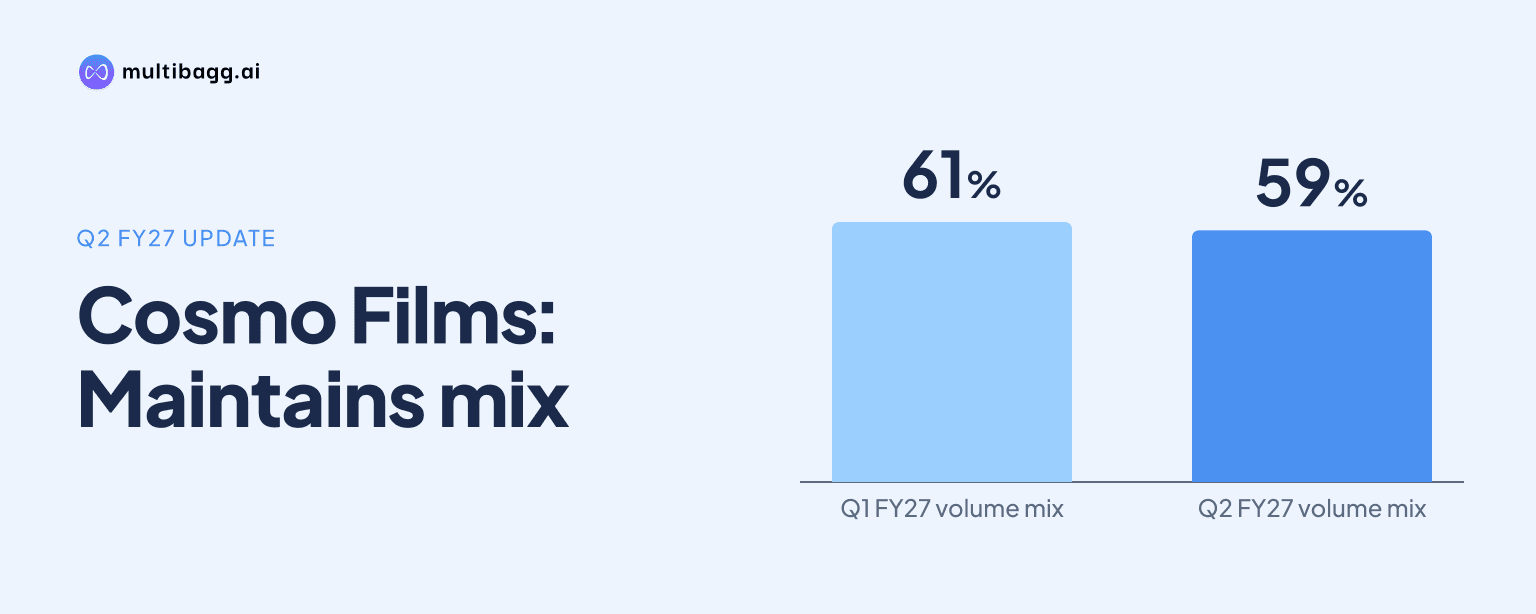
Cosmo Films maintained a 59% specialty and semi-specialty share of BOPP volume in Q2 FY27, while specialty films generated 62 per kg of contribution versus 29 per kg for base films, despite new BOPP-line ramp-up lifting base-film output.
Know Cosmo First inside out
Results, valuation, peers and who's buying, in one view.
How much of Cosmo Films' BOPP volume was specialty in Q2 FY27?
Cosmo Films reported that specialty and semi-specialty films made up 59% of BOPP volume in Q2 FY27, with base films accounting for the remaining 41%. The combined specialty share was lower than 61% in Q1 FY27 but higher than 56% in Q2 FY26, while the presentation reported 15% year-on-year volume growth in Q2 FY27.
Management said the mix was tracking a path back towards about 70%, after the new BOPP line continued to run higher base-film volumes during its ramp-up. The Q2 FY27 result was therefore close to the approximately 60% mix cited in the presentation, but below the 71% specialty and semi-specialty share recorded in FY25.
The longer-term data show a clear capacity-related change in the mix. Specialty and semi-specialty volume rose from 38% in FY19 to 71% in FY25, before declining to 58% in FY26 after new BOPP and cast polypropylene, or CPP, lines were commissioned and initially made more base BOPP and CPP films. In H1 FY27, the specialty and semi-specialty share was 60% and base films represented 40%.
How much higher is Cosmo Films' specialty contribution per kg?
Cosmo Films reported specialty-film contribution of 62 per kg in Q2 FY27, compared with 40 per kg for semi-specialty films and 29 per kg for base films. The 33-per-kg difference between specialty and base films is the presentation's numerical basis for directing incremental capital expenditure towards specialty assets.
The gap persisted despite sequential changes in all three categories. Specialty contribution declined from 63 per kg in Q1 FY27, semi-specialty contribution declined from 45 per kg, and base-film contribution declined from 30 per kg. The source defines these measures as per-kg contribution for their respective film categories.
Across FY19 to H1 FY27, specialty-film contribution ranged from 46 per kg to 67 per kg, while base-film contribution ranged from 10 per kg to 45 per kg. Cosmo Films said specialty contribution fell to 55 per kg in FY24 because of a changed sales and customer mix, then rose to 60 per kg in FY25 and 65 per kg in FY26 following the return of a specialty export customer for a high-margin film.
Why did Cosmo Films' specialty mix fall after FY25?
Cosmo Films said the specialty and semi-specialty share fell from 71% in FY25 to 58% in FY26 because newly commissioned BOPP and CPP lines initially produced higher volumes of base films. The same ramp-up effect continued in Q2 FY27, when the combined share was 59%, even as management retained its target of about 10% compound annual growth in specialty films, including new capacity.
The presentation distinguishes the categories by market and product characteristics. It classifies base films as having high competition and low pricing power, semi-specialty films as medium on both measures, and specialty films as having low competition and high pricing power. It also assigns specialty films high research and development requirements, customer stickiness and export opportunity.
Cosmo Films listed phenol-free DTP, green graphic films with specialty adhesives, twistable CPP film, golden metallised film, high-barrier and metallised CPP films, retort-grade transparent films, UV inkjet-printable label films and synthetic paper among innovations from the preceding 12 months. Its product portfolio spans packaging, graphics, label and industrial-film applications, rather than a single end market.
Got a follow-up? Ask IRIS
What capacity supports Cosmo Films' specialty-film plan?
Cosmo Films had BOPP capacity of 2.77 lakh metric tonnes, or MT, per annum in September 2026, up from 1.96 lakh MT per annum in March 2022. It also reported 30,000 MT of CPP capacity, 30,000 MT of biaxially oriented polyethylene terephthalate capacity, about 45,000 MT of coating capacity and about 57,000 MT of metallising capacity.
Capacity utilisation improved to more than 90% in Q2 FY27, and management said it was targeting near-full utilisation. The presentation states that capacity has been built for the next two years of specialty growth and that only specialty assets are planned for capital expenditure over the next couple of years.
A 16,000-MT coating line at Bidkin, Chhatrapati Sambhajinagar, was tentatively scheduled for commissioning in H2 FY27. The source says this would increase coating capacity from H2 FY27, alongside the existing approximately 45,000-MT coating base reported for September 2026.
How did Cosmo Films' packaging-films results change in Q2 FY27?
Cosmo Films' packaging-films sales rose 48% year on year to Rs 1,232 crore in Q2 FY27, while earnings before interest, tax, depreciation and amortisation, or EBITDA, increased 33% to Rs 171 crore. EBITDA margin declined to 13.9% from 15.5% in Q2 FY26, so sales and EBITDA growth did not prevent a lower reported margin.
For H1 FY27, packaging-films sales increased 47% to Rs 2,273 crore and EBITDA rose 25% to Rs 313 crore. The H1 FY27 EBITDA margin was 13.8%, compared with 16.2% in H1 FY26. The presentation does not quantify how much of that margin movement came from ramp-up, pricing, raw materials or product mix.
About 50% of Cosmo Films revenue comes from exports across more than 100 countries, and the company says a majority of exports comes from specialty films. It identifies the United States and Japan as premium-realisation markets and describes its position as among the top four global BOPP specialty-film players, the second-largest specialty-label-film player and the largest thermal-lamination-film supplier.
Conclusion
The reported data show why product mix remains central to Cosmo Films' films strategy. Specialty and semi-specialty products remained the larger BOPP volume category during the new-line ramp-up, and the per-kg contribution gap between specialty and base films remained substantial. At the same time, the lower packaging-films EBITDA margins in Q2 FY27 and H1 FY27 show that higher revenue and utilisation did not translate into a higher reported segment margin.
The next disclosed milestones are progress from more than 90% utilisation towards near-full utilisation, the tentative H2 FY27 commissioning of the 16,000-MT coating line, and movement in the specialty and semi-specialty BOPP mix towards approximately 70%. Management has also stated a target of about 10% compound annual growth in specialty films, including output from new capacity.