










Fratelli’s vineyard moat spans 230 acres and 12 varietals
Key highlights
- Fratelli reports 230 acres under active farming and about 600 acres supported by long-term contract farmers.
- Fratelli says 12 varietals imported from France and Italy were grafted on Indian root stock.
- Fratelli reports 5.4 million litres of winery capacity in 2024, versus 2.65 million litres in 2019.
- Fratelli reported FY26 revenue of Rs 184 crore and a gross profit margin of 78%.
powered by IRIS
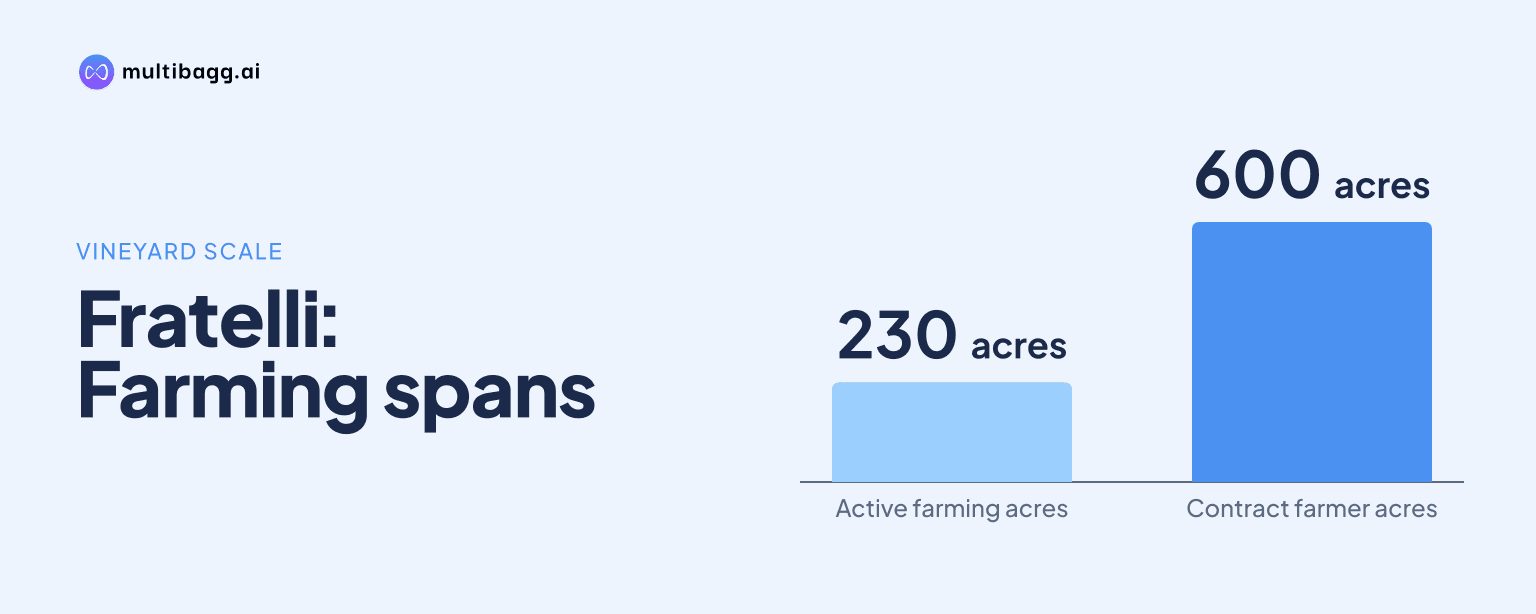
Fratelli Vineyards says its cultivation moat combines 230 acres under active farming, about 600 acres supplied by long-term contract farmers and 12 imported varietals grafted into indigenous clones, while claiming one-third of India’s wine market. The presentation does not identify the 230 active acres as owned.
Know Fratelli Vineyards inside out
Results, valuation, peers and who's buying, in one view.
What agricultural footprint does Fratelli report?
Fratelli reports 230 acres under active farming and approximately 600 acres supported by long-term contract farmers, giving it access to roughly 830 acres of grape-growing land through two sourcing arrangements. The company presents this combination as one of six elements behind its claimed one-third market share, alongside varietals, agronomy, soil and climate.
The presentation does not distinguish whether the 230 active acres are owned, leased or otherwise controlled, so ownership cannot be established from this disclosure. Its timeline says 240 acres of vineyards were set up at Akluj, Maharashtra, in 2007, and that it added 100 acres under active farming at Jambhali, Maharashtra, in 2023; these figures describe different points in the development history and do not reconcile the present 230-acre total.
The contract-farmer component is larger than the directly reported active-farming component by about 370 acres, making external growers the larger stated source of cultivation area. Fratelli does not disclose grape volumes, contract durations, pricing terms or the share of winery supply produced by each of the 230-acre and 600-acre channels.
How does Fratelli create its proprietary grape clones?
Fratelli says it imported 12 grape varietals from wine regions in France and Italy, then grafted them on Indian root stock to develop indigenous clones. The mechanism described is agricultural adaptation: imported varietals are combined with local root stock so that the resulting planting material is suited to Indian climatic and soil conditions.
The 12 varieties listed by Fratelli are Chardonnay, Cabernet Sauvignon, Chenin Blanc, Shiraz, Müller Thurgau, Gewürztraminer, Cabernet Franc, Mercelan, Petit Verdot, Merlot, Sangiovese Grosso and Sauvignon Blanc. The company says this collection of proprietary clones supports a differentiated wine portfolio, but it does not provide clone-level yield data, quality measures, legal protection details or commercial sales by variety.
Fratelli also identifies virgin, high-minerality soil and temperatures of 13-30°C as cultivation advantages. These are company descriptions of the terroir, rather than independently measured comparisons with other vineyards, but they explain why the company links clone development to the taste and flavour concentration of its wines.
Got a follow-up? Ask IRIS
Why does Fratelli call time an entry barrier in wine?
Fratelli calls time a significant entry barrier because it reports more than 15 years of agronomical experience and a vineyard programme that began with 240 acres in 2007. The company’s point is that plant selection, grafting, vineyard management and the development of wine ranges take multiple seasons rather than being created immediately through brand spending or distribution expansion.
Its timeline records the first varietal-wine launches in 2010, including Cabernet Sauvignon, Sauvignon Blanc and Chenin Blanc, followed by Sette in 2011 and the M/S range in 2016. It also says Sette was India’s number-one luxury wine at launch, but provides no methodology, period or market-measure definition for that ranking.
Fratelli says its adapted varietals can produce wines that cannot be replicated over the next several years. That is a company assertion about future replicability, not a disclosed patent claim or an independently tested estimate; the evidence supplied is the 12-varietal import programme, Indian-root-stock grafting and more than 15 years of stated agronomical experience.
The winery build-out provides a separate indicator of elapsed investment. Fratelli reached 2.65 million litres of capacity in 2019, added 1 million litres of capacity in 2023 and reported 5.4 million litres of winery capacity in 2024, more than double the 2019 level.
How does Fratelli’s vineyard platform fit its financial plan?
Fratelli’s agricultural platform sits beside a 5.4 million-litre winery, but its reported financial trajectory shows FY26 revenue remained below the FY24 level. Revenue rose from Rs 144 crore in FY22 to Rs 216 crore in FY24, before declining to Rs 182 crore in FY25 and recovering slightly to Rs 184 crore in FY26.
Gross profit rose from Rs 105 crore in FY22 to Rs 144 crore in FY26, while gross profit margin increased from 73% to 78%, despite revenue being Rs 32 crore lower in FY26 than in FY24. Fratelli attributes margin improvement to supply-chain streamlining and says it will continue launching products and investing in brand building.
Earnings before interest, tax, depreciation and amortisation, or EBITDA, fell from Rs 29 crore in FY24 to Rs 0.23 crore in FY25, then rose to Rs 1.06 crore in FY26. Profit after tax moved from Rs 9 crore in FY24 to losses of Rs 13 crore in FY25 and Rs 16 crore in FY26, indicating that the higher gross margin had not translated into positive reported net profit by FY26.
Conclusion
Fratelli’s disclosed moat is primarily an agricultural and time-based proposition: 230 active-farming acres, around 600 contract-farmer acres, 12 imported varietals adapted through Indian root stock and more than 15 years of agronomical experience. The company pairs these inputs with a claimed one-third market share and 5.4 million litres of capacity, although the presentation does not substantiate ownership of the active acreage or quantify the market-share calculation.
The next disclosed milestones are management’s Vision 2030 targets of revenue above Rs 500 crore, annual compound revenue growth above 20% and an EBITDA margin above 20% by FY30. Management also says a hospitality project is in planning with estimated investment of Rs 70 crore to Rs 80 crore, while product launches, premiumisation, more touch points and new markets are identified as growth drivers.