










Piramal Finance Q2 net profit rises 67% on NII growth
Key highlights
- Piramal Finance’s Q2 FY27 consolidated net profit rose 67% year on year to Rs 545 crore.
- Piramal Finance’s Q2 FY27 NII increased 35% year on year to Rs 1,530 crore.
- Piramal Finance’s gross AUM reached Rs 1,01,296 crore at September 2026, versus Rs 82,323 crore a year earlier.
- Piramal Finance’s capital adequacy was 20.10% at September 2026, compared with 18.85% at June 2026.
powered by IRIS
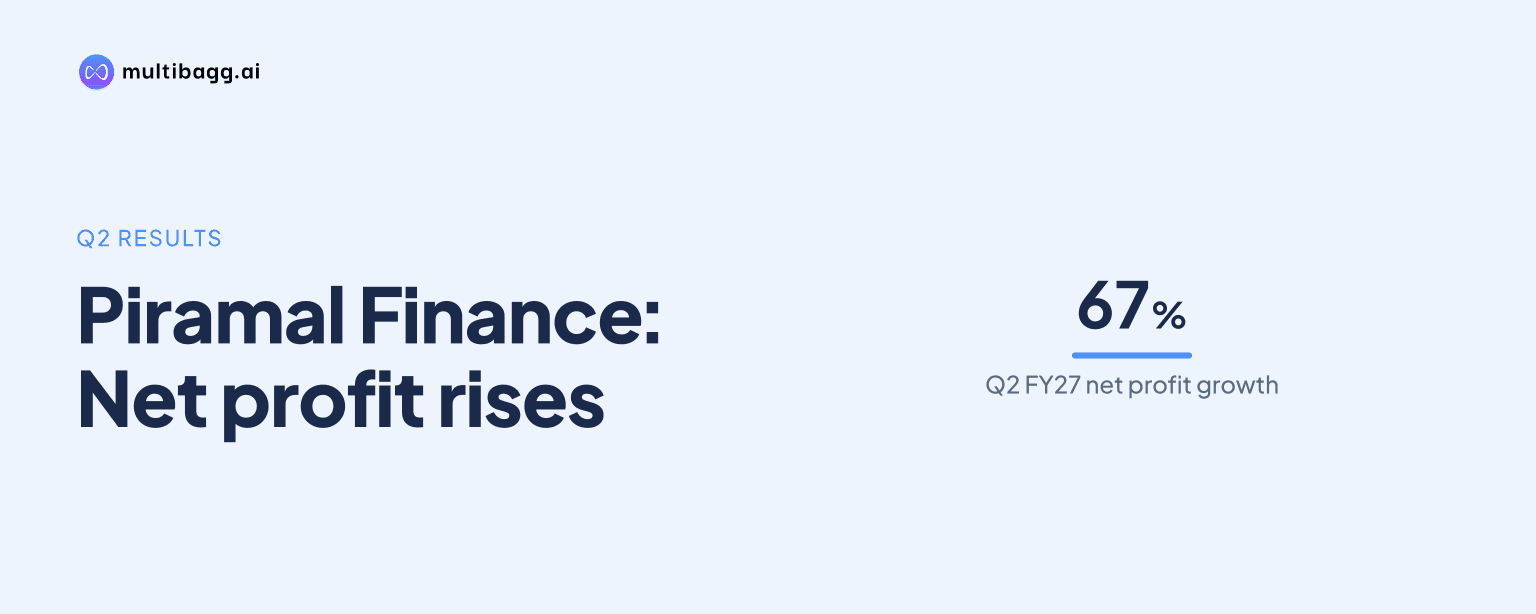
Piramal Finance reported consolidated net profit of Rs 545 crore in Q2 FY27, up 67% year on year, as net interest income increased 35% to Rs 1,530 crore. Total income rose 33% to Rs 1,767 crore, while operating expenses increased 13% to Rs 921 crore, lifting pre-provision operating profit by 64%.
Know Piramal Finance inside out
Results, valuation, peers and who's buying, in one view.
Why did Piramal Finance’s Q2 FY27 profit increase?
Piramal Finance’s Q2 FY27 profit increased because total income grew faster than both operating expenses and loan-loss provisions. Total income rose by Rs 439 crore year on year to Rs 1,767 crore, whereas operating expenses increased by Rs 108 crore to Rs 921 crore. Pre-provision operating profit, or PPOP, consequently rose by Rs 331 crore to Rs 846 crore.
Loan-loss provisions and fair-value loss or gain increased 22% year on year to Rs 302 crore, but were 34% below Rs 455 crore in Q1 FY27. Profit before tax and associate income rose 103% to Rs 543 crore. Associate income fell 41% to Rs 37 crore, while profit before tax rose 76% to Rs 580 crore.
The year-on-year comparison also includes exceptional items in Q2 FY26. That quarter included Rs 81 crore of exceptional charges, comprising Rs 70 crore of merger-related expenses and a Rs 21 crore one-off tax expense. In Q2 FY27, current and deferred tax was Rs 35 crore, compared with a Rs 78 crore tax credit a year earlier; net profit nevertheless rose Rs 218 crore year on year and Rs 84 crore sequentially.
How did net interest income support Piramal Finance’s revenue?
Piramal Finance’s net interest income, or NII, rose 35% year on year to Rs 1,530 crore because interest income grew 24%, faster than the 16% rise in interest expense. Interest income reached Rs 3,358 crore from Rs 2,702 crore, while interest expense increased to Rs 1,828 crore from Rs 1,570 crore.
NII was also 6% higher than Rs 1,438 crore in Q1 FY27. Interest income increased Rs 184 crore sequentially, compared with a Rs 92 crore increase in interest expense. Interest income included Rs 82 crore of direct-assignment upfront income in Q2 FY27, below Rs 112 crore in Q2 FY26 and Rs 85 crore in Q1 FY27.
Other income rose 20% year on year to Rs 237 crore, including fee and commission income of Rs 131 crore, up 9%, and dividend income of Rs 10 crore. For H1 FY27, NII increased 39% to Rs 2,968 crore and total income increased 35% to Rs 3,455 crore. The presentation also says Q1 FY27 interest income and loan-loss provisions were each reclassified lower by about Rs 5 crore for comparability.
Got a follow-up? Ask IRIS
What changed in Piramal Finance’s September 2026 balance sheet?
Piramal Finance’s total assets were Rs 1,16,982 crore at September 2026, up Rs 17,926 crore from September 2025 and Rs 5,731 crore from June 2026. Gross assets under management, or AUM, increased to Rs 1,01,296 crore from Rs 82,323 crore a year earlier and Rs 95,369 crore at June 2026.
Net AUM reached Rs 98,840 crore at September 2026, compared with Rs 80,616 crore at September 2025 and Rs 93,203 crore three months earlier. Expected credit loss, or ECL, provisions were Rs 2,457 crore, rising from Rs 1,708 crore a year earlier and Rs 2,167 crore at June 2026. Cash and liquid investments declined to Rs 6,899 crore from Rs 7,238 crore year on year.
Piramal Finance’s net worth increased Rs 3,733 crore year on year to Rs 31,180 crore, while gross debt increased Rs 14,193 crore to Rs 85,802 crore. Capital adequacy was 20.10% at September 2026, compared with 20.70% a year earlier and 18.85% at June 2026. Thus, capital adequacy rose sequentially while remaining below its September 2025 level.
How did Piramal Finance’s wholesale portfolio change?
Piramal Finance’s wholesale AUM rose to Rs 13,978 crore in Q2 FY27 from Rs 11,295 crore in Q2 FY26, while its average residual loan tenure declined to 2.6 years from 3.0 years. The average ticket size was Rs 55 crore, compared with Rs 54 crore a year earlier and Rs 56 crore in Q1 FY27.
The portfolio effective interest rate, or EIR, which includes fee income, declined to 14.1% in Q2 FY27 from 14.5% in Q2 FY26. AUM with an EIR below 14% increased to Rs 6,416 crore from Rs 4,128 crore, while AUM above 14% rose to Rs 7,562 crore from Rs 7,167 crore. Total wholesale AUM therefore increased Rs 2,683 crore while the portfolio EIR declined 0.4 percentage points.
Actual repayments were Rs 1,889 crore in Q2 FY27, exceeding contracted repayments of Rs 1,096 crore, although they were below Rs 2,268 crore in Q4 FY26. The annualised repayment rate was 24%, compared with 17% in Q2 FY26 and 34% in Q1 FY27. At September 2026, residential assets accounted for 56% of AUM, commercial assets 12%, broking 7%, NBFC-fintech 5% and NBFC-microfinance institution assets 5%.
Piramal Finance’s real-estate portfolio comprised 211 deals below Rs 100 crore, 36 deals above Rs 100 crore and up to Rs 200 crore, and six deals above Rs 200 crore at September 2026. Mumbai Metropolitan Region and Bangalore each accounted for 22% of real-estate AUM, followed by Chennai at 17%. Other corporates accounted for 7% of overall AUM and renewable energy represented 1%.
Conclusion
Piramal Finance’s Q2 FY27 results show profit growth outpacing income growth as NII rose 35%, total income increased 33% and operating expenses increased 13%. Net profit rose 67% to Rs 545 crore, while gross AUM reached Rs 1,01,296 crore and net worth increased to Rs 31,180 crore at September 2026.
The next disclosed event is Piramal Finance’s Piramal.ai Investor & Analyst Day 2026, scheduled for 19 and 20 November 2026. Management’s discussion may provide further detail on the Rs 13,978 crore wholesale portfolio, the 14.1% EIR, the 24% annualised repayment rate and the September 2026 balance-sheet expansion.