










Piramal Finance rural micro-loan 90+ DPD falls to 0.4% in Q2
Key highlights
- Piramal Finance rural micro-loan 90+ DPD fell to 0.4% in Q2 FY27 from 7.0% in Q4 FY25.
- Piramal Finance rural micro-loan AUM was Rs 1,762 crore, or 2% of total AUM, in Q2 FY27.
- Piramal Finance reported Rs 610 crore of rural-loan disbursements in Q2 FY27.
- Piramal Finance retail AUM grew 30% year on year to Rs 97,462 crore while retail 90+ DPD was 0.7% in Q2 FY27.
powered by IRIS
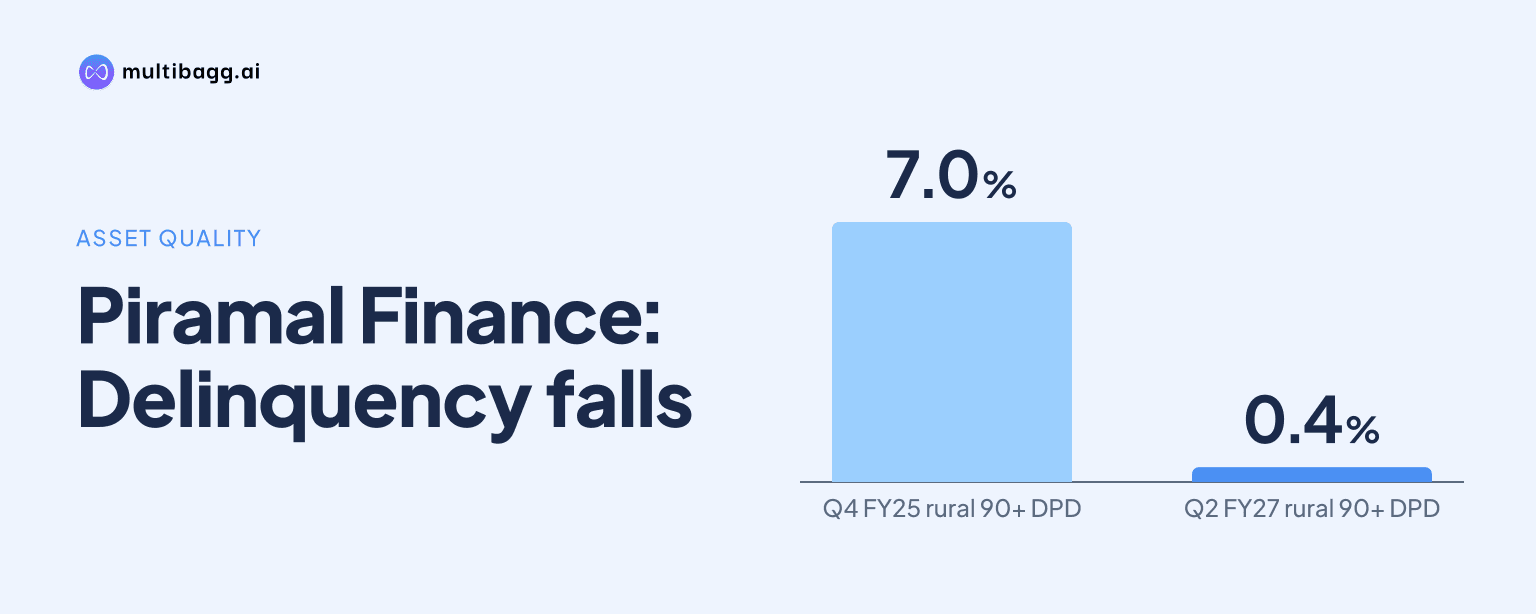
Piramal Finance reported rural micro-loan 90+ DPD, or accounts 90 or more days past due, of 0.4% in Q2 FY27, down from a 7.0% peak in Q4 FY25. The improvement occurred while rural micro-loan assets under management, or AUM, reached Rs 1,762 crore, equal to 2% of total AUM.
Know Piramal Finance inside out
Results, valuation, peers and who's buying, in one view.
How far have Piramal Finance rural micro-loan delinquencies declined?
Piramal Finance cut the rural micro-loan 90+ DPD ratio by 6.6 percentage points from 7.0% in Q4 FY25 to 0.4% in Q2 FY27. The ratio had risen from 0.1% in Q1 FY24 to 1.4% in Q4 FY24, then accelerated to 2.5% in Q1 FY25, 5.5% in Q2 FY25 and 6.9% in Q3 FY25 before reaching its reported peak.
The subsequent decline was rapid but occurred over several reporting quarters. Rural micro-loan 90+ DPD fell to 3.7% in Q1 FY26, 1.8% in Q2 FY26, 1.0% in Q3 FY26 and 0.6% in Q4 FY26. It remained at 0.6% in Q1 FY27 before decreasing by a further 0.2 percentage points to 0.4% in Q2 FY27.
The presentation gives the delinquency trajectory but does not identify a specific underwriting, collections or portfolio-management action as the cause of the improvement. It does show Q2 FY27 rural-loan disbursement of Rs 610 crore, alongside the Rs 1,762 crore rural micro-loan AUM, so the lower reported delinquency ratio coincided with continued origination activity.
How does rural micro-loan risk compare with other Piramal Finance products?
Piramal Finance’s 0.4% rural micro-loan 90+ DPD ratio in Q2 FY27 was below the 0.7% retail-overall ratio, 0.9% for digital loans and 1.2% for used-car loans. Housing loans and loan against property, or LAP, each reported 0.6%, while salaried personal loans reported 0.7% and unsecured business loans excluding rural loans reported 1.1%.
The rural segment, however, was smaller than the major secured portfolios at Q2 FY27. Housing-loan AUM was Rs 34,164 crore and LAP AUM was Rs 30,486 crore, versus Rs 1,762 crore for rural micro loans. Rural micro loans accounted for 2% of total AUM, while housing loans and LAP represented 30% and 27%, respectively.
Digital loans provide a separate comparison between expansion and reported asset quality. Digital-loan AUM increased 84% year on year to Rs 6,299 crore at Q2 FY27, and its 90+ DPD ratio was 0.9%, unchanged from Q1 FY27. The comparable ratio had been 3.0% in both Q2 and Q3 FY25, before declining to 1.5% in Q2 FY26.
Got a follow-up? Ask IRIS
What do Piramal Finance’s origination vintages show?
Piramal Finance’s rural micro-loan vintages show that newer originations had lower 90+ DPD after 12 months on book than the most stressed cohorts. The presentation measures each vintage by the quarter of origination, and reports rural micro-loan results of 9.0% for Q1 FY25 originations and 8.7% for Q2 FY25, versus 1.0% for Q1 FY26 and 0.9% for Q2 FY26.
The vintage evidence differs from the quarterly portfolio ratio because it follows loans after 12 months on book rather than measuring the current stock at each quarter-end. Rural micro-loan vintages increased from 0.5% in Q2 FY23 to 7.4% in Q4 FY24, then fell to 3.1% for Q3 FY25 and 1.7% for Q4 FY25. This sequence is consistent with the improvement in the reported 90+ DPD stock ratio from Q4 FY25 through Q2 FY27.
Newer vintages in several other products were also lower than earlier cohorts. Used-car-loan vintage 90+ DPD was 6.3% for Q1 FY23 originations and 1.5% for Q2 FY26 originations. Digital-loan vintages moved from 5.1% for Q1 FY23 to 2.5% for Q2 FY26, while salaried personal-loan vintages decreased from 4.3% for Q2 FY23 to 1.6% for Q2 FY26.
Is the broader Piramal Finance retail portfolio stable during growth?
Piramal Finance’s retail portfolio reported a 0.7% 90+ DPD ratio in Q2 FY27, the same as Q1 FY27 and Q4 FY26, while retail AUM grew 30% year on year to Rs 97,462 crore. The presentation characterises the retail portfolio as stable over four years, with quarterly 90+ DPD ranging from 0.6% to 1.1% from Q1 FY23 through Q2 FY27.
Growth was not limited to rural micro loans. Retail disbursements rose 34% year on year to Rs 14,646 crore in Q2 FY27, while total retail AUM increased from Rs 85,885 crore in FY26 to Rs 97,462 crore at Q2 FY27. Mortgages, comprising housing loans and LAP, represented Rs 64,650 crore, or 66% of retail AUM, and grew 27% year on year.
Risk performance was not identical across products. Used-car-loan 90+ DPD was 1.2% in Q2 FY27, below its 1.4% level in Q2 and Q3 FY26 but above the 0.4% rural micro-loan ratio. Unsecured business loans excluding rural loans improved from 1.6% in Q4 FY25 to 1.1% in Q2 FY27, whereas housing loans rose from 0.4% in Q4 FY24 to 0.6% in Q2 FY27.
Conclusion
Piramal Finance’s principal asset-quality change in the disclosed rural micro-loan data is the decline in 90+ DPD from 7.0% in Q4 FY25 to 0.4% in Q2 FY27. The 12-month-on-book vintage series also shows newer rural cohorts at 1.0% and 0.9% for Q1 and Q2 FY26, below the 9.0% and 8.7% outcomes recorded for Q1 and Q2 FY25 originations.
The next results should show whether rural micro-loan risk remains contained as new lending continues, following Rs 610 crore of Q2 FY27 disbursement and Rs 1,762 crore of AUM. Readers can also track the fast-growing digital-loan portfolio, where AUM rose 84% year on year to Rs 6,299 crore and 90+ DPD was 0.9% in Q2 FY27.