










CSB Bank targets 6% funding cost next financial year
Key highlights
- CSB Bank is targeting a cost of funds of about 6% next financial year, down from 6.55% in Q2 FY2027.
- CSB Bank aims to retain net interest margin at around 3.75% next year as it diversifies beyond gold loans.
- Gold loans are planned to decline from 53% of the lending mix last year to about 50% initially and 32% by 2030.
- CSB Bank expects fee income to reach 17% to 18% of total income and targets return on assets of 1.5% to 1.8% next year.
powered by IRIS
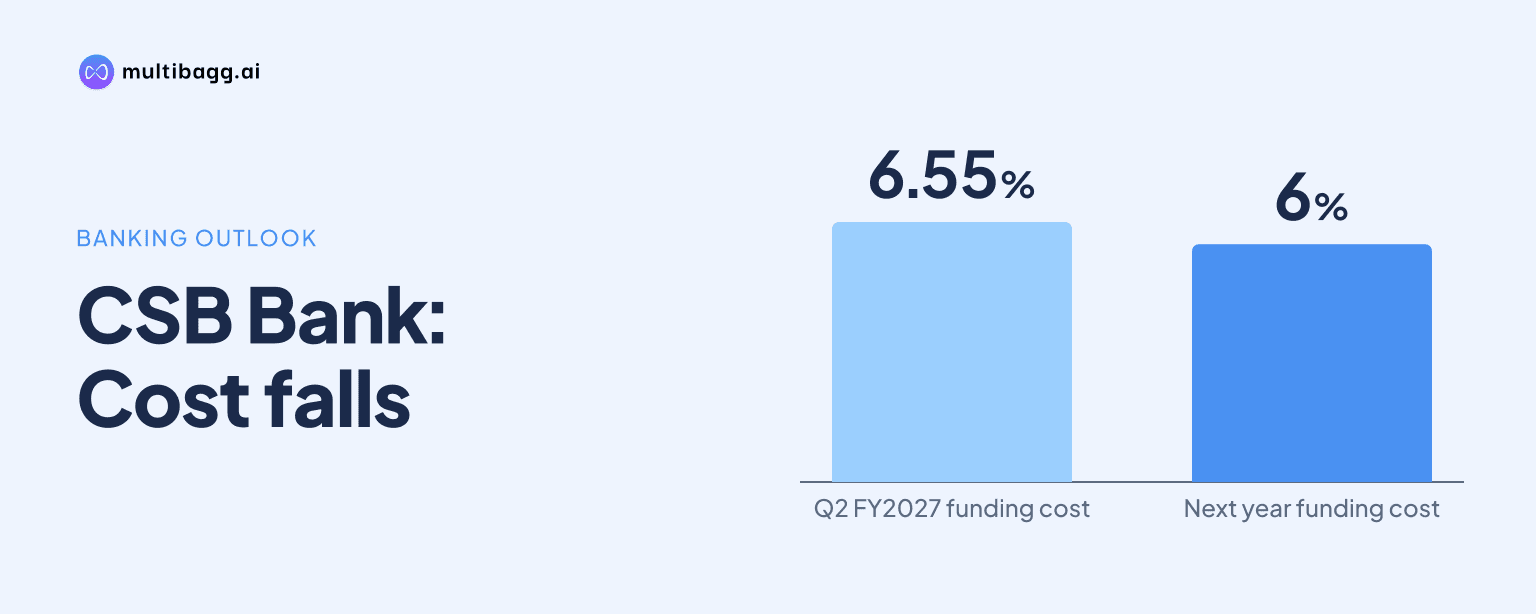
CSB Bank Limited aims to reduce its cost of funds from 6.55% to about 6% in the next financial year, management said on its Q2 FY2027 earnings call. The roughly 50-basis-point reduction is linked to a larger current-account push and is intended to help retain a net interest margin of around 3.75% as the loan mix broadens beyond gold loans.
Know CSB Bank inside out
Results, valuation, peers and who's buying, in one view.
What is CSB Bank's cost of funds target?
CSB Bank is targeting a cost of funds of around 6% next financial year, versus the 6.55% level management cited in Q2 FY2027. Pralay Mondal described the objective as a 50-basis-point lift, although the move from 6.55% to approximately 6% is dependent on achieving the stated target. A basis point is one-hundredth of a percentage point.
Management linked the funding-cost target to the effect of a changing business mix on asset yields. CSB Bank said it was currently above its longer-term net interest margin, or NIM, aim of 3.75% to 3.8%, and that it wanted to retain a NIM of around 3.75% next year. Its plan is to use lower funding costs to compensate for some yield changes as lending becomes less concentrated in gold loans.
The transcript did not provide a quarterly schedule for reaching 6%, a deposit-rate assumption, or a numerical split of the expected savings by deposit type. The 6% figure is therefore management's stated objective for the next financial year rather than a detailed forecast of quarterly funding costs.
How will current accounts lower CSB Bank's funding cost?
CSB Bank said a greater focus on current accounts across its franchise is the main identified lever for lowering its cost of funds toward 6%. Management said it would focus “a lot more” on current accounts as part of cost-of-fund management, while the bank changes the composition of its lending portfolio.
The bank presented this approach as an offset to the expected movement in yields from diversification. Management said the Board and other stakeholders had sought a more distributed bank rather than one focused mainly on gold loans. In that context, current-account growth is intended to support the 3.75% NIM target as the asset mix changes.
CSB Bank also expects transaction banking to contribute to its broader income model. Mondal said the bank was investing heavily in transaction banking and expected more income from wholesale banking, small and medium enterprises, or SME, and transaction banking. The call did not quantify the investment, current-account balances or deposit acquisition targets behind the 6% funding-cost objective.
Got a follow-up? Ask IRIS
Why is CSB Bank changing its gold-loan mix?
CSB Bank plans to reduce gold loans from 53% of its mix last year to around 50% initially, before lowering the share to 32% by 2030. Management said this glide path would allow the bank to build a more distributed lending franchise, with greater attention to SME, transaction banking and, subsequently, retail assets.
The shift in mix is why management sees funding costs as important to maintaining NIM near 3.75% next year. A larger share of non-gold assets may change portfolio yields, and management said a lower cost of funds would absorb part of that effect. It did not disclose the expected yield for each future lending segment or a numerical margin bridge.
Gold lending remains a substantial business for CSB Bank. Management said about 28% of its gold-loan portfolio was above Rs 20 lakh, describing these as loans generally used for business cash flow rather than household consumption. It added that borrowing demand in this segment is determined by customer cash-flow requirements, not solely by the value of pledged gold.
Gold-loan tonnage declined 6% year on year, which management associated with higher gold prices during Q3 and Q4 of the prior year. Mondal said the bank was not seeing the same level of daily or quarterly tonnage outflow at the time of the call, but the annual comparison still reflected the earlier reduction. The deliberate reduction in gold-loan concentration therefore coincides with market-driven changes in gold-loan volumes.
What are CSB Bank's margin, fee and ROA targets?
CSB Bank expects to retain NIM of around 3.75% next year and expects fee income to reach 17% to 18% of total income. Management said growth in core fee income from wholesale banking, SME, transaction banking and eventually retail could support the income trajectory while the loan mix and funding costs change.
Management distinguished these core income sources from treasury and priority sector lending certificate, or PSLC, income. It said the prior year had included very large non-core income from treasury and PSLC, whereas current income was lower. Mondal said he did not expect that income to return in the current year, although a recovery of some income next year could support return on assets, or ROA, near 1.50%.
CSB Bank said ROA had moved quarter on quarter to 1.29% during the year discussed on the Q2 FY2027 call. Management expects ROA for the current year to be between 1.29% and 1.5%, then exceed 1.5% next year. Its next-year objective is 1.5% to 1.8%, probably closer to 1.5%, with bond yields and other conditions affecting the result.
The outlook rests on three stated management factors: cost of funds moving from 6.55% to about 6%, fee income reaching 17% to 18% of total income, and a lower concentration in gold loans from the 53% level of last year. Management did not assign a separate ROA or NIM contribution to each factor.
Conclusion
CSB Bank's funding-cost target is central to its plan to manage margins during a change in lending mix. Management aims to bring cost of funds from 6.55% to about 6% next financial year, using greater current-account focus to help retain NIM around 3.75% while gold loans move from 53% of the prior year's mix toward 50%.
The next indicators are whether current-account efforts deliver the targeted funding-cost reduction, whether fee income approaches 17% to 18% of total income, and whether ROA rises above 1.5% next year. Management also tied execution to its SBS 2030 objective, describing technology leadership and distribution as elements of its current scale phase.