










Lemon Tree says corporate travel stays muted amid IT hiring
Key highlights
- Lemon Tree expects its nearly 6,000 owned or leased rooms to be more or less fully upgraded by the end of this year.
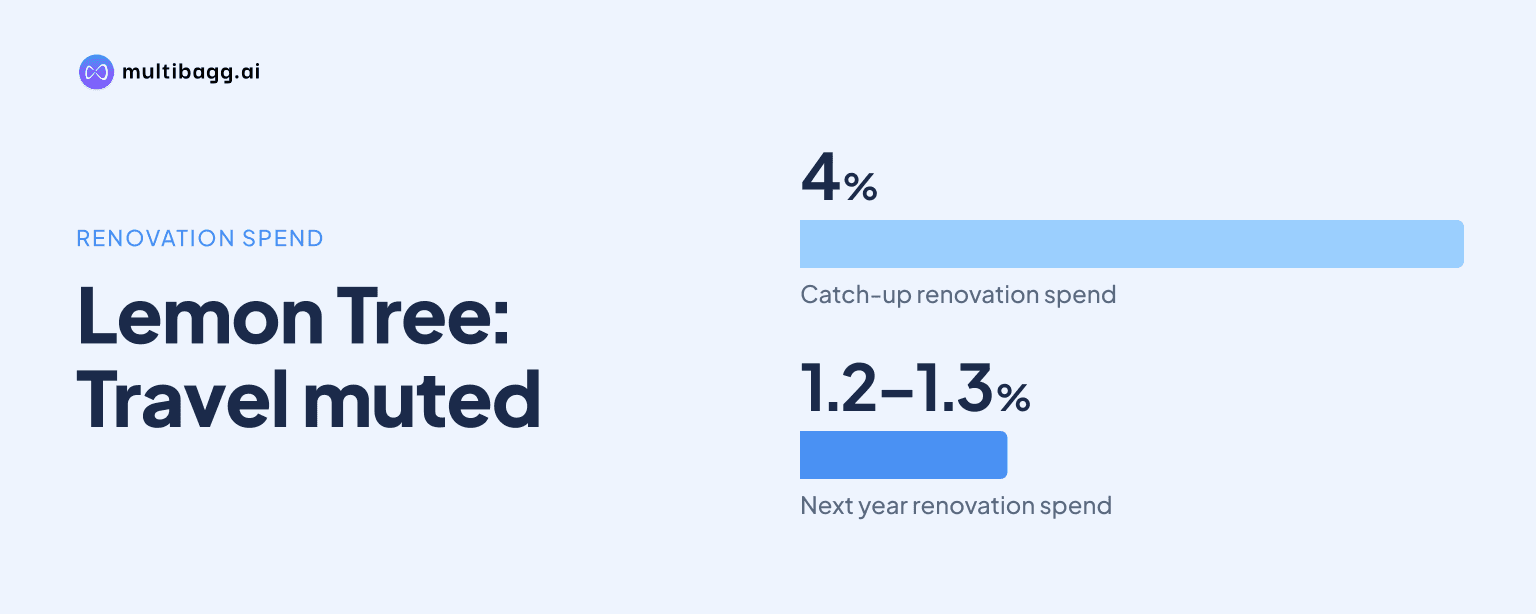
- Management expects renovation spending to return to about 1.2%-1.3% of revenue from next year after a catch-up of about 4%.
- The Omaxe arrangement covers about 4,000 rooms across 10 properties, including nine greenfield projects.
- Fleur Hotels aims to have visibility on 2,500 rooms within nine to 12 months and operate them by FY30-FY31.
powered by IRIS
Lemon Tree Hotels Limited said corporate travel remains restrained by discretionary-spending controls and IT-sector hiring conditions, even as it expects its nearly 6,000 owned or leased rooms to be more or less fully upgraded by the end of this year. Management said the renovation programme is intended to support room repricing and occupancy.
Know Lemon Tree Hotels inside out
Results, valuation, peers and who's buying, in one view.
Why does Lemon Tree see corporate travel as muted?
Lemon Tree sees corporate travel as muted because employers can reduce discretionary travel, particularly among the mid-market managers that account for a larger share of its volume demand. Management said chief executives and senior vice-presidents may continue to travel and stay in five-star hotels, while managers may reduce or stop travel when companies seek to control costs. It also cited the effect of IT-sector hiring among the external variables affecting hotel demand.
Management said revenue is influenced first by supply and demand in each micro-market, then by the business segments served by a hotel, and finally by national economic conditions. Geopolitical conflict, inflation and companies reducing discretionary expenditure were among the pressures it identified. Lemon Tree therefore did not present corporate travel as moving in line with a single broad economic indicator.
Airline traffic is an indirect proxy for hotel demand rather than a direct one, according to management. It illustrated that a 10% increase in airline traffic could include 4% of same-day trips, leaving 6% that might translate into overnight-stay demand. Double occupancy can further reduce the relationship because two airline passengers travelling together require only one hotel room.
How is Lemon Tree responding to slower corporate demand?
Lemon Tree is responding through a renovation catch-up, planned repricing at selected hotels and cost control. Management said renovation spending should return to about 1.2%-1.3% of revenue from next year, after more than three years in which normal upgrades had not been carried out. It described the accumulated catch-up requirement as about 4%.
The programme was intended initially to address deferred maintenance rather than geopolitical disruption, management said. The Keys portfolio had become old and worn down, while certain higher-priced hotels were seen as candidates for improvement and higher pricing. Lemon Tree expects its portfolio to be more or less fully upgraded by the end of this year and said the work should enable repricing, higher occupancy and operating leverage.
Management described cost discipline as a core operational response to uncertainty. It said nearly 6,000 rooms that Lemon Tree has built or leased are in high-demand markets, where it sees less incoming supply than in Tier 2, Tier 3 and Tier 4 cities. The company said it cannot determine when conflicts will end or energy prices will decline, but aims to be prepared operationally as those external conditions change.
Got a follow-up? Ask IRIS
Does Lemon Tree expect hotel supply to exceed demand?
Lemon Tree does not expect supply to exceed demand nationally, although management acknowledged that competition may increase in individual locations. It said India has a structural deficit between hotel supply and demand, with much of the new supply coming in Tier 2 and Tier 3 markets rather than in what management called deep-demand districts. New destinations and highway development were also cited as demand-supporting factors.
For Lemon Tree, hotel development in smaller cities can expand its management and brand network without requiring capital deployment in every market. Management said about 50% of its portfolio is not yet open, giving it room to add properties through an asset-light model. It said competition is likely as Tier 2 cities become more attractive to hotel operators, but does not expect it to outweigh broader demand growth.
The Omaxe memorandum of understanding illustrates this approach. Lemon Tree said the arrangement covers about 4,000 rooms across 10 properties, including nine greenfield developments, with Lemon Tree acting as manager and brand owner rather than investor. One Greater Noida property may open in 12 to 18 months, while the other projects are expected to take three years or more because they are part of larger townships.
Which expansion and portfolio events could affect Lemon Tree?
Lemon Tree said Fleur Hotels is working towards having visibility on 2,500 rooms in the next nine to 12 months, with those rooms targeted to be operational by FY30-FY31. The plan includes both brownfield and greenfield assets. Management said legal, technical, soil and financial diligence can extend acquisition timelines, while construction restrictions such as winter GRAP measures in Delhi can affect project completion.
Warburg Pincus has committed Rs 960 crore for Fleur acquisitions and developments, with the funding available on call and no stated restriction tied to a listing timetable. Management said Warburg Pincus requires two weeks after a call for funds, and Lemon Tree would use the commitment only where it can deploy the capital. Based on projects then under review, management said it was nearly 100% sure it would draw the full amount.
A Gurgaon lease termination also changed the owned portfolio during the period. Lemon Tree terminated the lease in August after approval to use one of two basements for banquets was withdrawn; management said banquets and related conferences had supplied about 30% of that hotel's business. The accounting reversal created about Rs 41 crore of exceptional revenue, partly offset by a Rs 16 crore property-tax provision and a Rs 3 crore reduction in the value of an associate-company investment.
Conclusion
Lemon Tree's demand outlook separates hotel-industry momentum from the corporate-travel patterns that matter to its mid-market business. Management said IT-sector hiring, company travel budgets, same-day air journeys and local supply-demand conditions can all limit overnight demand, while the nearly 6,000-room upgrade programme is intended to improve pricing and occupancy.
The next indicators are whether Lemon Tree completes its portfolio upgrade by the end of this year and whether repricing and occupancy improve quarter by quarter as management expects. Investors can also watch progress towards identifying 2,500 Fleur rooms in nine to 12 months, the potential 12-to-18-month opening of the Greater Noida Omaxe property, and any call on the Rs 960 crore Warburg Pincus commitment.