










Lemon Tree Hotels maps 26,400-room platform for FY31
Key highlights
- Lemon Tree Hotels projects about 26,400 rooms in FY31, compared with 12,131 rooms in H1 FY27.
- The FY31 platform is shown with about 17,300 owned rooms and about 9,100 third-party rooms.
- Lemon Tree Hotels reports a managed and franchised pipeline of about 14,300 rooms, including about 10,900 third-party-owner rooms.
- Pro-forma revenue rose from Rs 148 crore in FY23 to Rs 247 crore in FY26, while managed rooms increased from 8,382 to 11,811.
powered by IRIS
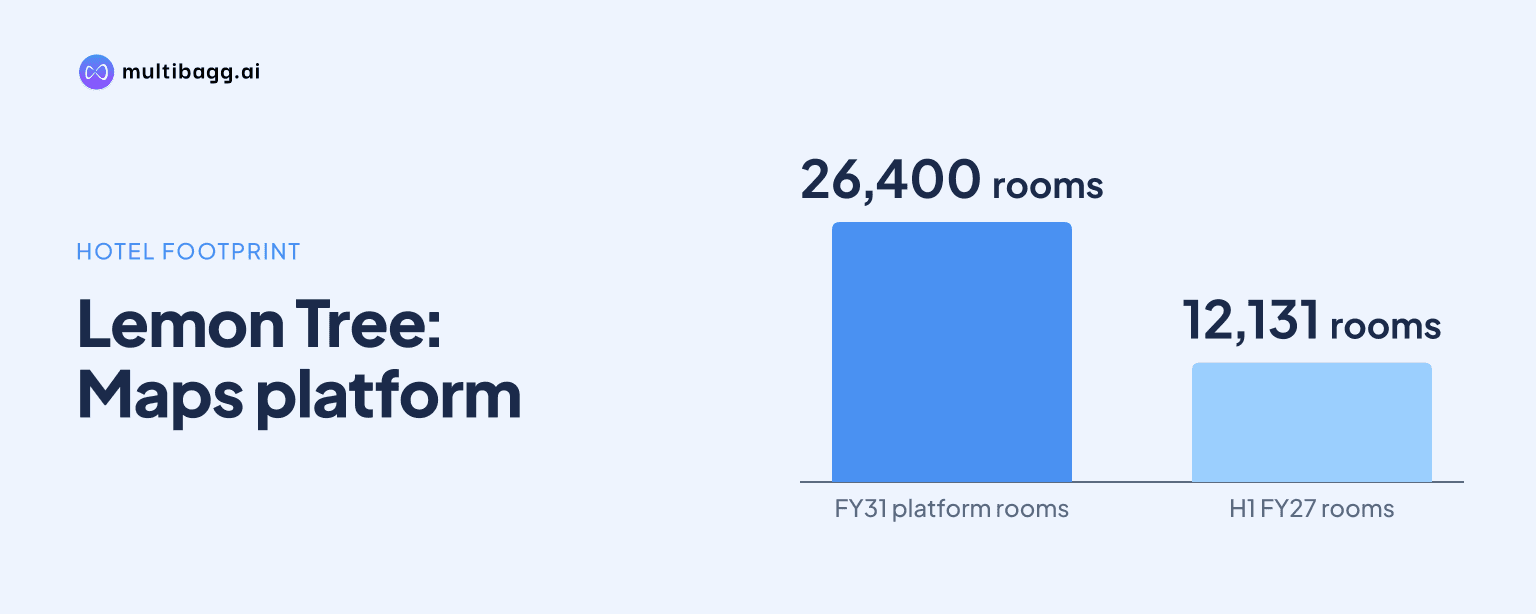
Lemon Tree Hotels Limited projects its post-scheme platform will have about 26,400 rooms in FY31, compared with 12,131 rooms in H1 FY27, with about 17,300 owned and 9,100 third-party rooms in the endpoint mix. The presentation therefore places most of the stated FY31 room base in the owned category.
Know Lemon Tree Hotels inside out
Results, valuation, peers and who's buying, in one view.
How is Lemon Tree Hotels building its FY31 room platform?
Lemon Tree Hotels plans to expand its room platform from 12,131 rooms in H1 FY27 to about 26,400 rooms in FY31 through both owned-hotel development and third-party management contracts. The H1 FY27 chart shows 6,452 owned rooms and 5,679 third-party rooms, while the FY31 endpoint shows about 17,300 owned rooms and about 9,100 third-party rooms.
The stated mix means owned rooms would increase by about 10,848 between H1 FY27 and FY31, while third-party rooms would increase by about 3,421. The chart also displays 900-plus rooms for H2 FY27, 2,500-plus rooms in each of FY28 and FY29, and 3,000-plus rooms in each of FY30 and FY31, alongside a pipeline of about 2,300 rooms.
Lemon Tree Hotels notes that its H1 FY27 owned-room figure includes 202 rooms at Lemon Tree Hotel Indore and Lemon Tree Hotel Aurangabad. Those 202 rooms are not being transferred to Fleur Hotels under the scheme, a qualification relevant when comparing the H1 FY27 starting point with the post-scheme platform plan.
What role do third-party hotels have in Lemon Tree Hotels’ growth?
Third-party hotels remain a material part of Lemon Tree Hotels’ planned FY31 base, rising from 5,679 rooms in H1 FY27 to about 9,100 rooms. The company describes itself as an asset-light management, brand and distribution platform, and says it has scaled to more than 6,000 operating third-party managed rooms in about 10 years.
Lemon Tree Hotels reported a managed and franchised pipeline of about 14,300 rooms. Of that pipeline, about 10,900 rooms are owned by third-party hotel owners, while about 3,400 rooms are associated with Fleur Hotels, including 1,084 rooms under construction and about 2,300 rooms under active discussion.
The pipeline composition differs from the FY31 platform mix. Third-party owners account for roughly three-quarters of the disclosed 14,300-room managed and franchised pipeline, but owned rooms make up about 17,300 of the projected 26,400-room FY31 platform. The presentation does not state a completion timetable for the 2,300 rooms under active discussion.
Lemon Tree Hotels says it provides hotel owners with brands, distribution and revenue-management capabilities rather than requiring ownership of every hotel asset. Its commercial network includes sales and marketing personnel on-site in 138 hotels, eight regional offices, dynamic pricing systems and the Infinity Rewards loyalty programme, which had more than 20 lakh members.
How has Lemon Tree Hotels’ fee business performed before FY31?
Lemon Tree Hotels increased managed rooms from 8,382 in FY23 to 11,811 in FY26 on a pro-forma basis, while total revenue rose from Rs 148 crore to Rs 247 crore. The presentation reports a 19% compound annual growth rate, or CAGR, in total revenue over FY23 to FY26.
Earnings before interest, tax, depreciation and amortisation, or EBITDA, rose by Rs 55 crore from FY23 to FY26, while EBITDA margin moved from 63% to 60%. Margin was 64% in FY24 before declining to 60% in FY25 and remaining at 60% in FY26; Lemon Tree Hotels attributes the FY25 and FY26 effect to technology investment of about 5% of revenue.
The FY26 pro-forma figures represent rooms managed for third-party owners, including Fleur Hotels and two leased hotels. Separately, the pro-forma financial presentation shows FY26 total revenue of Rs 247 crore, up 12.3% from Rs 220 crore in FY25, and net EBITDA of Rs 149.3 crore, up 13.6% from Rs 131.5 crore.
Got a follow-up? Ask IRIS
What evidence does Lemon Tree Hotels provide for hotel-owner outcomes?
Lemon Tree Hotels says its same-store occupancy exceeded the India comparison by 2 percentage points in FY23, 3 percentage points in FY24 and 4 percentage points in FY25. Its same-store occupancy rose from 68% in FY23 to 72% in FY25, while the India figure moved from 66% to 68% over the same period.
At Keys Prima Hotel, Pimpri, Pune, Lemon Tree Hotels reports gross average room rate increased 90% from Rs 3,100 in FY19 to Rs 5,900 in FY26. EBITDA before management fees increased from Rs 6 crore to Rs 11 crore, and the EBITDA margin before management fees increased by about 8 percentage points from about 46% to about 54%, while occupancy was about 80% in FY19 and about 78% in FY26.
The presentation also provides two indexed examples. A leisure hotel in Rishikesh reached 5.6 times its pre-COVID revenue base in FY26, with EBITDA margin before management fees at 56% versus 40% before COVID. A business hotel in Noida reached 2.3 times its FY19 revenue base in FY26, while EBITDA margin before management fees rose from 39% in FY19 to 57%.
Lemon Tree Hotels presents these individual hotels as case studies rather than portfolio-wide results. Its stated mechanism is that distribution reach, loyalty demand, active revenue management and branding can support owner revenue and margins, which in turn can underpin management-fee income as managed inventory grows.
What must happen for Lemon Tree Hotels to meet the FY31 plan?
Lemon Tree Hotels must deliver the scheduled room additions and convert its managed, franchised and development opportunities into operating hotels to reach about 26,400 rooms in FY31. The presentation identifies India’s roughly 23 lakh unbranded hospitality rooms as its addressable opportunity, compared with about 2 lakh branded rooms out of 25 lakh total rooms.
The company says it will expand management contracts across sub-segments and Tier I, Tier II and Tier III markets. Its brand portfolio spans luxury, upper-upscale, upscale, upper-mid-scale, mid-scale and economy categories, while management says the platform has 12,131 rooms operationalised over more than 20 years.
The owned-hotel portion depends on the role allocated to Fleur Hotels under the scheme. Lemon Tree Hotels says Fleur Hotels is the exclusive development partner for owned-hotel opportunities originating within the Lemon Tree group, while a long-term management agreement is intended to provide contractually anchored fee-income visibility for Lemon Tree Hotels.
Lemon Tree Hotels also discloses an ownership stake of about 41% in Fleur Hotels. The presentation says Fleur Hotels has a primary equity line of Rs 960 crore from Warburg Pincus to fund growth, but it does not specify how much of that facility will be drawn, when it may be used or which projects it will support.
Conclusion
The FY31 plan combines an increase in third-party rooms to about 9,100 with a larger rise in owned rooms to about 17,300. Historical pro-forma figures show managed rooms increasing from 8,382 in FY23 to 11,811 in FY26 and revenue rising from Rs 148 crore to Rs 247 crore, providing the reported operating context for the planned expansion.
The next disclosed milestones are 900-plus rooms in H2 FY27, followed by 2,500-plus to 3,000-plus annual room additions from FY28 to FY31. Progress on the about 2,300 rooms under active discussion, the 1,084 Fleur Hotels rooms under construction and the scheme’s treatment of the 202 Indore and Aurangabad rooms will determine how the displayed platform takes shape.