










Lemon Tree scheme raises public Fleur ownership to 57.5%
Key highlights
- Public shareholders’ effective Fleur ownership would rise to 57.5% from 45.8% under the proposed scheme.
- Lemon Tree would transfer 17 hotels, including 15 operational hotels and 2 under-construction hotels, to Fleur.
- Total attributable EBITDA would increase to Rs 434 crore from Rs 402 crore on FY26 pro forma figures.
- Fleur’s FY26 pro forma revenue would be Rs 1,332.7 crore and net EBITDA with renovation would be Rs 554.1 crore.
powered by IRIS
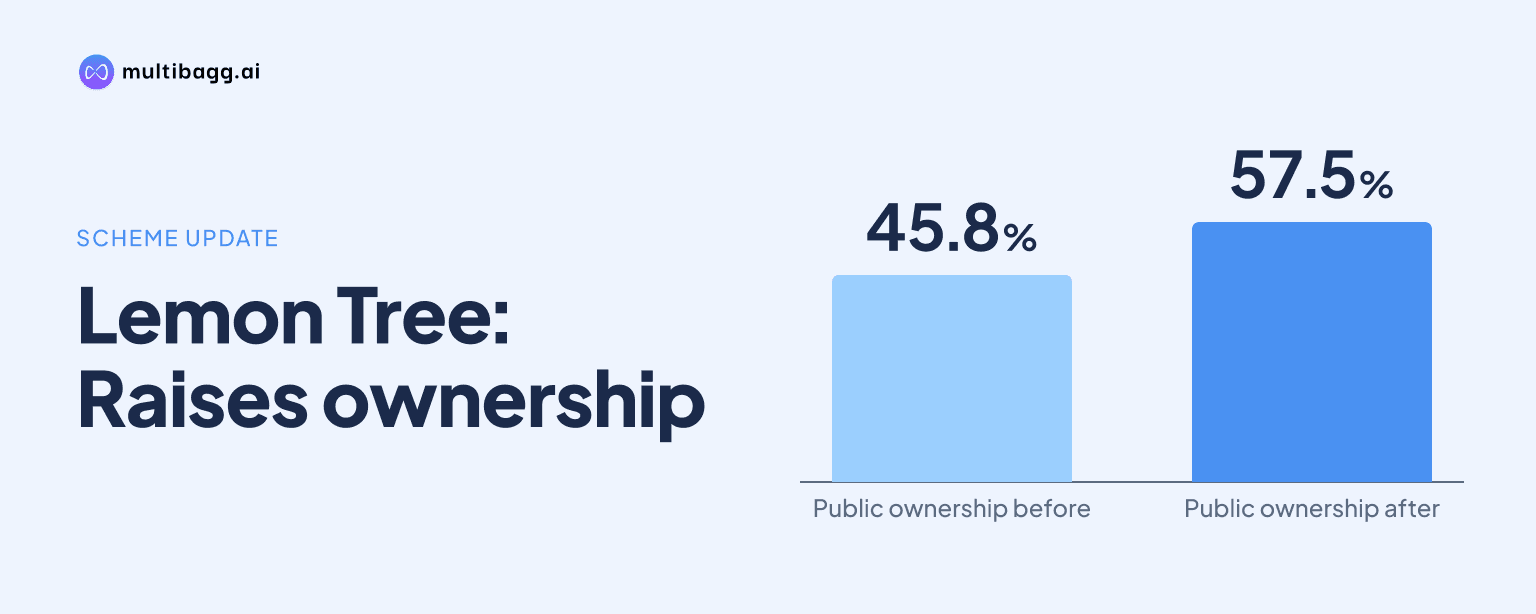
Lemon Tree Hotels Limited’s proposed restructuring would raise public shareholders’ effective ownership of Fleur Hotels to 57.5% from 45.8% and increase total attributable EBITDA to Rs 434 crore from Rs 402 crore on an FY26 pro forma basis. The scheme transfers 17 hotels and development capabilities to Fleur and contemplates Fleur’s separate listing.
Know Lemon Tree Hotels inside out
Results, valuation, peers and who's buying, in one view.
What would Lemon Tree transfer to Fleur?
Lemon Tree would transfer 17 hotels to Fleur, comprising 15 operational properties and two under-construction properties, along with development capabilities. Fleur would issue new shares to Lemon Tree and its shareholders in exchange, while the presentation treats the resulting structure and financial figures as pro forma, assuming the demerger has taken effect.
The restructuring has three stated elements: Warburg Pincus’s purchase of APG’s approximately 41% Fleur stake, the transfer of the 17 hotels, and Fleur’s listing as an independent entity after the scheme. The post-scheme ownership illustration excludes any primary investment by Warburg Pincus, and the presentation does not provide an exchange ratio, implementation date or approval timetable.
Before the proposed demerger, Lemon Tree reported FY26 consolidated revenue of Rs 1,452.7 crore and net EBITDA, or earnings before interest, tax, depreciation and amortisation, of Rs 699.3 crore. Fleur’s pre-demerger FY26 consolidated revenue was Rs 1,014 crore and consolidated EBITDA was Rs 443 crore, while Lemon Tree’s depicted holding in Fleur was 58.9%.
How would public shareholders’ Fleur ownership change?
Public shareholders’ effective Fleur ownership would increase by 11.7 percentage points to 57.5% from 45.8%, according to Lemon Tree’s proposed ownership calculation. Before the scheme, public shareholders, including APG, held 77.7% of Lemon Tree, and their effective 45.8% Fleur interest was derived from Lemon Tree’s 58.9% holding in Fleur.
After the scheme, the 57.5% effective interest would comprise a 25.6% direct Fleur holding and a 31.9% indirect holding through Lemon Tree. The indirect component is calculated as the public shareholders’ 77.7% Lemon Tree ownership multiplied by Lemon Tree’s proposed 41.0% Fleur stake; the promoter group would retain 22.3% of Lemon Tree in the illustration.
Total attributable EBITDA would rise by more than 8% to Rs 434 crore from Rs 402 crore under the pro forma structure. Lemon Tree attributes the post-scheme total to Rs 142 crore from the 25.6% direct Fleur stake, Rs 177 crore from the 31.9% effective Fleur stake through Lemon Tree, and Rs 116 crore attributable through the public shareholders’ 77.7% ownership of Lemon Tree.
Got a follow-up? Ask IRIS
What would Lemon Tree and Fleur report after the scheme?
Lemon Tree would operate as the asset-light management, brand and distribution platform, with FY26 pro forma revenue of Rs 247 crore and net EBITDA of Rs 149.3 crore. Those figures compare with FY25 revenue of Rs 220 crore and net EBITDA of Rs 131.5 crore, representing reported growth of 12.3% and 13.6%, respectively.
Fleur would hold the hotel assets and development capabilities, with FY26 pro forma revenue of Rs 1,332.7 crore, up 12.1% from Rs 1,189 crore in FY25. Its FY26 net EBITDA including renovation effects would be Rs 554.1 crore, up 12.5% from Rs 509.5 crore; excluding renovation effects, EBITDA would be Rs 612.4 crore compared with Rs 544.1 crore in FY25.
Lemon Tree’s FY26 profit after tax, or PAT, would be Rs 98.1 crore without its share of Fleur’s PAT and Rs 160 crore including that share, compared with Rs 146.3 crore on the latter basis in FY25. The FY26 figure includes Rs 17.4 crore of extraordinary expenses relating to ex-gratia, Delhi hotel property tax, the new labour code impact and restructuring expenses.
Fleur’s FY26 PAT would be Rs 190.1 crore, up 34.9% from Rs 141 crore in FY25, after Rs 15.9 crore of extraordinary expenses for similar items. The comparison shows that Fleur would account for Rs 1,332.7 crore of the two platforms’ combined pro forma revenue base, while Lemon Tree’s Rs 247 crore would reflect the management-led business after the asset transfer.
Why does Lemon Tree propose separate platforms?
Lemon Tree says separate platforms would provide dedicated leadership and capital structures suited to asset ownership and asset-light operations. Fleur would fund hotel ownership and development through a new Warburg Pincus equity line, while Lemon Tree would focus on management, brands and distribution; Patanjali Govind Keswani is identified as Fleur’s Executive Chair.
The two entities would retain a long-term management agreement, which Lemon Tree says would create contractually anchored fee-income visibility. Lemon Tree would retain an approximately 41% Fleur stake, while Fleur would be the exclusive development partner for owned-hotel opportunities originating in the Lemon Tree group.
Fleur would also be free to pursue third-party transactions, mergers and acquisitions, and partnerships, including with other hospitality brands in domestic and international markets. Lemon Tree’s management and franchise pipeline was approximately 14,300 rooms, including about 10,900 rooms owned by third parties and about 3,400 rooms owned by Fleur, of which 1,084 were under construction and roughly 2,300 were under active discussion.
Conclusion
The proposed scheme would separate Lemon Tree’s hotel-management activities from Fleur’s asset ownership and development operations while increasing public shareholders’ stated effective Fleur interest from 45.8% to 57.5%. On the presentation’s FY26 pro forma basis, the ownership change is accompanied by a Rs 32 crore increase in total attributable EBITDA to Rs 434 crore, despite Lemon Tree’s direct Fleur holding declining from 58.9% to 41.0%.
What to watch next is whether the scheme becomes effective on the illustrated terms, as the presentation does not disclose an exchange ratio or timetable and excludes any primary Warburg Pincus investment from its ownership chart. Execution will also depend on the transfer of 17 hotels, Fleur’s FY26 pro forma Rs 1,332.7 crore revenue base, and the planned long-term management agreement between Lemon Tree and Fleur.