










Lemon Tree Hotels Limited Q2 Revenue Rises 18% to ₹363.8 Crore
Key highlights
- Lemon Tree Hotels reported Q2 FY27 total revenue of ₹363.8 crore, up 18% year-on-year.
- Net EBITDA rose 22% to ₹162.2 crore and net EBITDA margin reached 44.6%.
- Profit after tax increased 90% to ₹79.8 crore, including an approximately ₹22 crore net non-cash exceptional gain.
- Gross debt declined 11% year-on-year to ₹1,429.2 crore as of September 30, 2026.
powered by IRIS
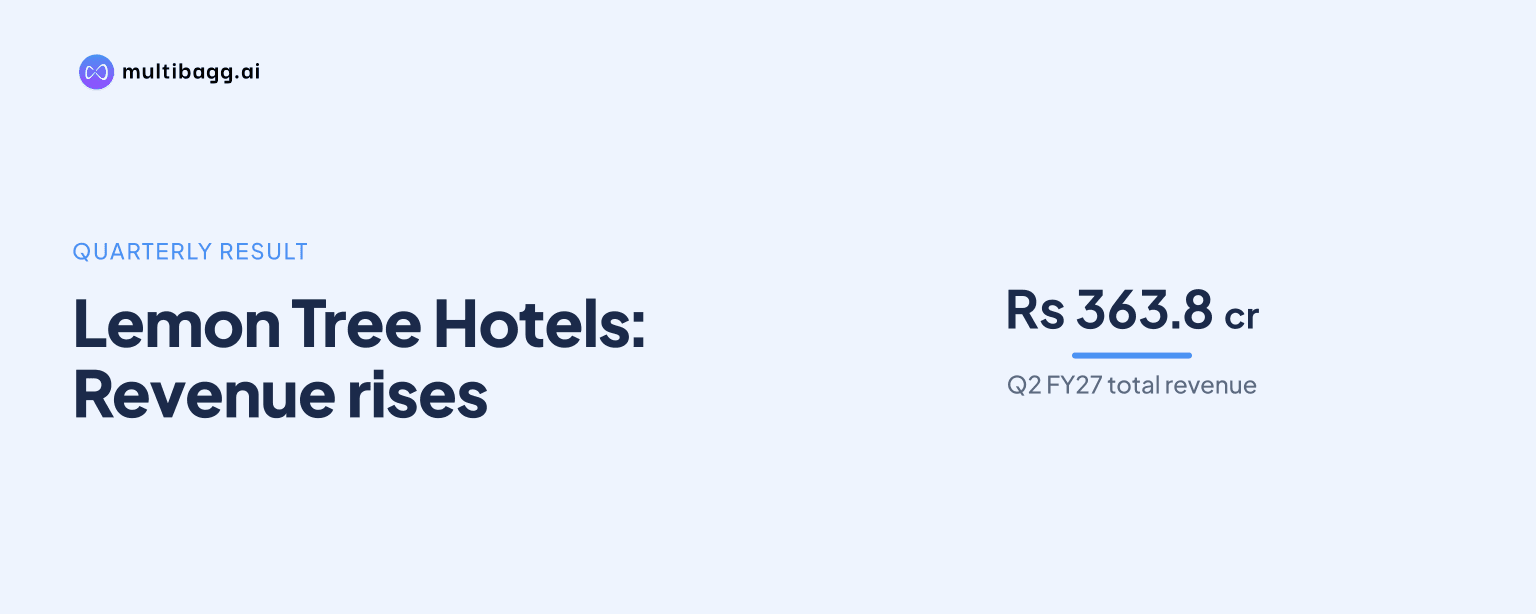
Lemon Tree Hotels Limited reported Q2 FY27 total revenue of ₹363.8 crore, up 18% year-on-year and ₹18.8 crore above the ₹345 crore estimate, supported by higher room rates, occupancy and RevPAR. Net EBITDA rose 22% to ₹162.2 crore, while profit after tax increased 90% to ₹79.8 crore.
Know Lemon Tree Hotels inside out
Results, valuation, peers and who's buying, in one view.
What did Lemon Tree Hotels report for Q2 FY27?
Lemon Tree Hotels reported its strongest-ever second quarter, with total revenue rising 18% year-on-year to ₹363.8 crore for the quarter ended September 30, 2026. The company discussed the unaudited quarterly and half-year results during an investor conference call held on November 11, 2026.
Net EBITDA increased 22% year-on-year to ₹162.2 crore, taking the net EBITDA margin to 44.6%. This was 157 basis points above the 43% margin reported in the corresponding quarter a year earlier. Profit after tax rose 90% to ₹79.8 crore, while cash profit increased 28% to ₹97.2 crore.
The reported total revenue was above the ₹345 crore estimate cited in the earnings material. Separately, revenue from operations was reported at ₹361.4 crore, also up 18% year-on-year. The difference reflects the distinction in the disclosed measures of total revenue and revenue from operations.
Management said the quarter delivered record Q2 levels of average room rate, revenue, EBITDA, profit before tax, profit after tax and cash profit. The earnings call was attended by Executive Chairman Patanjali Keswani, Managing Director Neelendra Singh, Executive Director and Chief Financial Officer Kapil Sharma, and other executives.
What drove Lemon Tree Hotels' revenue and operating performance?
Lemon Tree Hotels' performance was driven by an 8% year-on-year increase in gross average room rate to ₹6,751 and a 633-basis-point increase in occupancy to 76.1%. These operating gains lifted revenue per available room, or RevPAR, by 18% to ₹5,137.
The company said RevPAR grew in double digits across every brand and region. Growth ranged from 11% in Mumbai to 25% in Delhi, indicating that the gains were not confined to one market or hotel format. Management also said supply was growing in India, but not at the same pace in the high-demand markets in which the company operates.
Owned hotels generated revenue of ₹337 crore during the quarter, up 15% year-on-year. Hotel EBITDA margin for owned hotels improved by 112 basis points to 53%, reflecting stronger operating performance in the portfolio.
The company noted that its reported profitability was achieved despite provisions related to SAR and GST that together increased expenses by 3.2% of total revenue during the quarter. On a like-to-like basis, management said the net EBITDA margin would have been 47.7%, up 474 basis points year-on-year.
Why did Lemon Tree Hotels' profit after tax rise 90%?
Lemon Tree Hotels' profit after tax rose 90% to ₹79.8 crore, though the reported figure included an approximately ₹22 crore net non-cash exceptional gain. The exceptional item is important when comparing the pace of profit growth with the underlying increase in revenue and EBITDA.
Net EBITDA growth of 22% and the 44.6% margin show that operating profit also improved during the quarter. However, the 90% rise in profit after tax should be considered alongside the disclosed exceptional gain, rather than being treated solely as recurring operating growth.
Corporate demand remained muted, according to the earnings-call summary. Even so, higher occupancy and room rates enabled the company to record its best-ever Q2 across the principal operating and profit measures cited by management.
For investors, the quarter presents two separate indicators. Revenue, RevPAR and EBITDA provide the clearest measure of hotel operations, while the profit after tax result includes the additional effect of the non-cash exceptional gain.
Got a follow-up? Ask IRIS
What does the quarter show about Lemon Tree Hotels' balance sheet and restructuring?
Lemon Tree Hotels reduced gross debt by 11% year-on-year to ₹1,429.2 crore as of September 30, 2026, from ₹1,610.2 crore a year earlier. Lower gross debt alongside rising EBITDA and cash profit is a relevant financial development for a hotel company with owned assets and expansion plans.
Management also provided an update on the proposed demerger scheme during the earnings call. The planned structure is intended to create Lemon Tree Hotels as an asset-light management and brand platform, while Fleur is intended to operate as a hotel asset ownership and development platform.
According to the information presented with the earnings material, the restructuring had received Competition Commission of India approval in April 2026 and a Securities and Exchange Board of India no-objection in September 2026. The call included an update from Fleur's management on its portfolio and hotels under development.
The company has made the audio recording of the November 11 call available on its website. The recording allows shareholders and other market participants to review management's comments on operating performance, the demerger and the outlook discussed with analysts.
How does the Q2 result matter for investors and the hotel industry?
The Q2 result matters because Lemon Tree Hotels delivered simultaneous improvements in rate, occupancy, RevPAR, revenue and EBITDA margin. Revenue exceeded the cited estimate, while the increase in net EBITDA outpaced revenue growth, showing operating-margin expansion during the quarter.
The results also underline the importance of demand conditions in major urban hotel markets. Management's comments on limited supply growth in high-demand markets provide context for the improvement in room rates and occupancy, although it also identified corporate demand as muted.
For shareholders, the debt reduction and proposed separation of the management-and-brand business from Fleur's asset ownership and development activities are material alongside quarterly earnings. The demerger has regulatory milestones behind it, but the source does not provide a completion date in the disclosed material.
For customers and local hotel operations, the 76.1% occupancy level and higher average room rate indicate firm utilisation across the network. The company did not disclose a change in customer pricing strategy beyond the reported rise in gross ARR.
Conclusion
Lemon Tree Hotels Limited recorded an 18% year-on-year increase in Q2 FY27 total revenue to ₹363.8 crore, ahead of the cited estimate, as higher room rates and occupancy lifted RevPAR. EBITDA growth, margin expansion and lower gross debt point to improved operating and financial performance, while the exceptional gain should be considered when assessing the 90% increase in reported profit after tax.
Investors will watch the company's subsequent disclosures on corporate demand, room-rate and occupancy trends, debt reduction, and progress on the demerger involving Fleur. The company has also made its November 11, 2026 earnings-call recording publicly available for review of management's detailed commentary.