










Lemon Tree Omaxe deal adds about 4,000 asset-light rooms
Key highlights
- Lemon Tree's Omaxe memorandum covers about 4,000 rooms across 10 properties.
- Lemon Tree said it will make no investment and will act as manager and brand owner.
- Nine of the 10 Omaxe properties are greenfield projects with an indicated 3-to-3.5-year timeline.
- One Greater Noida property may open within 12 to 18 months, according to management.
powered by IRIS
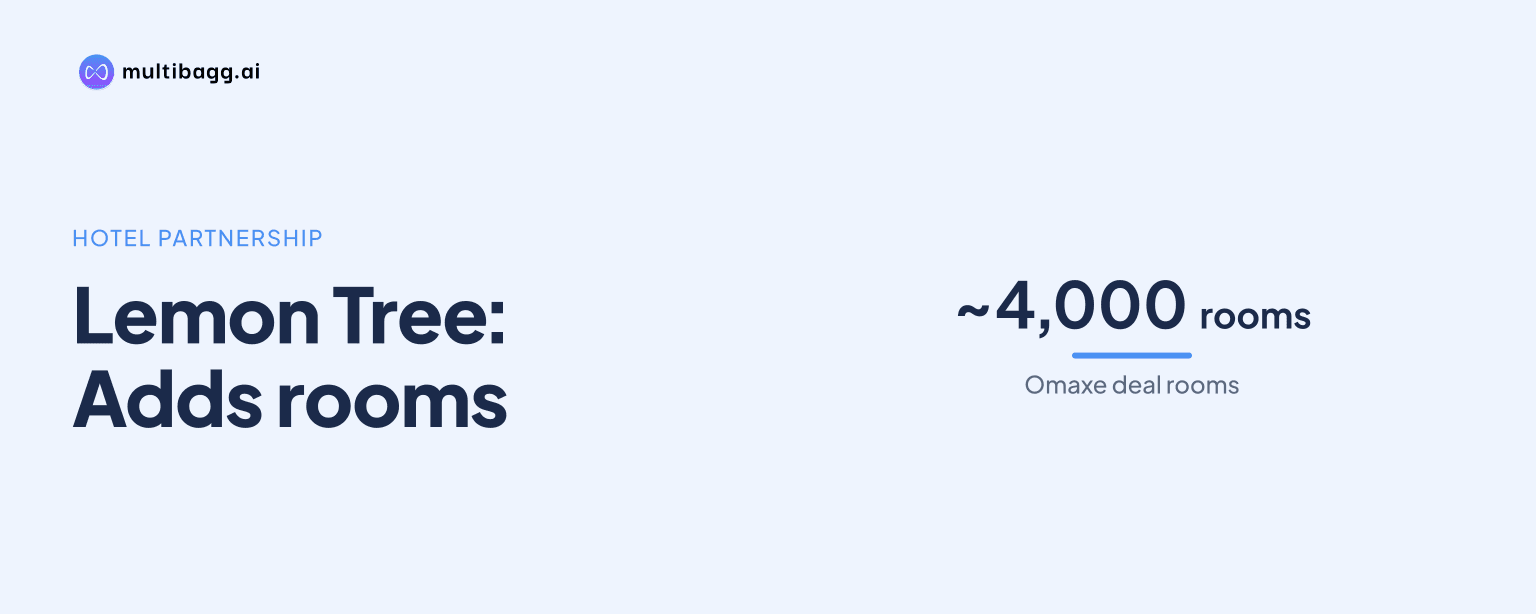
Lemon Tree Hotels signed an asset-light memorandum with Omaxe during the quarter covering about 4,000 rooms across 10 properties, with no investment planned by Lemon Tree. Management said nine of the 10 projects are greenfield developments expected to take around 3 to 3.5 years, or potentially longer, to come to fruition.
What does Lemon Tree's Omaxe memorandum cover?
Lemon Tree's memorandum with Omaxe covers a ballpark 4,000 rooms across 10 properties that Omaxe is developing in townships and at redeveloped bus transit sites. Lemon Tree will be the manager and brand owner rather than the developer. Management described the arrangement as aligned with its plan to extend its network into deeper markets, including Lucknow, Varanasi, Ghaziabad and Greater Noida.
Know Lemon Tree Hotels inside out
Results, valuation, peers and who's buying, in one view.
The 10-property scope combines two Omaxe development types. The first consists of large townships, which management said extend over hundreds of acres and can generate demand from residents and transit visitors. The second consists of public-private partnership, or PPP, projects to remodel bus stations in Tier 2 and Tier 3 cities, where hotels would be positioned close to transport nodes that management said are often in central city locations.
The split between 10 announced properties and nine greenfield projects means most of the room count is attached to developments yet to be built, rather than hotels available for immediate rebranding or management. Management did not disclose property-level room counts, management-fee rates, contract durations or projected fee income for the 4,000-room memorandum.
Why is the Omaxe arrangement asset-light?
The Omaxe arrangement is asset-light because Lemon Tree said it will make no investment in the 10 properties and will instead act as manager and brand owner. Omaxe, as the developer, is developing the townships, hotels and bus-station remodelling projects. That leaves Lemon Tree focused on operating and branding the hotels rather than funding construction or land acquisition.
Management said its expansion in Tier 2, Tier 3 and Tier 4 markets is directed at fee income rather than capital deployment in those locations. It also said about 50% of its portfolio is not yet open, framing future openings as a material element of network growth. The Omaxe agreement adds 10 properties to that future development opportunity without a disclosed Lemon Tree investment requirement.
When are Lemon Tree's Omaxe properties expected to open?
Management expects one Greater Noida property to arrive in the next 12 to 18 months, while the other nine Omaxe properties are expected to follow the usual timeline of more than three years. It gave an indicative 3 to 3.5-year timeframe for the nine greenfield developments, while cautioning that the large-township format could take slightly longer.
The timing creates a clear difference within the announced 4,000 rooms. One operating opportunity could emerge within 12 to 18 months, but nine of the 10 projects remain dependent on greenfield construction. The memorandum therefore expands Lemon Tree's stated future network immediately, while most potential management activity is not expected on the same timetable.
Management's comments on Fleur Hotels illustrate why signed room pipelines and operational additions need separate treatment. Fleur is working toward 2,500 rooms becoming operational by FY30-FY31, and management said it remained hopeful of achieving that target through brownfield and greenfield assets. For Omaxe, the disclosed plan is 10 properties and about 4,000 rooms, with nine specifically identified as greenfield.
Construction and approval risks remain relevant to the stated dates. In discussing Fleur's 2,500-room target, management cited legal, technical and soil diligence, as well as city-specific construction constraints such as Delhi's winter Graded Response Action Plan, or GRAP. It did not say these matters would delay Omaxe, but the 3-to-3.5-year range for its nine greenfield projects remains an estimate rather than a committed opening date.
Got a follow-up? Ask IRIS
How does the Omaxe deal fit Lemon Tree's network strategy?
The Omaxe memorandum fits Lemon Tree's stated strategy of expanding its hotel network in markets where management sees new supply as an opportunity for asset-light growth. Management said hotel supply is growing mainly in Tier 2, Tier 3 and Tier 4 markets, while it intends to build its network there without allocating capital. The Omaxe development pipeline gives that strategy a defined 10-property channel.
Management's rationale rests on the location of Omaxe's projects. It said townships can create resident and transit demand, while redeveloped bus stations are often in the heart of a city because surrounding urban areas historically formed around those transit points. The cities cited on the call, including Lucknow, Varanasi, Ghaziabad and Greater Noida, show that the arrangement is directed beyond the largest established hotel markets.
The agreement also sits alongside management's view that supply need not outstrip demand nationally. Management said it sees a structural supply-demand deficit in India and expects demand to continue as new destinations and highways develop, while acknowledging that individual areas can become more competitive. This is management's market assessment; the call did not provide city-level supply, demand or revenue-per-available-room data for the Omaxe sites.
For Lemon Tree, the practical distinction is between network scale and near-term contribution. The memorandum adds about 4,000 rooms to the stated development opportunity, but nine of 10 properties have a construction-led wait of at least three years. The company has disclosed a prospective asset-light expansion, not an immediate addition of 4,000 operating rooms.
Conclusion
The Omaxe memorandum gives Lemon Tree a prospective 4,000-room, 10-property route into township and transit-oriented locations without a disclosed investment requirement. Its asset-light structure is consistent with management's emphasis on fee-income expansion in Tier 2, Tier 3 and Tier 4 markets, while the 12-to-18-month Greater Noida opening offers a nearer operational milestone than the other nine projects.
The next item to watch is whether the Greater Noida hotel opens within management's stated 12-to-18-month range and whether the nine greenfield projects progress around the indicated 3-to-3.5-year timeline. Future disclosures would be needed to assess property-level room counts, opening schedules and fee contribution from the 10-property Omaxe arrangement.