










CSB Bank targets 50% gold-loan mix as portfolio broadens
Key highlights
- CSB Bank targets a gold-loan share of about 50% by year-end, down from 54% last quarter.
- The bank’s gold-loan portfolio grew by about 36% despite efforts to reduce its share of the overall loan mix.
- CSB Bank plans to reduce gold loans to 32% of its portfolio by 2030 through wholesale, SME and later retail expansion.
- About 28% of CSB Bank’s gold-loan portfolio comprises loans above Rs 20 lakh, according to management.
powered by IRIS
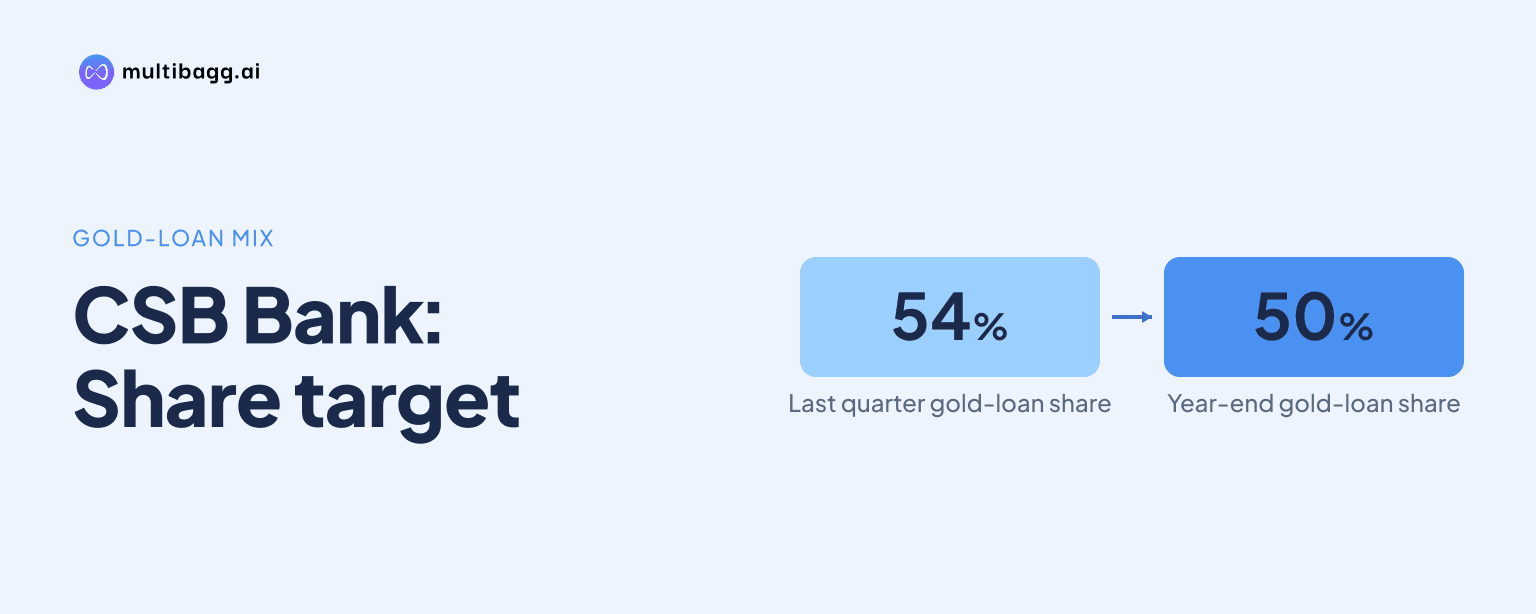
CSB Bank Limited plans to bring gold loans to about 50% of its overall loan mix by the end of this year, from 54% last quarter and roughly 53% at the previous year-end. Management said the shift will come through expansion in small and medium enterprise, wholesale and eventually retail lending, while the gold-loan portfolio still grew by about 36%.
Know CSB Bank inside out
Results, valuation, peers and who's buying, in one view.
What is CSB Bank's gold-loan target this year?
CSB Bank's target is for gold loans to account for about 50% of its overall loan mix by the end of this year. Management said the target follows Board guidance and can be achieved without affecting return on assets, return on equity or other financial parameters. The stated purpose is to create a more balanced bank in which lending segments grow together rather than concentrating expansion in gold loans.
The immediate target is about 4 percentage points below the 54% reported last quarter. Management also repeated a longer-term glide path toward 32% gold loans by 2030, making the 50% target an intermediate step rather than the intended end-state. The approach is to reduce concentration through growth in other businesses, not through a withdrawal from secured gold lending.
Why is CSB Bank moderating gold-loan disbursements?
CSB Bank is moderating gold-loan disbursements partly by choice and partly because loan-renewal mechanics and gold prices have changed reported flows. Management said the bank historically could disburse around Rs 16,000 crore against a gold-loan portfolio of around Rs 19,000 crore because customers closing and rebooking loans were recorded as fresh disbursements. It is no longer renewing some accounts through that close-and-rebook process, reducing reported disbursements without necessarily indicating a comparable contraction in the loan book.
Gold prices have also affected pledged tonnage. Management said gold-loan tonnage declined 6% year on year after declines in the third and fourth quarters of the previous year, when gold prices rose significantly. In CSB Bank's customer segment, management said borrowing is determined by business cash-flow needs rather than simply collateral availability. It added that it was not seeing the daily or quarterly tonnage outflows that had occurred earlier, despite the annual decline appearing close to double digit.
Which lending businesses will reduce CSB Bank's gold reliance?
CSB Bank expects wholesale and small and medium enterprise, or SME, lending to account for more expansion as it limits gold loans' relative contribution. Management said wholesale disbursements and growth were doing well, although the business can vary between quarters because larger transactions move across reporting periods. SME loan growth had been flat despite disbursements because the bank allowed run-offs, exited customers after a quality review and did not match interest rates sought by some borrowers.
Management said SME lending would begin contributing from the current quarter, while wholesale lending was already growing. Retail assets are intended to follow after CSB Bank expands its liability customer base. Management said it did not want to build a risky retail portfolio before establishing that funding and customer foundation. The planned sequence is therefore wholesale and SME growth first, then retail lending linked to customer acquisition, alongside continuing but less dominant gold-loan growth.
Got a follow-up? Ask IRIS
How does CSB Bank describe its gold-loan customer mix?
CSB Bank said its gold-loan segment is positioned at the higher end of the market than some non-bank finance companies and specialist gold-loan banks. About 28% of its gold-loan portfolio has values above Rs 20 lakh, according to management. The bank said these customers commonly use the loans as business cash flow rather than for household consumption, helping explain why loan demand does not automatically rise with the value of pledged gold.
Management also addressed its loan-to-value ratio, or LTV, of about 75%, compared with the 60% to 65% range cited by an analyst for Karur and Federal Bank. It said CSB Bank has a larger agricultural portfolio, where the permitted LTV is higher. Management added that agricultural loans provide priority-sector lending certificate and other benefits, and said the larger agricultural component was a deliberate portfolio choice.
What will determine the pace of CSB Bank's diversification?
CSB Bank said the pace of portfolio rebalancing depends on building a larger liability franchise rather than finding lending opportunities. Management said it had technology, teams and products in place, but retail lending would depend on adding liability customers, where cross-selling can occur. It is focusing first on current-account acquisition and plans to launch three to four retail liability products each quarter; products introduced over the past two quarters had shown initial success.
The funding mix remains a constraint on the pace of broader asset growth. Management said current account savings account, or CASA, deposits would grow more slowly than term deposits this year, before CASA grows faster from FY2028. It also said deposits were around 48% retail and 52% wholesale. Management's stated loan-growth guidance remains 30% to 50% faster than the banking system, subject to this calibrated build-out of the liability franchise.
Conclusion
CSB Bank's 50% year-end gold-loan target puts its 36% growth in that portfolio in a different context: gold lending remains a major engine, but management intends it to become a smaller share as wholesale, SME and later retail assets expand. The decline in reported gold-loan disbursements reflects both changed renewal mechanics and a deliberate decision to preserve a more balanced lending mix.
The next measure to watch is whether SME growth resumes from the current quarter while wholesale lending continues and current-account acquisition expands the liability base. Management's disclosed path calls for gold loans to reach 32% of the portfolio by 2030, while CASA is expected to begin growing faster than term deposits from FY2028.