










Dachepalli Publishers receivables rise to Rs 11.61 crore
Key highlights
- Trade receivables from School Book Company and Pelican Publishing House rose to Rs 11.61 crore at September 30, 2026 from Rs 4.92 crore at March 31, 2026.
- School Book Company accounted for Rs 10.89 crore of the closing receivables and Rs 6.45 crore of the Rs 6.69 crore increase.
- Dachepalli Publishers recorded Rs 12.32 crore of half-year sales to the two common-control entities, including Rs 8.76 crore to School Book Company and Rs 3.56 crore to Pelican Publishing House.
- The company reported Rs 23.37 crore of unsecured long-term borrowings from key management personnel and relatives, alongside Rs 9.92 crore of trade payables to KMP relatives.
powered by IRIS
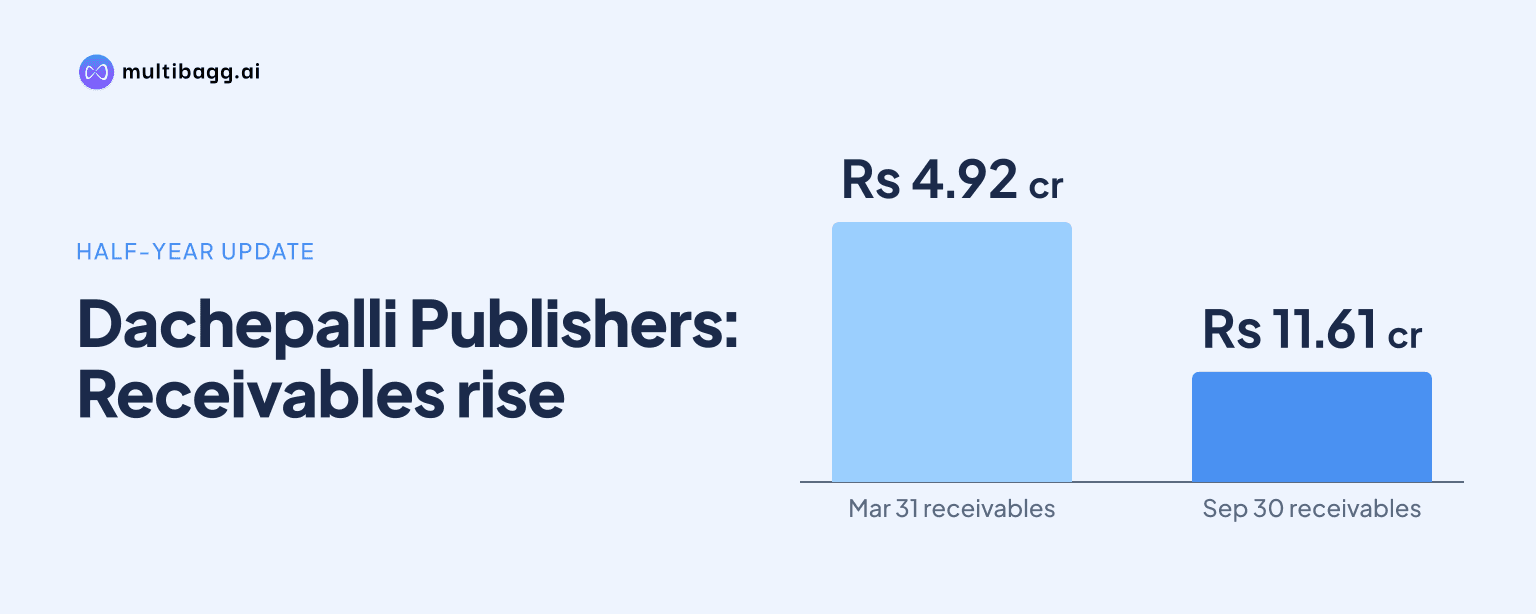
Dachepalli Publishers Limited reported Rs 11.61 crore of trade receivables from Pelican Publishing House and School Book Company at September 30, 2026, compared with Rs 4.92 crore at March 31, 2026. The Rs 6.69 crore rise followed Rs 12.32 crore of half-year sales to the two entities under common control.
Know Dachepalli Publishers inside out
Results, valuation, peers and who's buying, in one view.
Why did Dachepalli Publishers’ related-party receivables increase?
Dachepalli Publishers’ receivables increased chiefly because the balance due from School Book Company rose to Rs 10.89 crore at September 30, 2026 from Rs 4.44 crore at March 31, 2026. The amount due from Pelican Publishing House also increased, to Rs 71.43 lakh from Rs 47.10 lakh over the same six-month period.
The two balances totalled Rs 11.61 crore at September 30, 2026, against Rs 4.92 crore at March 31, 2026. School Book Company accounted for Rs 6.45 crore of the Rs 6.69 crore aggregate increase, while Pelican Publishing House accounted for Rs 24.33 lakh.
The disclosure classifies both balances as trade receivables or payables with entities under common control. It separately shows Dachepalli Printers with a Rs 9.25 lakh credit balance at both reporting dates, which the filing identifies as a payable rather than a receivable.
Dachepalli Publishers did not disclose collection dates, credit terms, sales returns or an ageing analysis for the Rs 10.89 crore School Book Company balance or the Rs 71.43 lakh Pelican Publishing House balance. The filing therefore identifies the closing amounts and period transactions, but not the timing of expected collections.
How much did Dachepalli Publishers sell to common-control entities?
Dachepalli Publishers recorded Rs 12.32 crore of sales to the two entities under common control in the half year ended September 30, 2026. Sales to School Book Company were Rs 8.76 crore, while sales to Pelican Publishing House were Rs 3.56 crore, based on gross debits to the party accounts.
The half-year sales to School Book Company exceeded the Rs 8.50 crore reported for the full year ended March 31, 2026 by Rs 25.86 lakh. Sales to Pelican Publishing House were Rs 3.56 crore in the six months to September 2026, compared with Rs 1.77 crore for the full preceding financial year.
Total product sales were Rs 70.01 crore for the half year ended September 30, 2026, compared with Rs 51.00 crore in the half year ended March 31, 2026. The related-party sales disclosure therefore occurred alongside a Rs 19.01 crore sequential increase in reported product sales.
The company is primarily engaged in one business segment, printing and publishing of books, and operates within one geographical area, according to its results notes. It consequently reported no separate segments under Accounting Standard 17, while the related-party note separately identifies the Rs 12.32 crore of sales to the two common-control entities.
What borrowings did Dachepalli Publishers report from related parties?
Dachepalli Publishers reported Rs 23.37 crore of unsecured long-term borrowings from key management personnel, or KMP, and their relatives at September 30, 2026. The KMP balances were Rs 15.91 crore and borrowings from relatives were Rs 7.46 crore, compared with a combined Rs 23.66 crore at March 31, 2026.
D. Vinod Kumar had the largest KMP balance at Rs 4.30 crore, followed by D. Abhinav at Rs 3.29 crore, D. Manjula at Rs 3.12 crore and D. Harish Kumar at Rs 3.04 crore. D. Rushikesh had a Rs 2.15 crore balance, bringing the five KMP balances to Rs 15.91 crore, down from Rs 16.18 crore at March 31, 2026.
Among relatives, D. Ankitha had Rs 2.91 crore outstanding, D. Vinod Kumar HUF had Rs 2.43 crore and D. Sneha had Rs 1.44 crore. HUF means Hindu Undivided Family. The relatives’ aggregate fell from Rs 7.47 crore at March 31, 2026 to Rs 7.46 crore, as D. Ramya’s balance declined to Rs 20.77 lakh from Rs 21.55 lakh.
The filing distinguishes these unsecured long-term borrowings from trade balances. It also reports Rs 9.92 crore of trade payables to relatives of KMP at September 30, 2026, unchanged from March 31, 2026, including Rs 2.14 crore to D. Sneha and Rs 1.96 crore each to D. Abhinav HUF and D. Ankitha.
Got a follow-up? Ask IRIS
What loan movements did Dachepalli Publishers disclose in the half year?
Dachepalli Publishers reported Rs 66.85 lakh of loans received or credited to loan accounts from directors in the half year ended September 30, 2026. D. Manjula accounted for Rs 30.24 lakh, D. Vinod Kumar for Rs 24.08 lakh, D. Abhinav for Rs 7.25 lakh, D. Harish Kumar for Rs 5.10 lakh and D. Rushikesh for Rs 18,000.
Repayments or debits to loan accounts totalled Rs 94.12 lakh when the disclosed director and relative entries are combined. The reported repayments included Rs 32.04 lakh to D. Vinod Kumar, Rs 22.76 lakh to D. Manjula, Rs 16.44 lakh to D. Rushikesh, Rs 15.42 lakh to D. Abhinav, Rs 6.68 lakh to D. Harish Kumar and Rs 78,000 to D. Ramya.
Director remuneration was Rs 50.10 lakh for the half year ended September 30, 2026, compared with Rs 1.00 crore for the year ended March 31, 2026. D. Rushikesh received Rs 12.60 lakh, D. Abhinav and D. Harish Kumar each received Rs 10.50 lakh, and D. Manjula received Rs 7.50 lakh; no half-year remuneration amount for D. Vinod Kumar appears in the table.
The prior-year disclosure also included purchases of Rs 2.97 crore from Dachepalli Printers for the year ended March 31, 2026. For the half year ended September 30, 2026, purchases from Dachepalli Printers were Rs 2 lakh, while its Rs 9.25 lakh credit balance was unchanged.
What wider financing changes did Dachepalli Publishers report?
Dachepalli Publishers availed a Rs 12 crore loan against property from HDFC Bank on April 30, 2026 and applied Rs 3.95 crore of it to take over the existing HDFC Term Loan-1. It then received a further Rs 6 crore loan against property from HDFC Bank on July 10, 2026.
The company foreclosed its Protium Finance Limited term loan on August 12, 2026, and included Rs 4.38 lakh of foreclosure charges in finance costs. Total finance costs were Rs 79.16 lakh for the half year ended September 30, 2026, compared with Rs 64.01 lakh in the half year ended March 31, 2026.
Profit for the half year ended September 30, 2026 was Rs 9.71 crore, compared with Rs 7.65 crore in the half year ended March 31, 2026. Basic and diluted earnings per share were Rs 6.48 for the September 2026 half year, while the company stated that there were no potential dilutive equity shares.
The results were reviewed by the Audit Committee and approved by the board at its meeting on October 24, 2026. Dachepalli Publishers also stated that it declared and paid no interim dividend for the half year ended September 30, 2026.
Conclusion
Dachepalli Publishers’ related-party disclosure shows that amounts due from Pelican Publishing House and School Book Company increased from Rs 4.92 crore to Rs 11.61 crore in six months, led by the Rs 6.45 crore rise in School Book Company’s balance. The same filing records Rs 12.32 crore of sales to those entities, Rs 23.37 crore of unsecured long-term borrowings from KMP and relatives, and Rs 9.92 crore of trade payables to KMP relatives.
What to watch next is whether subsequent disclosures show a change in the Rs 10.89 crore School Book Company receivable and the Rs 71.43 lakh Pelican Publishing House balance. The filing also identifies financing changes during the period, including Rs 18 crore of new HDFC Bank loans against property and the August 12, 2026 foreclosure of the Protium Finance Limited term loan.