










PageCraft targets Rs 20-25 crore by replacing traded notebooks
Key highlights
- PageCraft expects Rs 20-25 crore of notebook turnover, but management said the figure is not based on confirmed orders.
- Installed machinery can manufacture notebooks worth Rs 30-40 crore, exceeding the current turnover expectation.
- Manufactured notebooks could generate around 12% PAT versus roughly 6%-7% for traded notebooks, according to management.
- PageCraft has closed tie-ups with 100 schools for the coming academic year and has another 20 schools in its pipeline.],
powered by IRIS
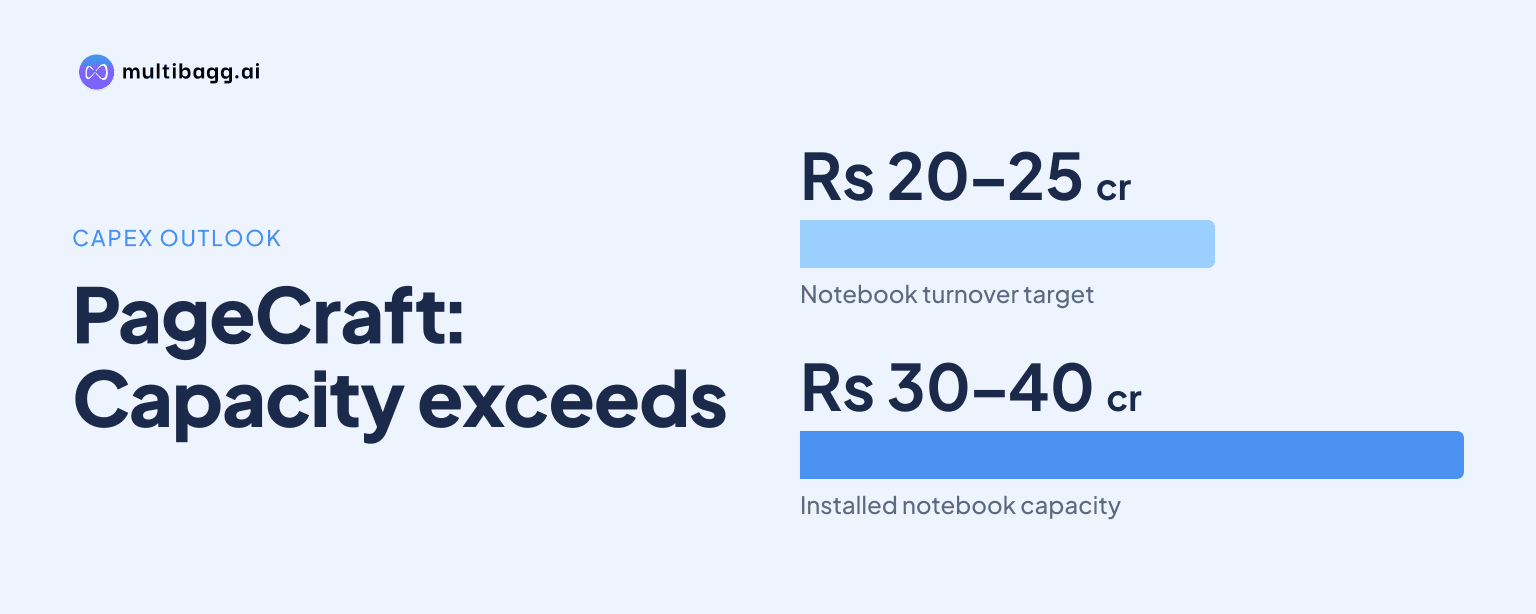
PageCraft expects Rs 20-25 crore of notebook turnover by replacing externally sourced notebooks with in-house production, management said. The target is an expectation rather than confirmed orders and rests on converting notebook purchases among existing school customers. Installed machinery can manufacture notebooks worth Rs 30-40 crore, above the stated sales objective.
Know Dachepalli Publishers inside out
Results, valuation, peers and who's buying, in one view.
How much notebook revenue does PageCraft expect?
PageCraft expects Rs 20-25 crore of notebook turnover, and management said the figure is an expectation rather than a confirmed-order value. The target forms part of the Rs 150 crore turnover objective discussed on the call, so it was not presented as entirely additional company revenue.
Management said PageCraft could generate about Rs 20 crore if it secured a 20% notebook share from its existing customers. It also referred to a 20%-30% conversion opportunity among those accounts, indicating that the plan depends primarily on sales through established school relationships rather than on acquiring new customers.
The machinery currently installed can manufacture notebooks worth Rs 30-40 crore, according to management. This gives PageCraft capacity above its Rs 20-25 crore turnover expectation, although management said further machinery may be needed if production rises beyond the capacity of the existing equipment.
Is PageCraft revenue new or replacing traded notebooks?
PageCraft revenue is partly replacing traded notebook sales, because management described the intended shift as traded products becoming manufactured products. In its e-commerce school channel, the company had bought notebooks from outside suppliers and plans to introduce PageCraft notebooks in those schools instead.
Management said an e-commerce model with about Rs 25 crore of turnover had generated roughly Rs 3-4 crore from traded notebooks. That portion is being brought in-house, meaning it changes the source of production for existing sales rather than creating equivalent new demand.
The balance of the Rs 20-25 crore PageCraft objective would require wider sales to existing customers, including school-supply customers beyond the e-commerce channel. Management said it had not pitched another company's notebook range to every account because the product was not its own, while an in-house PageCraft brand can be offered more directly.
Management estimated that securing a 20% share of notebook business across clients could produce Rs 20-30 crore of turnover. Its specific PageCraft expectation remains Rs 20-25 crore, however, and the company must manufacture orders after receiving them rather than simply distribute stock bought from third parties.
Why is PageCraft bringing notebook production in-house?
PageCraft is bringing notebook production in-house because management expects manufacturing margins to exceed trading margins. Management said notebooks had been the major traded product, accounting for about 10%-12% of total turnover, but expected the category to rise toward 25% as schools require both textbooks and notebooks.
That prospective change in the notebook mix prompted the purchase of machinery and the creation of PageCraft as a manufacturing division. Management said it had already adopted textbook-related products in schools and concluded that notebook demand alongside those products justified its own production unit.
In the e-commerce business, management said 60% of products are in-house and 40% are traded. It put profit after tax, or PAT, below 10% for that channel at present, attributing the level in part to the traded-product share and saying PAT should rise as more company products are adopted.
Management gave an indicative notebook profitability comparison of around 6%-7% PAT for traded product and around 12% for manufactured product. These are management figures, not a reported financial result, and depend on PageCraft converting sales while meeting manufacturing and delivery requirements.
Got a follow-up? Ask IRIS
Can PageCraft deliver custom notebook orders on time?
PageCraft faces a delivery challenge because it must manufacture notebooks after an order is received and supply them within the required school timetable. Management cited different state specifications, including 80-page, 160-page and 172-page notebooks, which require order-specific production rather than a standard single format.
The Rs 30-40 crore machinery capacity therefore does not by itself ensure delivered turnover. PageCraft must convert customer demand into the required page-count formats, produce those products after order receipt, and dispatch them on schedule. Management said it hopes its existing team and capacity can achieve about Rs 20 crore despite those constraints.
The company has closed tie-ups with 100 schools for the coming academic year in the Pelican education-supply business, management said. It also referred to another 20 schools in the pipeline but said it was restricting onboarding because warehouse capacity must be sufficient to pack and distribute products on time.
Management said about 50 schools produced around Rs 25 crore of e-commerce turnover last year, while 100 signed schools could generate around Rs 50 crore. It later clarified that this is linked to the academic year rather than neatly to a financial year, since some school counters begin in March or April and schools reopen in June.
How does PageCraft fit the school-products plan?
PageCraft fits management's plan to sell more school-related products to existing school customers rather than seek unrelated client categories. Management said it intends to continue doing business only with schools and to introduce only products that can be sold in schools, including textbooks, software and notebooks.
The approach makes the notebook plan dependent on account conversion rather than a separate retail rollout. Management said it could reach Rs 20 crore if it obtained a 20% notebook share from existing customers, while the immediate replacement of Rs 3-4 crore of traded e-commerce notebooks provides an identified starting point.
Management also disclosed a tie-up with Wiki Kids as sole distributor in India for IFT panels, described on the call as smart boards. It said the business would make about a 10% margin on each panel sold, but stressed that the product is in a pilot stage and gave no revenue target.
Unlike the Rs 20-25 crore PageCraft notebook expectation, management said it could provide a clearer IFT-panel outlook only in the next financial year. Service, installation and adoption questions remain to be assessed, leaving the notebook transition as the school-products initiative with the most specific turnover and capacity figures disclosed.
Conclusion
PageCraft's disclosed plan combines a shift in sourcing with a broader customer-share opportunity. The company intends first to replace traded notebooks in its e-commerce school channel and then sell its own notebooks more widely to current school accounts. Management expects this to raise notebook PAT from around 6%-7% in trading to around 12% in manufacturing, subject to execution.
The next issue to watch is whether PageCraft can convert 20%-30% of existing customer sales while producing 80-page, 160-page and 172-page formats within school delivery schedules. Management has set a Rs 20-25 crore notebook turnover expectation against Rs 30-40 crore of machinery capacity, while limiting school onboarding at 100 because of warehouse and distribution capacity.