










Dalmia Bharat Q2 FY27 Loss: Costs Cut EBITDA to ₹746
Key highlights
- Dalmia Bharat reported a consolidated net loss of ₹205 crore in Q2 FY27, compared with a profit of ₹239 crore a year earlier.
- Consolidated revenue increased 4% year-on-year to ₹3,563 crore, while EBITDA fell to ₹493 crore from ₹696 crore.
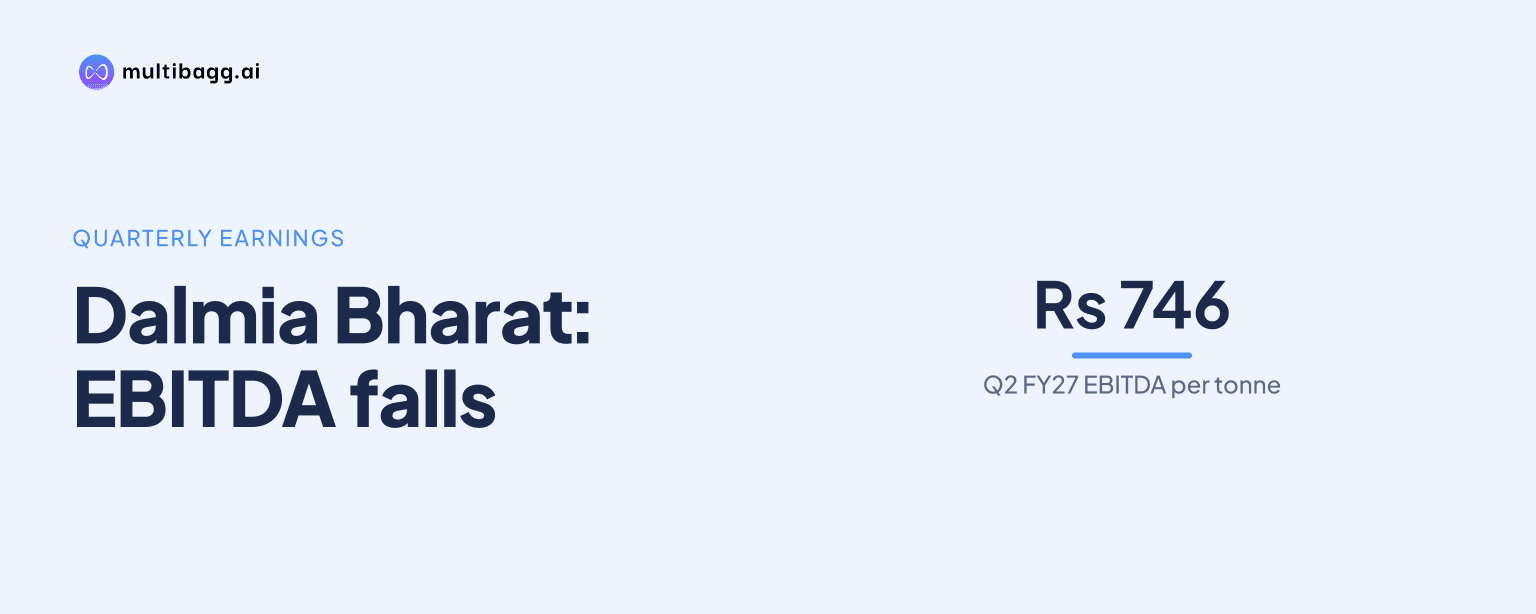
- Sales volumes rose 3% year-on-year to 7.1 million tonnes, but EBITDA per tonne declined to ₹746 on the ex-Central basis cited on the earnings call.
- Dalmia Bharat expects Central India assets to reach 35% to 40% utilisation by the end of FY27, with EBITDA dilution of ₹100 to ₹125 per tonne in Q3.
powered by IRIS
Quarterly loss follows a mixed operating performance
Dalmia Bharat Ltd reported a consolidated net loss of ₹205 crore for the September quarter of FY27. The loss was attributed to exceptional expenses and higher input costs. The quarter presented a mixed picture for the cement maker, with sales volumes increasing while profitability weakened. Consolidated revenue rose 4% year-on-year to ₹3,563 crore from ₹3,417 crore in Q2 FY26. However, EBITDA declined to ₹493 crore from ₹696 crore a year earlier. The result shows how cost inflation and regional demand differences affected the company despite continued infrastructure-led cement demand in parts of India.
Know Dalmia Bharat inside out
Results, valuation, peers and who's buying, in one view.
Volumes rise 3% to 7.1 million tonnes
Overall sales volumes grew 3% year-on-year to 7.1 million tonnes during the quarter. On an ex-Central India basis, volume growth was 4% year-on-year, according to management. South and West India recorded growth approaching double digits. These regions benefited from construction activity supported by public spending and resilient consumption. In contrast, the East and Northeast markets remained weak because of severe floods and heavy rainfall. Management said demand had begun to improve in those regions after the quarter.
Higher costs reduced operating profitability
Cost inflation was the central pressure point in the September quarter. Management said total cost increased by around ₹260 per tonne on an ex-Central basis. Variable costs rose by about ₹200 per tonne, driven by higher fuel, freight and raw-material costs. A quarter-on-quarter decline in volume also resulted in lower fixed-cost absorption. About ₹140 per tonne of the cost increase was linked to this under-absorption of fixed costs. Higher shutdown costs accounted for the remaining fixed-cost increase cited by the company.
Lower realisations added to margin pressure
Realisation declined by about ₹49 per tonne on an ex-Central basis during the quarter. The combination of lower realisations and higher costs reduced EBITDA per tonne to ₹746 on the basis discussed in the earnings call. Separately, the Q2 FY27 investor presentation reported operating margin of ₹698 per tonne, compared with ₹1,013 per tonne in Q2 FY26. The difference reflects the respective reporting bases used in the call and presentation. Both measures point to a substantial year-on-year weakening in unit profitability. The lower margin translated into the decline in EBITDA and the reported consolidated loss.
Key Q2 FY27 figures
Cement prices offer some support after quarter-end
Management said cement prices had increased in the South and East after the quarter. Prices in both regions were around ₹15 per bag above the Q2 average at the time of the earnings call. This movement may provide partial support against the increase in fuel, freight and raw-material costs. But the company did not give a quantified forecast for the impact on future earnings. Pricing remains relevant because realisations fell during the reported quarter. The extent to which higher prices offset cost pressure will depend on demand and competitive conditions across regions.
Got a follow-up? Ask IRIS
Belgaum expansion progresses ahead of schedule
Dalmia Bharat said it had lit its new clinker line at Belgaum and started trial runs ahead of schedule. The company is also progressing with the ramp-up of its Central India assets at Rewa. Mining has restarted at Rewa, while clinker and cement mills are under trial runs. The company is targeting utilisation of 35% to 40% for the Central assets by the end of FY27. Management expects these assets to approach break-even by the end of FY27 and reach Dalmia-standard EBITDA by the end of FY28.
Central assets may weigh on near-term unit economics
The Central India ramp-up is expected to affect unit profitability in the near term. Chief Financial Officer Yatin Malhotra indicated an EBITDA dilution of ₹100 to ₹125 per tonne in Q3, compared with around ₹50 per tonne in Q2. This is because Rewa is beginning commercial production and related costs will no longer be capitalised. Such start-up costs are a normal part of bringing new cement capacity into operations. Higher utilisation can improve fixed-cost absorption over time. For investors, the pace of ramp-up at Rewa will be a key operating measure through FY27.
Capital expenditure guidance remains unchanged
Organic capital expenditure was ₹909 crore in Q2, taking first-half FY27 spending to around ₹1,420 crore. Dalmia Bharat retained its full-year organic capital expenditure guidance of ₹3,200 crore to ₹3,400 crore. The continued investment indicates that the company is pursuing capacity additions despite the weaker quarterly earnings outcome. Management expects second-half organic volume growth to be broadly in line with industry growth of around 7% to 8%. This outlook is conditional on regional demand recovery, particularly in the East and Northeast. The company’s quarterly performance will also be influenced by freight, fuel and other input-cost trends.
What the quarter means for investors
Dalmia Bharat’s Q2 FY27 performance highlights the gap between volume growth and earnings growth in a cost-intensive cement business. A 3% increase in volumes was insufficient to absorb higher variable costs, shutdown expenses and weaker fixed-cost absorption. The East and Northeast demand disruption added to the operational challenge, while South and West markets provided relative support. The company has identified price increases, improving regional demand and higher utilisation as potential supports for future performance. Its next results will provide a clearer indication of whether these factors are reducing the margin pressure. For now, the reported loss and lower EBITDA underline the importance of cost control and the execution of the Central India ramp-up.