










Datamatics delivered 75+ AI projects for 40+ GenAI customers
Key highlights
- Datamatics says it has delivered more than 75 AI projects.
- Datamatics says it processes more than 15 million balance-sheet pages annually.
- More than 40 customers use GenAI-powered TruBot, TruCap+ and TruBI.
- Datamatics says it has built AI agents for 3 sectors: insurance, banking and logistics.
powered by IRIS
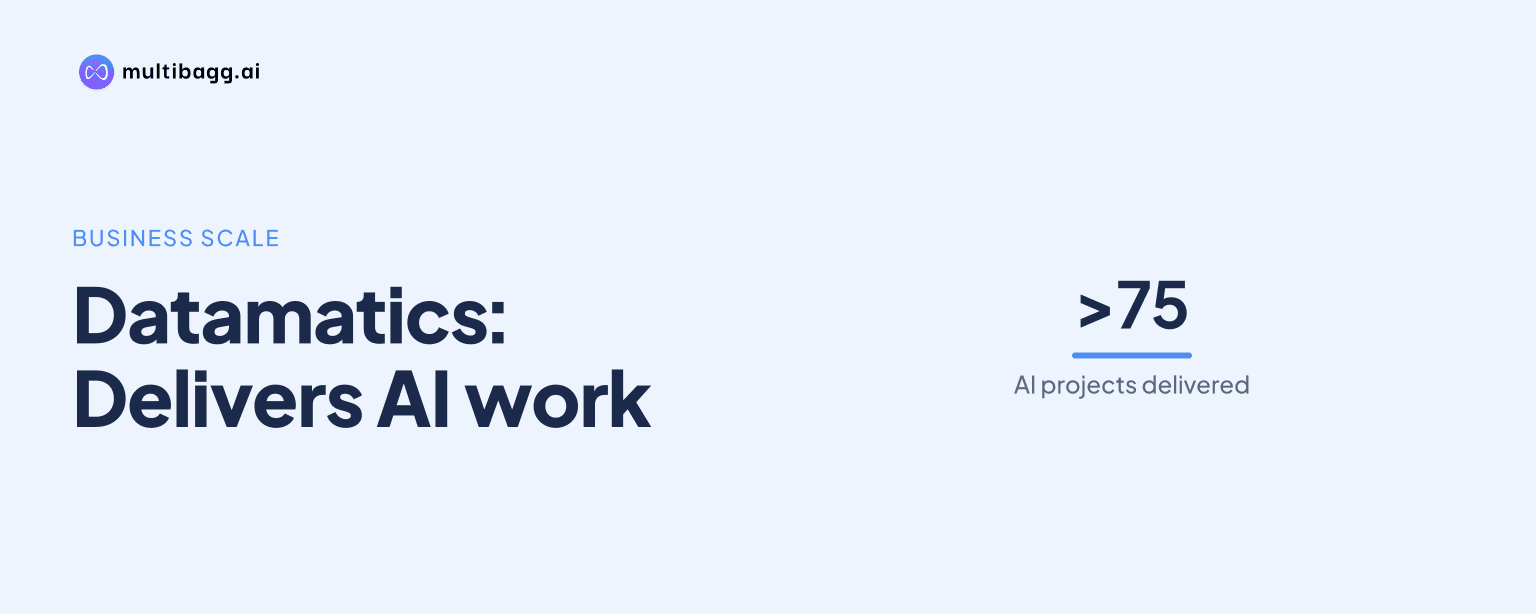
Datamatics says it has delivered more than 75 artificial intelligence projects and has more than 40 customers using generative AI-powered TruBot, TruCap+ and TruBI, while processing more than 15 million balance-sheet pages annually. The disclosed measures show commercial AI activity across products, services and deployments in banking, insurance and logistics.
Know Datamatics Global Services inside out
Results, valuation, peers and who's buying, in one view.
How much AI work has Datamatics delivered?
Datamatics reports delivering more than 75 AI projects and processing more than 15 million balance-sheet pages annually. The company does not disclose the revenue, contract values, implementation dates, customer identities or geographic distribution associated with the 75-plus project count.
The annual page-processing figure is linked to a 2020 deployment for a credit-rating agency, when Datamatics said it processed 15 million balance-sheet pages annually. Its current disclosure describes the workload as more than 15 million pages, indicating that the cited volume is at least maintained above the level stated in the 2020 case history.
The 75-plus project total is broader than the 40-plus GenAI customer measure. Datamatics ties the customer count specifically to GenAI-powered TruBot, TruCap+ and TruBI, whereas its project count covers AI services, solutions and products; it does not state how many projects were delivered for those 40-plus customers.
Which Datamatics products have GenAI customers?
More than 40 customers use GenAI-powered TruBot, TruCap+ and TruBI, according to Datamatics. TruBot is its robotic process automation product, TruCap+ is its intelligent document processing product, and TruBI is its business-intelligence product.
Datamatics says GenAI elevated TruBot and TruCap+ in 2023, marking a product-development step after its earlier AI activity. In that year, the company also said it built a small language model and a copilot in collaboration with Microsoft and Google, but it does not separately quantify adoption of either offering.
The AI-powered product list extends beyond the three products included in the 40-plus customer metric. It also includes FINATO for finance transformation and TruDiscovery, described as a knowledge assistant, while the AI solutions list separately includes financial statement analysis, credit risk analysis, contract management and TruAI Underwriting.
This distinction means the reported customer figure should not be read as customer adoption across every AI product. Datamatics identifies only TruBot, TruCap+ and TruBI in that measure, and provides no individual customer count for FINATO, TruDiscovery, TruAI Underwriting or the six other solutions listed in its AI catalogue.
What shows Datamatics’ AI deployment over time?
Datamatics traces its AI journey to 2014, when it began with TruAI and introduced AI-driven robotic process automation through TruBot. The presentation gives use cases rather than annual AI revenue, including 35 million records streamlined for an American bank in 2015 and more than 10,000 emails processed for a leading bank in 2016.
In 2017, Datamatics said its AI-powered TruCap+ advanced intelligent document processing, and in 2018 it used natural language processing for machine-drawing extraction. The 2020 credit-rating-agency example then added the 15 million annual balance-sheet-page workload, showing a progression from record and email workflows to high-volume document processing.
The company identifies 2023 as the point at which it introduced FINATO and added GenAI to TruBot and TruCap+. It also reports recognition from Microsoft as an AI-First Mover and from Google as a strategic partner for the “Back Office of the future,” although these recognitions are not measures of AI revenue or customer growth.
For 2024 and 2025, the examples move toward industry-specific transformation and agentic AI. Datamatics says an AI centre of excellence accelerated a Middle Eastern bank’s transformation in 2024, while a 2025 logistics example reduced safety-data retrieval from days to minutes; no financial impact was supplied for either example.
Got a follow-up? Ask IRIS
Which sectors and workflows does Datamatics target with AI?
Datamatics says it has built AI agents for insurance, banking and logistics, three sectors it links to autonomous workflow orchestration and decision-making. Its 2025 disclosures also include the launch of TruAI Underwriting, an agentic-AI product intended for insurance underwriting.
Insurance examples include propensity-based claim decisions for a leading insurer in 2015 and a 2025 statement that agentic AI improved underwriting efficiency for another leading insurer. Datamatics does not provide a percentage improvement, project value or customer name for either insurance deployment.
Banking is represented by the 35 million records streamlined in 2015, the 10,000-plus emails processed in 2016 and the current financial-statement and credit-risk analysis offerings. These examples connect the sector to data extraction, document processing and decision-support workflows rather than to a disclosed bank customer count.
Logistics is represented by the 2025 safety-data retrieval case, an agentic-AI operations deployment for an American logistics leader and a dynamic-pricing application. Datamatics says dynamic pricing can unlock higher logistics margins, but provides no before-and-after margin, customer identity or revenue contribution.
How is Datamatics structuring its AI services and governance?
Datamatics lists AI strategy and consulting, model development, solution development and integration, agentic-AI-enabled transformation, and Microsoft Copilot integration as service lines. These services sit alongside products such as TruBot and TruCap+, so the 75-plus project measure can include both implementation work and proprietary-platform deployments.
The company says it received ISO 42001:2023 certification for Artificial Intelligence Management Systems in 2024 and describes itself as one of the first companies globally certified to that standard. The presentation does not state the certification’s scope by product, operating unit or geography.
Datamatics also says its Digital Technologies business is powered by a proprietary robotic process automation suite to enable faster time-to-value and improved productivity. It does not disclose research and development spending, AI employee numbers, AI-project profitability, backlog, or a target for increasing the 40-plus GenAI customer base.
Conclusion
Datamatics presents measurable evidence of AI commercialisation through more than 75 delivered projects, more than 15 million balance-sheet pages processed annually and more than 40 customers using three GenAI-powered products. Its timeline shows AI use cases from 2014 through 2025, with the most recent applications focused on agentic workflows in insurance, banking and logistics.
What to watch next is whether Datamatics discloses revenue, renewals, sector mix or product-level adoption for its 40-plus GenAI customers. Its stated 2025 direction includes TruAI Underwriting, AI agents in three sectors and logistics dynamic pricing, but the presentation provides no quantitative customer, project or revenue target for those initiatives.