










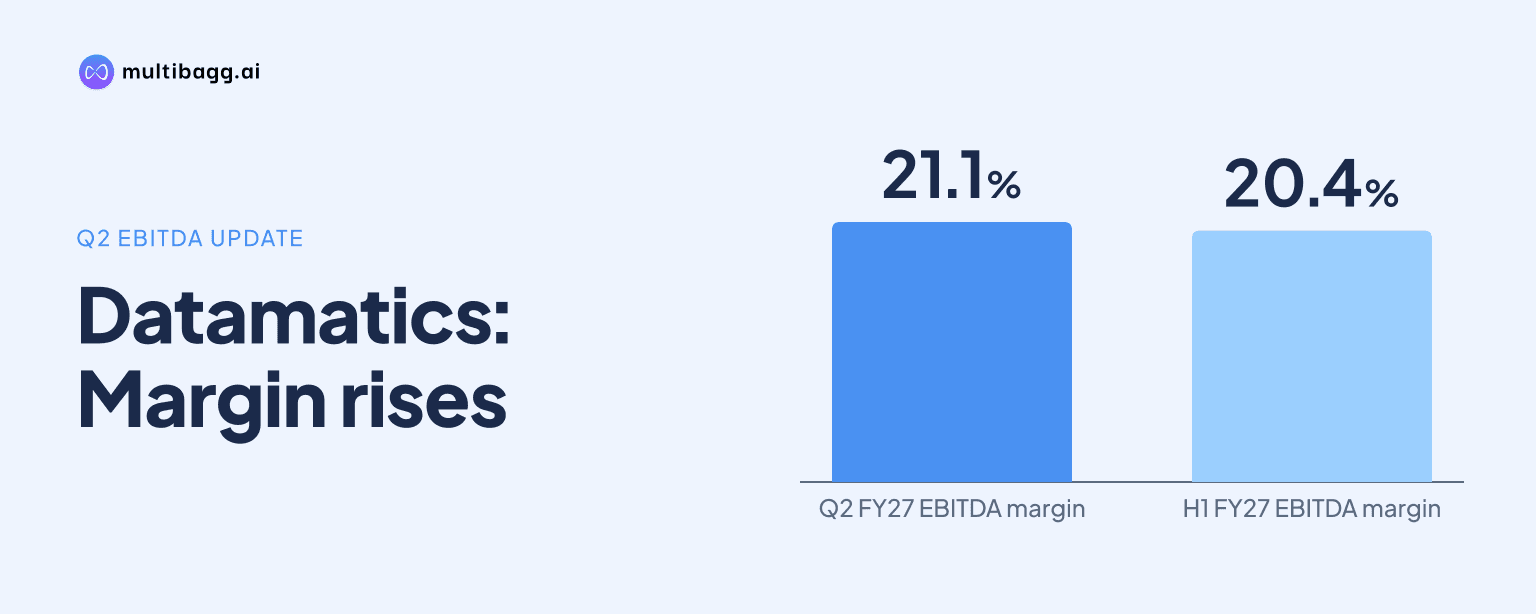
Datamatics Q2 EBITDA margin rises to 21.1% on growth
Key highlights
- Datamatics Q2 FY27 revenue rose 11.5% year on year to Rs 546.6 crore.
- Datamatics Q2 FY27 EBITDA increased 30% to Rs 115.5 crore and margin expanded 301 basis points to 21.1%.
- Digital Operations revenue grew 15.6% to Rs 314.9 crore, with a 21.8% EBIT margin.
- H1 FY27 revenue reached Rs 1,060.6 crore, up 10.7%, while EBITDA margin expanded 322 basis points to 20.4%.
powered by IRIS
Datamatics Global Services Limited expanded its Q2 FY27 EBITDA margin by 301 basis points year on year to 21.1%, as revenue rose 11.5% to Rs 546.6 crore and EBITDA increased 30% to Rs 115.5 crore. For the quarter ended September 30, 2026, reported EBIT grew 33.8% to Rs 92.2 crore.
Know Datamatics Global Services inside out
Results, valuation, peers and who's buying, in one view.
How did Datamatics perform in Q2 FY27?
Datamatics delivered revenue of Rs 546.6 crore in Q2 FY27, up 11.5% year on year, while EBITDA rose faster, by 30%, to Rs 115.5 crore. That difference lifted the EBITDA margin to 21.1%, an expansion of 301 basis points, or 3.01 percentage points. Management attributed the growth to deeper strategic-client engagement, expansion within existing accounts and a growing portfolio of artificial intelligence, or AI-led, services.
Reported EBIT was Rs 92.2 crore, up 33.8% year on year, and the EBIT margin rose 281 basis points to 16.9%. Profit after tax, or PAT, after non-controlling interest reached Rs 73.4 crore, an increase of 16.1%, while the PAT margin expanded 69 basis points to 13.2%. EBITDA and EBIT therefore grew faster than revenue in the September 2026 quarter, while PAT growth was lower than EBIT growth.
What drove Datamatics' margin expansion?
Datamatics said Q2 FY27 margin improvement was largely driven by revenue growth and operating leverage in Digital Operations, rather than a material currency movement from the preceding quarter. Digital Operations reported a 21.8% EBIT margin, compared with 9.5% in Digital Technologies and 12.0% in Digital Experiences. Management said the 21.1% consolidated EBITDA margin was fairly sustainable and did not expect substantial fluctuation.
Management had indicated at the start of FY27 that it was targeting EBITDA-margin improvement of 100 to 150 basis points and said it was operating in the vicinity of 20%. In H1 FY27, Datamatics reported a 20.4% EBITDA margin, up 322 basis points year on year, compared with 21.1% in Q2 FY27. Management did not quantify further margin levers beyond operating leverage, account expansion and AI-enabled delivery.
Which Datamatics segments and markets grew fastest?
Digital Operations was Datamatics' largest and fastest-growing segment in Q2 FY27, generating Rs 314.9 crore of revenue and growing 15.6% year on year. Management linked the performance to deeper customer engagement and operational execution in digital content. It also added agentic claims management to its TruAI underwriting offering, extending its insurance coverage across the policy life cycle.
Digital Technologies generated Rs 166.6 crore, up 8.8% year on year, while Digital Experiences recorded Rs 65.1 crore, up 0.8%. Management said Digital Technologies saw accelerated demand for AI-led application modernization and development. Its KAi Modernization Factory can deliver up to 40% cost savings and a three-times faster go-live, according to management, which is seeking to convert interest from the Gartner IT Symposium in Florida into production deployments and repeatable engagements.
The United States remained Datamatics' largest market, accounting for 57% of business in Q2 FY27, followed by the United Kingdom and Europe at 24%, India at 12% and the rest of the world at 7%. Management identified the United States and Europe as primary growth drivers. The top five, 10 and 20 clients contributed 29%, 39% and 53% of revenue, respectively, with management saying growth in accounts outside the top groups reduced percentage concentration.
Got a follow-up? Ask IRIS
How did the TNQTech acquisition affect reported EBIT?
Datamatics reported adjusted EBIT of Rs 99.3 crore in Q2 FY27 and an adjusted EBIT margin of 18.2%, excluding amortisation of intangible assets recognised through the purchase price allocation for TNQTech. Reported EBIT was Rs 92.2 crore with a 16.9% margin. The company described the acquisition-related amortisation as a non-cash accounting charge that does not reflect underlying operating performance.
The TNQTech intangible-asset amortisation began in Q4 FY25, will run over 12 quarters and is expected to be fully amortised by Q3 FY28. In H1 FY27, reported EBIT was Rs 170.6 crore and adjusted EBIT was Rs 184.7 crore, with margins of 16.1% and 17.4%, respectively. Management also said TNQTech delivered healthy growth, while the final acquisition-payment tranche reduced net cash and investments net of debt to Rs 557 crore at September 30 from Rs 710.2 crore at June 30.
What is Datamatics targeting after H1 FY27?
Datamatics reported H1 FY27 revenue of Rs 1,060.6 crore, up 10.7% year on year, with EBITDA rising 31.4% to Rs 216.6 crore. H1 PAT after non-controlling interest was Rs 145.8 crore, up 28.3%, and earnings per share were Rs 24.66, also up 28.3%. Billed days sales outstanding, or DSO, stood at 66 days as of September 30, 2026.
Management said it expected full-year growth in the high single digits, potentially closer to 9% to 9.5% rather than 7.5% to 8%, based on its pipeline. It also reiterated a three-year revenue target of Rs 3,000 crore, saying it expected roughly 15% compound annual growth, with 10% to 12% from organic growth and 3% to 4% from acquisitions. Management said it was in discussions with several companies but had no transaction mature enough to disclose.
Conclusion
Datamatics paired 11.5% Q2 FY27 revenue growth with 30% EBITDA growth, producing a 21.1% margin and a 301-basis-point year-on-year expansion. Digital Operations led segment growth at 15.6% and recorded the highest EBIT margin at 21.8%, while reported EBIT included non-cash TNQTech acquisition-related amortisation scheduled through Q3 FY28.
The next measures to watch are whether Datamatics converts AI-focused opportunities, which management said account for about 55% of opportunities, into production deployments, and whether it maintains high-single-digit FY27 growth. Management's Rs 3,000 crore three-year target also depends mainly on 10% to 12% organic growth, with 3% to 4% expected from inorganic expansion that remains under discussion.