










DBL says Siarmal rail constraint eased, retains FY27 target
Key highlights
- DBL reported 9 million tonnes of Siarmal coal production in H1 FY27 and expects 18 million tonnes in H2 FY27.
- DBL retained its 27-million-tonne Siarmal target and 34-million-tonne combined coal-production target for FY27.
- Mining SPVs generated Rs 795 crore of revenue in H1 FY27 at a 25% EBITDA margin.
- DBL management expects FY27 mining PAT of Rs 300 crore to Rs 320 crore.
powered by IRIS
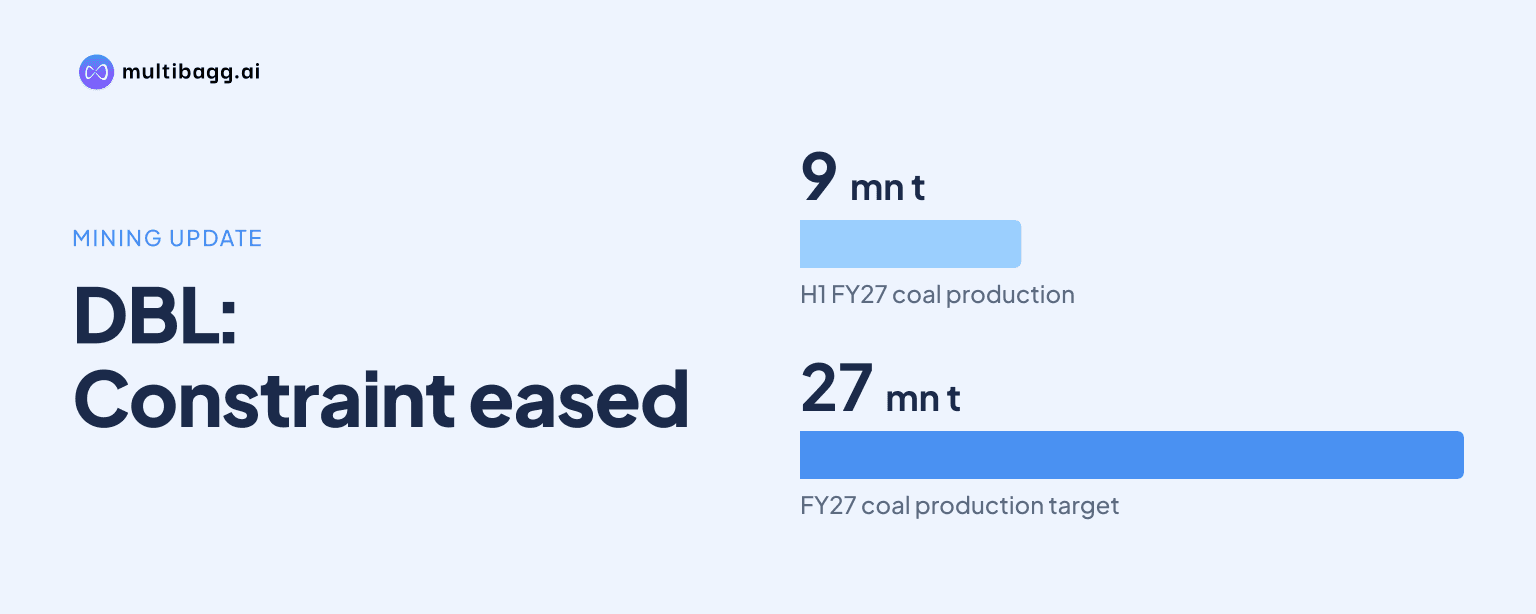
Dilip Buildcon Limited said rail-evacuation constraints at Siarmal have largely been resolved, supporting management’s plan for 18 million tonnes of coal production in H2 FY27 and its retained 27-million-tonne target for FY27. Siarmal produced 9 million tonnes in H1 FY27, while the mining special-purpose vehicles generated Rs 795 crore of revenue at a 25% EBITDA margin.
Know Dilip Buildcon inside out
Results, valuation, peers and who's buying, in one view.
Has DBL resolved the Siarmal rail-evacuation constraint?
DBL said the Siarmal rail-evacuation constraint has largely been sorted out, although management did not say it had been permanently eliminated. It said Q1 FY27 coal production was affected by limited rail evacuation, but rake availability had improved from October 2026 and the pace of the preceding one-and-a-half months supported its H2 plan.
The company expects Siarmal coal production to double from 9 million tonnes in H1 FY27 to 18 million tonnes in H2 FY27. That second-half plan would deliver the reiterated 27-million-tonne FY27 target, with the first half accounting for one-third of the annual objective and the following six months accounting for the remaining two-thirds.
Siarmal also removed around 12 million cubic metres of overburden in H1 FY27. Overburden is the rock and soil removed to access coal seams, and management said the improved rail position should contribute to better realisation, profitability and cash generation at the project.
Management did not disclose Siarmal’s separate H1 FY27 revenue, EBITDA or profit. It reported, however, that the mining special-purpose vehicles, or SPVs, together generated Rs 795 crore of revenue in H1 FY27 at an EBITDA margin of 25%.
How does Siarmal’s production plan compare with Pachhwara?
DBL is targeting 34 million tonnes of combined coal production in FY27, comprising 27 million tonnes from Siarmal and 7 million tonnes from Pachhwara. The target represents the company’s stated physical-performance plan for its mining development and operation, or MDO, portfolio.
Pachhwara produced 1.98 million tonnes in H1 FY27 and removed 5.7 million cubic metres of overburden, which management said was more than required. Its coal dispatches were lower because of a strike at a Punjab power plant, but management said dispatches had restarted from September 2026.
Pachhwara must produce about 5.02 million tonnes after September 2026 to reach its 7-million-tonne FY27 target. Management said there would be no gap in physical or financial performance, but it did not provide a separate H2 production target or dispatch schedule for the mine.
The company reported total coal production of 10.89 million tonnes in H1 FY27, compared with the 9 million tonnes disclosed for Siarmal and 1.98 million tonnes for Pachhwara. Management did not reconcile the difference between the consolidated figure and the two operation-level figures on the call.
What does DBL expect mining to contribute in FY27?
DBL management expects the 34-million-tonne mining portfolio to deliver an EBITDA margin of around 25%, a profit-after-tax, or PAT, margin of around 15% to 16%, and annual mining PAT of Rs 300 crore to Rs 320 crore in FY27. These are management targets, rather than reported results.
The H1 FY27 mining-SPV revenue of Rs 795 crore and EBITDA margin of 25% provide the reported benchmark for that outlook. DBL did not disclose H1 mining PAT, the revenue split between Siarmal and Pachhwara, or mine-specific EBITDA margins.
Management said fuel-related cost increases under its MDO contracts are passed through under the price-adjustment mechanism, though with a lag. It also said the extension of the price-adjustment mechanism had provided some relief amid elevated diesel and bitumen costs.
The mining target sits alongside a wider H2 FY27 execution ramp-up. DBL reported consolidated revenue of Rs 4,628 crore in H1 FY27, while management expects projects awarded in Q4 FY26 to begin contributing from Q3 FY27 after their mobilization and development periods.
Got a follow-up? Ask IRIS
How does Siarmal fit DBL’s cash-flow and funding plan?
DBL expects Siarmal’s remaining equity requirement to be met from cash generated by the project SPV, with no further equity contribution from the parent company expected. The funding plan depends on the project’s operating cash flows as production and dispatches ramp up.
For FY29, management retained its annual coal-production target of about 57 million tonnes, led by Siarmal and Pachhwara. At that output level, it expects the mining business to generate annual operating cash flow of about Rs 1,000 crore, with contractual escalation providing additional support over time.
Management also expects mining operations and infrastructure investment trust, or InvIT, holdings to generate about Rs 1,300 crore of annual cash flow over the next few years, excluding new engineering, procurement and construction, or EPC, orders. As of September 30, 2026, DBL held InvIT units worth Rs 1,578 crore.
This cash-flow strategy accompanies management’s debt-reduction plan. Standalone net debt was Rs 2,146 crore and consolidated net debt was Rs 8,950 crore on September 30, 2026; management targets a Rs 600 crore to Rs 800 crore debt reduction in FY27 and standalone net debt freedom by FY28.
What should investors monitor in H2 FY27?
Investors should monitor whether Siarmal can sustain the dispatch pace required for 18 million tonnes in H2 FY27. Management cited improved rake availability from October 2026, but it did not disclose monthly output, coal dispatches, rake availability or rail-evacuation capacity.
Pachhwara’s recovery is also material to the combined 34-million-tonne target because it produced 1.98 million tonnes in H1 FY27 against a 7-million-tonne full-year objective. Management said the Punjab power-plant disruption had eased from September 2026, without providing post-restart volume data.
The next operational milestone at Siarmal is commissioning of the coal-handling plant, which management identified as the next major milestone. The company did not provide a commissioning date or quantify the facility’s expected effect on handling capacity, production or dispatches.
Mining margins will also require attention. Management’s FY27 forecast of a 25% EBITDA margin and a 15% to 16% PAT margin follows a reported 25% H1 FY27 EBITDA margin for the mining SPVs, but the call did not provide a mine-level profitability breakdown.
Conclusion
DBL has retained its 27-million-tonne Siarmal FY27 coal target because management believes improved rail-rake availability can support 18 million tonnes of H2 production after 9 million tonnes in H1. Along with Pachhwara’s 7-million-tonne target, that plan underpins the 34-million-tonne mining outlook and management’s Rs 300 crore to Rs 320 crore FY27 mining PAT expectation.
The next measures to watch are monthly Siarmal production and dispatch data, progress on the coal-handling plant and Pachhwara’s volumes after dispatches restarted in September 2026. Management’s longer-term plan remains 57 million tonnes of annual coal production by FY29 and about Rs 1,000 crore of annual mining operating cash flow at that production level.