










Dilip Buildcon Limited keeps FY27 growth target after H1
Key highlights
- DBL retained FY27 revenue-growth guidance of about 30% to 40% after H1 growth of 5.5%.
- DBL expects projects worth about Rs 15,000 crore to begin contributing in Q3 FY27 and ramp up in Q4 FY27.
- DBL’s order book was Rs 33,081 crore at September 30, 2026, with roads accounting for 15.6%.
- DBL targets FY27 debt reduction of Rs 600 crore to Rs 800 crore from standalone net debt of Rs 2,146 crore.
powered by IRIS
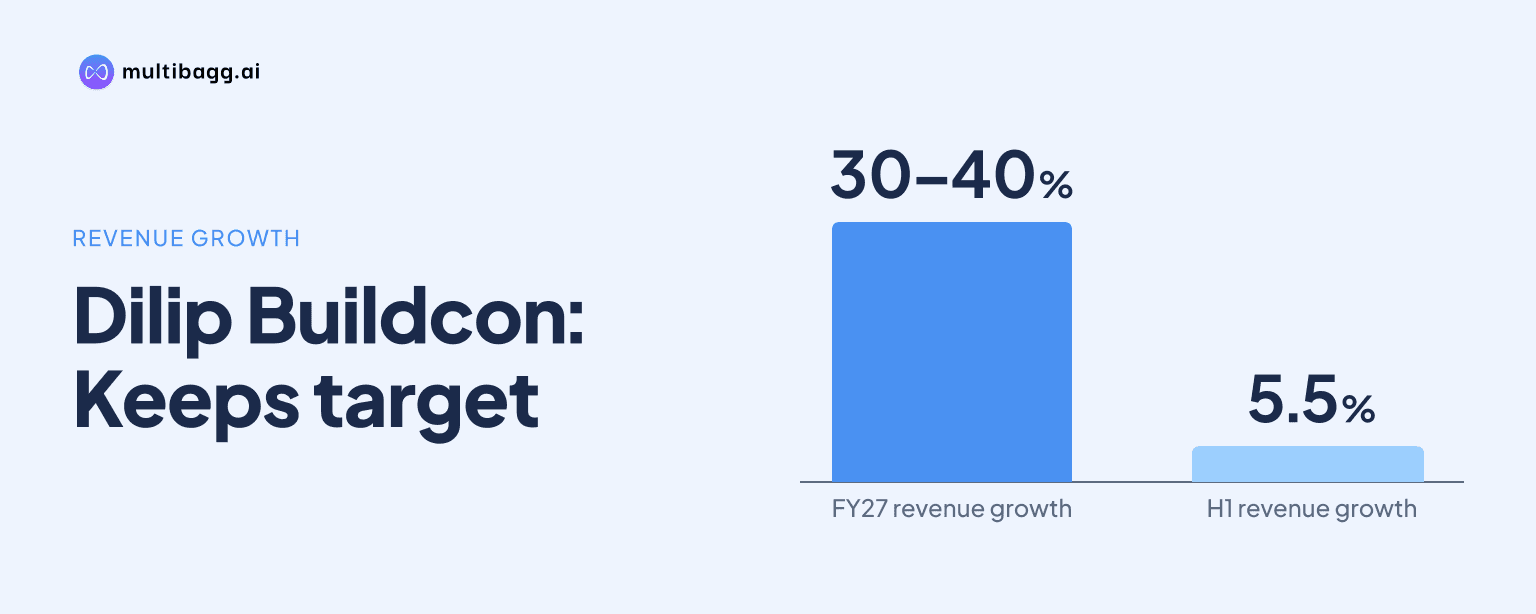
Dilip Buildcon Limited maintained its FY27 revenue-growth target of about 30% to 40% on November 12, 2026, after first-half revenue growth of 5.5%, because projects worth about Rs 15,000 crore are expected to begin contributing in Q3 and ramp up in Q4. DBL’s Rs 33,081 crore order book supports that management outlook.
Know Dilip Buildcon inside out
Results, valuation, peers and who's buying, in one view.
Why is DBL retaining its FY27 revenue-growth target?
DBL is retaining its FY27 revenue-growth target because management expects projects awarded in Q4 FY26 to move beyond mobilisation and start generating revenue in Q3 FY27. Management said first-half revenue grew 5.5%, as large projects with an aggregate value of about Rs 15,000 crore were still in mobilisation and development.
The difference between the 5.5% first-half growth rate and the 30% to 40% full-year target depends on execution timing rather than a revised forecast. Management described Q2 as a seasonally softer execution period because of monsoon conditions, and said the new projects should ramp up in Q4 before continuing into Q1 and Q2 of the following financial year.
DBL’s standalone revenue from operations rose to Rs 1,686 crore in Q2 FY27 from Rs 1,417 crore in Q2 FY26. Earnings before interest, tax, depreciation and amortisation, or EBITDA, increased to Rs 175 crore from Rs 152 crore, while the EBITDA margin was 10.4% in Q2 FY27.
When will DBL’s recently awarded projects add revenue?
DBL expects the recently awarded projects to start contributing in Q3 FY27, with the principal execution ramp in Q4 FY27. Management said a typical engineering, procurement and construction, or EPC, project takes six to eight months to begin revenue contribution, while a public-private partnership, or PPP, project usually takes nine to 12 months.
The Rs 15,000 crore project pool was awarded in Q4 FY26, placing its expected Q3-Q4 FY27 contribution within the timetable management gave for EPC and PPP projects. This remains a management expectation: the call did not disclose project-level construction progress, revenue recognised from this award pool, or a quarterly revenue forecast for the rest of FY27.
Fresh wins add to the work available for execution. DBL secured orders worth about Rs 7,321 crore in Q2 across build-operate-transfer, EPC and hybrid annuity model, or HAM, projects, taking H1 FY27 order inflow to about Rs 7,589 crore. By the November 12 call, management said a further Rs 1,300 crore of orders had been added.
That cumulative order intake represented about 90% of management’s FY27 order-inflow guidance of Rs 10,000 crore to Rs 12,000 crore. DBL also had submitted bids worth Rs 23,000 crore awaiting opening, within an overall bid pipeline of about Rs 3.30 lakh crore, neither of which was included in the reported order book.
How is DBL’s order book changing by sector?
DBL’s order book stood at Rs 33,081 crore as of September 30, 2026, across 12 business verticals, with roads representing 15.6%. Management said mining, irrigation, renewable energy and transmission accounted for a larger share than roads, changing the mix away from the road engineering segment.
Management called the Rs 33,081 crore balance DBL’s largest order book to date. It said it would accept a smaller road share rather than pursue smaller road packages whose bidding prices, in management’s view, did not reflect underlying risks and returns; the National Highways Authority of India had floated more than Rs 1 lakh crore of road orders.
In mining, DBL reported a three-year rolling order-book snapshot of about Rs 3,998 crore for its mine developer and operator contracts. The balance contract value of the mining portfolio was about Rs 98,618 crore at current prices, showing that the reported rolling order-book measure and total contract balance are different measures.
Got a follow-up? Ask IRIS
What mining and asset-monetisation plans support DBL’s outlook?
DBL’s mining business produced 6.1 million tonnes of coal in Q2 FY27 and 10.89 million tonnes in H1 FY27. Management retained a production target of about 27 million tonnes at Siarmal for FY27, saying rail-evacuation constraints that affected Q1 had largely been resolved.
Management also maintained its FY29 target for annual coal production of about 57 million tonnes, led by Siarmal and Pachhwara. At that production level, management expects mining operating cash flow of about Rs 1,000 crore a year, and said Siarmal’s remaining equity requirement should be funded from its special purpose vehicle’s cash flows rather than further DBL equity.
DBL held infrastructure investment trust, or InvIT, units worth Rs 1,578 crore across Anantam Highways Trust and Shrem InvIT at September 30, 2026. Management expects four HAM projects to transfer to Anantam in the next quarter and the remaining assets in FY28, subject to approvals from the National Highways Authority of India.
Once the planned transfers are completed, management expects road InvIT units worth about Rs 3,000 crore to Rs 3,200 crore and annual distributions of Rs 350 crore. Management said mining operations and InvIT holdings together could generate about Rs 1,300 crore of annual cash flow over the next few years, excluding new EPC orders.
How does DBL plan to reduce debt while funding execution?
DBL reported standalone net debt of Rs 2,146 crore and consolidated net debt of Rs 8,950 crore as of September 30, 2026. Management targets a debt reduction of Rs 600 crore to Rs 800 crore during FY27 and said reductions should become visible from Q3 as execution, collections and working-capital conditions improve.
Standalone net debt-to-equity was 0.31 times at September 30, 2026, while management is targeting about 120 working-capital days by FY27-end. It also aims to become net debt-free on a standalone basis by FY28 and said standalone capital expenditure would remain at or below Rs 100 crore in FY27, entirely for replacement requirements.
The planned Alpha Alternatives transactions are part of DBL’s funding model for new assets. The solar and transmission transactions have a combined enterprise value of about Rs 9,740 crore against combined project cost of about Rs 8,430 crore, with Alpha Alternatives to fund about Rs 820 crore of the Rs 1,680 crore combined construction-phase equity requirement.
Conclusion
DBL’s retained 30% to 40% FY27 growth target relies on translating a Rs 33,081 crore diversified order book into Q3 and Q4 execution after 5.5% first-half growth. Mining production, planned InvIT distributions and asset transactions are intended to supplement EPC cash generation while the company targets Rs 600 crore to Rs 800 crore of debt reduction in FY27.
The next disclosed milestones are the expected Q3 start of revenue contribution from about Rs 15,000 crore of recent awards, the Q4 execution ramp, and the planned transfer of four HAM projects to Anantam Highways Trust in the next quarter. Remaining HAM transfers are expected in FY28 but still depend on National Highways Authority of India approvals.