










DCM Shriram sees firm PVC demand as energy costs shape margins
Key highlights
- DCM Shriram reported Q2 FY27 Vinyl PBDIT of Rs 51 crore, up from Rs 12 crore in Q2 FY26.
- DCM Shriram said PVC prices were Rs 95,000 to Rs 1 lakh a tonne and PVC volumes rose 29% year on year.
- DCM Shriram said energy represents about 60% to 70% of Vinyl production costs.
- DCM Shriram plans to add 70 to 80 megawatts of renewable power capacity.
powered by IRIS
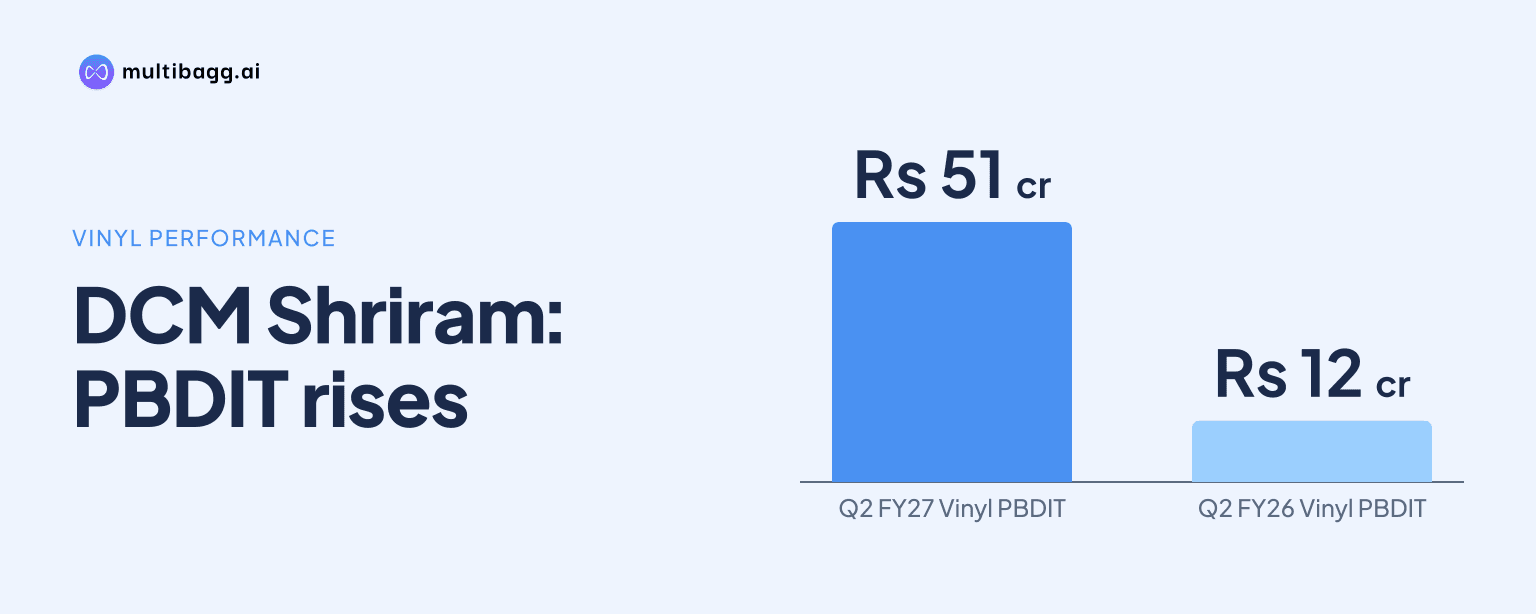
DCM Shriram said PVC demand kept utilisation at 100% or higher in Q2 FY27 at prices of Rs 95,000 to Rs 1 lakh a tonne, and Vinyl profit before depreciation, interest and tax (PBDIT) rose to Rs 51 crore from Rs 12 crore. Management said energy costs, 60% to 70% of production cost, determine the margin outlook.
Know DCM Shriram inside out
Results, valuation, peers and who's buying, in one view.
Is DCM Shriram seeing demand destruction in PVC?
No, DCM Shriram said it is not seeing a demand challenge and is producing at 100% of capacity, or slightly above it. Management said the end of the monsoon should support the seasonal PVC market in Q3 and Q4 FY27, which it described as good quarters for the product. Its assessment differs from the concern raised by an analyst about other PVC companies reporting demand destruction and lower volume guidance.
DCM Shriram’s Q2 FY27 operating data supports that view: PVC volumes rose 29% year on year and PVC prices rose 25%. Vinyl revenue increased 20% year on year, reflecting higher volumes and realisations in both PVC and carbide. Carbide volumes increased 15% and prices rose 16%, meaning the segment’s growth was not reliant on PVC alone.
PBDIT rose by Rs 39 crore year on year to Rs 51 crore in Q2 FY27. DCM Shriram attributed the increase to better volume and realisation, while noting that higher input costs partly offset those gains. Management did not provide a numeric forecast for the next quarter’s Vinyl profit.
What are current PVC prices and what supports them?
DCM Shriram said prevailing PVC prices were Rs 95,000 to Rs 1 lakh a tonne during the call. The analyst noted that the prior cycle’s peak was about Rs 90,000 a tonne, placing the cited current range above that level. Management did not offer a specific price target, but said it was hopeful that PVC prices would remain firm.
Management linked its expectation of price stability to the minimum import price and import duty already in place. The chairman said those measures should make current prices “quite stable,” while another executive said the minimum import price should keep the business healthy. These comments are management’s view of the policy framework, not a guarantee that PVC selling prices will remain at Rs 95,000 to Rs 1 lakh a tonne.
The pricing backdrop fed through to reported results in Q2 FY27. PVC prices increased 25% year on year, versus a 16% increase in carbide prices, while PVC volume growth of 29% exceeded carbide’s 15% growth. That mix of price and volume gains lifted Vinyl PBDIT to Rs 51 crore from Rs 12 crore, even as DCM Shriram reported higher input costs across the segment.
Why do energy costs matter to Vinyl margins?
Energy matters because DCM Shriram said it accounts for about 60% to 70% of Vinyl production cost. Management said product prices had improved by more than costs in both year-on-year and quarter-on-quarter comparisons, which is why margins improved. However, it also said coal remains the majority of its energy cost and that coal prices were rising.
Management set out a conditional view of margins. If PVC prices stay at the current level, margins should ideally decline, it said; if prices rise further, margins could improve. This means the Rs 95,000 to Rs 1 lakh-a-tonne PVC range alone does not determine profitability, because the eventual spread also depends on the direction of coal and other energy costs.
DCM Shriram said its power is largely captive rather than sourced from the grid, using coal-based and renewable generation. Excluding sugar, it cited about 107 megawatts of renewable capacity at peak level against about 345 megawatts of coal-based power, and said it plans to add another 70 to 80 megawatts. Management’s target is for renewable energy to provide around one-third of total power requirements within the next year.
Got a follow-up? Ask IRIS
How is DCM Shriram reducing Vinyl energy exposure?
DCM Shriram is commissioning renewable capacity at Kota to reduce the production-cost burden from coal. Management said the Kota renewable project, expected to average 32 to 33 megawatts, was partly commissioned and the remaining portion was expected to be commissioned within days of the call. It described these steps as part of an effort to optimise and reduce the cost of production.
The company said renewable investments generate returns on investment above 20% to 25%, though it did not disclose the investment amount or a separate Vinyl-specific saving. The stated mechanism is that more renewable generation reduces dependence on coal-based captive power, although management cautioned that the scale of saving will still vary with coal prices.
The broader Q2 FY27 result shows why cost action is relevant across DCM Shriram. Consolidated revenue, net of excise duty, rose 22% year on year to Rs 3,977 crore, while consolidated PBDIT fell to Rs 319 crore from Rs 408 crore. Management attributed the overall decline principally to higher Chemicals input costs and lower Agri-Input earnings, even as Vinyl PBDIT rose to Rs 51 crore.
How does DCM Shriram’s Vinyl business compare with other segments?
Vinyl was one of DCM Shriram’s improved businesses in Q2 FY27, with PBDIT rising to Rs 51 crore from Rs 12 crore, while Chemicals PBDIT declined to Rs 158 crore from Rs 254 crore. Chemicals revenue increased 47% year on year, but management said production costs increased by about 6% to 8% across chemistries while selling prices fell about 4% to 6%.
Other segments had varied outcomes. Sugar and Ethanol PBDIT increased to Rs 62 crore from Rs 33 crore, while Fenesta Building Systems PBDIT rose 15% to Rs 49 crore despite slightly lower margins. Shriram Farm Solutions PBDIT declined to Rs 78 crore from Rs 106 crore, and Bioseed recorded a PBDIT loss of Rs 41 crore compared with a loss of Rs 7 crore in the prior-year quarter.
Vinyl’s improvement therefore came alongside pressure elsewhere in the portfolio. As of September 30, 2026, DCM Shriram reported net debt of Rs 917 crore, compared with Rs 773 crore a year earlier, and return on capital employed of 12%, versus 15%. The company also declared a 200% interim dividend amounting to Rs 62.38 crore.
Conclusion
DCM Shriram’s Q2 FY27 Vinyl performance indicates that its own PVC demand and utilisation remained firm despite concerns raised about demand elsewhere in the market. The segment’s Rs 51 crore PBDIT, compared with Rs 12 crore a year earlier, was supported by 29% PVC volume growth and 25% price growth, but management’s comments make clear that energy costs are the key variable for margins from here.
The next point to watch is commissioning and ramp-up of the Kota renewable project, which management said should average 32 to 33 megawatts and was nearing full commissioning. Management also plans another 70 to 80 megawatts of renewable capacity, targeting about one-third of total power needs from renewable sources within one year, while PVC price movement and coal costs remain unresolved margin drivers.