










DCM Shriram Q2 revenue rises 22%, PBDIT falls 22% year on year
Key highlights
- Q2 FY27 net revenue increased 22% year on year to Rs 3,977 crore.
- Q2 FY27 PBDIT declined 22% year on year to Rs 319 crore.
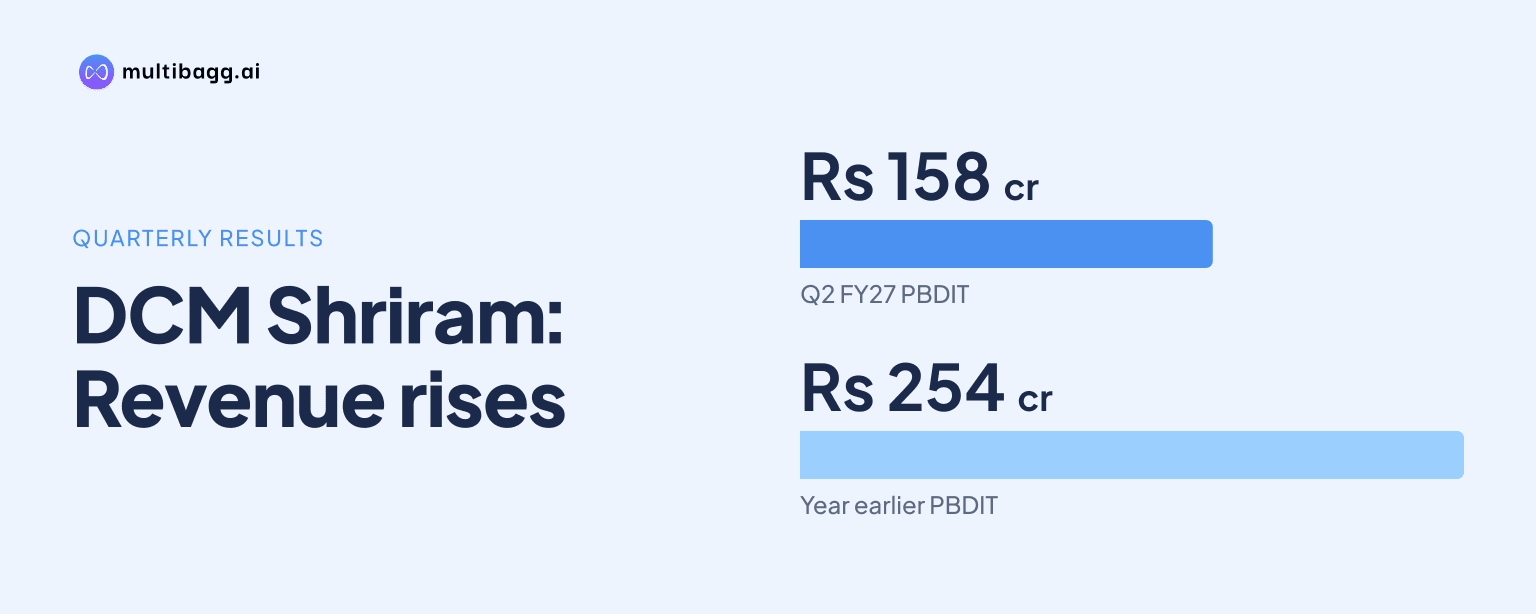
- Chemicals PBDIT fell to Rs 158 crore from Rs 254 crore despite 47% revenue growth.
- Fertilizer subsidy outstanding was Rs 446 crore on September 30, 2026, versus Rs 187 crore a year earlier.
powered by IRIS
DCM Shriram Limited reported Q2 FY27 net revenue of Rs 3,977 crore, up 22% year on year, while PBDIT fell 22% to Rs 319 crore from Rs 408 crore as higher chemical input costs and lower agri-input earnings outweighed growth in Vinyl, Fertilizer and Fenesta Building Systems.
Know DCM Shriram inside out
Results, valuation, peers and who's buying, in one view.
Why did DCM Shriram's Q2 PBDIT fall despite revenue growth?
DCM Shriram's Q2 FY27 PBDIT fell to Rs 319 crore from Rs 408 crore because higher input costs reduced Chemicals earnings and agri-input businesses recorded lower profits. The Q2 FY26 comparison also included a Rs 76 crore Gujarat government incentive in Chemicals and Rs 15.5 crore from an upward revision in sugar power rates.
The revenue and profit movements varied substantially by business. Chemicals revenue increased 47% year on year but PBDIT fell to Rs 158 crore from Rs 254 crore, whereas Vinyl PBDIT rose to Rs 51 crore from Rs 12 crore and Sugar & Ethanol PBDIT increased to Rs 62 crore from Rs 33 crore.
Chemicals was the main drag on group profitability. Management said production costs across its chemistries rose by about 6% to 8% during the quarter while selling prices declined by about 4% to 6%, except in one or two smaller products. Hydrogen peroxide was an exception, as its in-house hydrogen supply and higher market prices partly supported performance.
Which businesses supported DCM Shriram's Q2 revenue growth?
DCM Shriram's Vinyl, Fertilizer and Fenesta Building Systems businesses contributed to Q2 FY27 revenue growth, while Vinyl and Sugar & Ethanol also increased PBDIT. Vinyl revenue rose 20% year on year, led by a 29% increase in polyvinyl chloride, or PVC, volumes and a 25% rise in PVC prices; carbide volumes and prices increased 15% and 16%, respectively.
Chemicals revenue grew 47%, supported by a 2% increase in caustic soda volumes, a 6% rise in electrochemical unit, or ECU, prices, and contributions from hydrogen peroxide, aluminium chloride and advanced materials. ECU is the combined value of chlorine and caustic soda from the chlor-alkali process. Caustic capacity utilisation was 89% in Q2 FY27.
Sugar & Ethanol revenue rose 10% as domestic sugar prices increased 14%, despite a 6% reduction in sugar volumes. Ethanol volumes increased 24%, which management attributed to timing differences. The segment's PBDIT rose to Rs 62 crore, though Q2 FY26 included the Rs 15.5 crore power-tariff revision benefit.
Fenesta Building Systems revenue increased 22%, led by the project vertical, and PBDIT rose 15% to Rs 49 crore. Management said margins were slightly lower because of product mix, elevated input costs and fixed expenses for new business platforms. Phase one of Fenesta's aluminium extrusion plant at Kota was commissioned during the quarter.
Got a follow-up? Ask IRIS
How did higher costs and weather affect DCM Shriram?
DCM Shriram faced higher coal costs in caustic soda and volatile glycerine costs in epichlorohydrin and downstream products. Management said power is the key raw material in its energy-intensive caustic business and coal prices had risen significantly. It also said the business consumed high-cost glycerine during Q2 FY27 before glycerine prices subsequently declined.
The weather impact was most evident in agri inputs. Shriram Farm Solutions revenue fell 10% year on year due to lower Seed and Specialty Plant Nutrition volumes, while PBDIT declined to Rs 78 crore from Rs 106 crore. Management said part of the timing-related impact from research wheat seed sales could reverse in Q3 FY27, subject to crop conditions and channel demand.
Bioseed reported a Q2 FY27 PBDIT loss of Rs 41 crore, compared with a loss of Rs 7 crore a year earlier. Lower corn and paddy volumes increased the burden of fixed expenses, while doubtful-debt provisions in India and seed discards in the Philippines added pressure. Management said cotton volumes were better than last year, but acreage in corn, cotton and paddy remained below prior-year levels in key markets.
Fertilizer revenue rose 40%, primarily because realizations increased 46% with higher gas prices, while PBDIT rose 25% to Rs 25 crore. Outstanding fertilizer subsidy stood at Rs 446 crore on September 30, 2026, compared with Rs 187 crore a year earlier. Management said higher gas prices increased the working-capital requirement linked to subsidy receivables.
What projects and financial measures should readers track?
DCM Shriram commissioned a 68-megawatt hybrid renewable power project at Kota, a 100-tonne-per-day aluminium chloride plant at Bharuch and part of a calcium chloride project during Q2 FY27. The calcium chloride plant reached 133 tonnes per day, or 50% of its planned 266-tonne-per-day capacity, while the 58-megawatt group-captive renewable project at Bharuch was progressing as scheduled.
The company announced a 40-megawatt peak solar plant at Kota costing Rs 145 crore, filter presses at its Kota cement plant costing Rs 60 crore and Bharuch and Kota debottlenecking projects costing Rs 120 crore. Management said the debottlenecking work is intended to improve energy efficiency and increase caustic capacity.
DCM Shriram's net debt was Rs 917 crore on September 30, 2026, compared with Rs 773 crore a year earlier, and return on capital employed was 12%, down from 15%. The board declared a 200% interim dividend amounting to Rs 62.38 crore. Management said incremental depreciation from recently capitalised chemical projects was Rs 10 crore in Q2 FY27.
Management said the proposed demerger was at an advanced stage but required work because the company's businesses are interlinked. In response to an analyst, management said it was targeting board consideration in two to three quarters, around Q1 FY28. That is a management target rather than a completed corporate action.
Conclusion
DCM Shriram's Q2 FY27 results showed that sales growth in Vinyl, Fertilizer and Fenesta Building Systems did not offset the Rs 96 crore year-on-year reduction in Chemicals PBDIT and weaker agri-input performance. Net revenue increased 22% to Rs 3,977 crore, but group PBDIT fell 22% to Rs 319 crore as costs rose and the prior-year quarter contained one-time benefits.
Next, management's ramp-up of the 68-megawatt Kota renewable project, new chemical capacity and Fenesta's aluminium extrusion facility will indicate progress on its efficiency and integration plans. Other disclosed items to watch are Q3 FY27 research wheat seed sales, fertilizer subsidy receivables of Rs 446 crore, ethanol feedstock availability and the management target for demerger board consideration around Q1 FY28.