










DCX non-offset project share rises from 15% to about 40%
Key highlights
- DCX says non-offset projects increased from about 15% to about 40% of its system-integration mix.
- The move represents an increase of about 25 percentage points in DCX's non-offset project share.
- DCX is investing in Raneal Advanced Systems to expand PCBA for captive use, exports and other markets.
- DCX holds AS-9100:2016 certification for aviation, space and defence manufacturing quality systems.
powered by IRIS
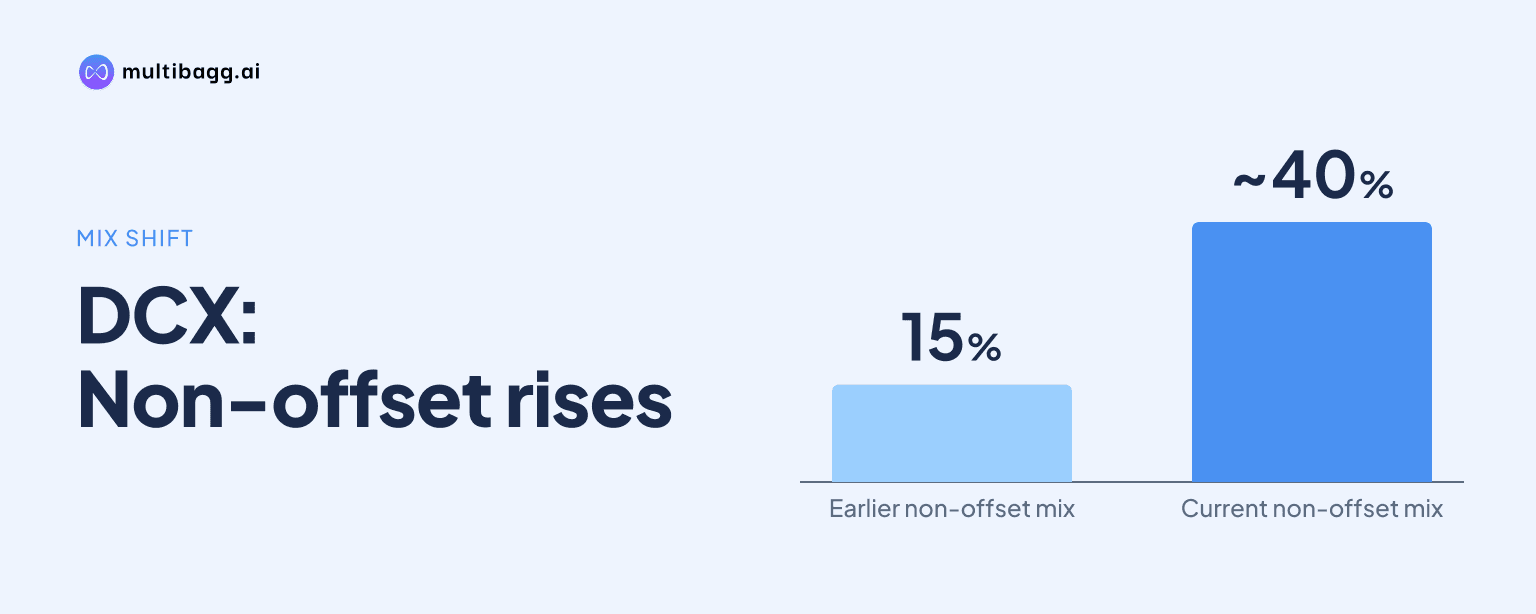
DCX Systems Limited says non-offset projects have risen from about 15% to about 40% of its system-integration mix, a shift intended to reduce dependence on offset projects and benefit margins. DCX is supporting the change through electronics and electro-mechanical assemblies, cable and wire harnesses, and printed circuit board assembly backward integration.
Know DCX Systems inside out
Results, valuation, peers and who's buying, in one view.
Why is DCX increasing its non-offset project mix?
DCX is increasing its non-offset order book to reduce dependence on its offset-project model. The company identifies itself as a preferred IOP and says its non-offset project share has grown from about 15% to about 40%.
The change is centred on system integration, where DCX provides electronics and electro-mechanical assemblies for radar, communication, surveillance and missile systems. Its presentation links increasing non-IOP projects to international quality standards, execution capability, cost competitiveness and an ethical foundation. DCX also says it is seeking penetration into new geographies, which is consistent with broadening work beyond offset-linked programmes.
The disclosed movement changes the role of the IOP channel rather than ending it. DCX still describes a strong IOP order book and calls itself a preferred IOP for the IAI Group, while its stated focus is to expand non-offset orders alongside that existing system-integration activity.
What does DCX's offset business still include?
DCX's offset business still includes build-to-print system integration and cable and wire-harness manufacturing for the Indian defence market. The company says it is among the largest IOPs for the IAI Group in Israel and lists electronic assemblies, automatic missile-detection radars, unmanned aerial vehicle systems and Barak systems among the relevant capabilities.
The listed offset applications also include medium-range maritime reconnaissance aircraft and short-range surface-to-air missiles. DCX holds AS-9100:2016 certification, a quality-management certification for aviation, space and defence product manufacturing, and a Defence Industrial License from the Ministry of Commerce and Industry for manufacturing key products.
DCX characterises its relationship with Israeli defence companies as having been built over a decade. The company says it acts as an IOP and non-IOP partner for Israeli and US original equipment manufacturers, or OEMs, supplying a range of aerospace and defence products. That dual role provides the stated basis for pursuing non-offset projects while retaining access to offset-related work.
How does system integration support DCX's transition?
System integration supports DCX's transition because the company can provide electronics and electro-mechanical assemblies rather than only a single manufacturing step. DCX says the service includes in-house quality testing, including vibration and environmental-stress testing for complex radio-frequency, or RF, products used in radar, communication, surveillance and missile systems.
The company says customers supply equipment for testing and qualification of customised products, supporting an asset-light model despite a capital-intensive product portfolio. It also states that customers typically reimburse costs incurred to maintain buyer-furnished equipment. This arrangement is distinct from the company's manufacturing expansion into cable harnesses and printed circuit board assembly.
DCX says it has better-than-industry-average yield in system integration, although it does not provide a numerical yield figure or a comparison period. Its presentation attributes the increasing non-IOP project flow to its quality standards, execution capability and cost competitiveness; these are company statements rather than independently quantified performance measures.
Got a follow-up? Ask IRIS
Which manufacturing businesses are being expanded?
DCX is expanding cable and wire harnesses and electronics manufacturing services, or EMS, as manufacturing components of its business structure. Its cable portfolio covers RF, coaxial, mixed-signal, power and data cable assemblies, designed for electronic-warfare and communication systems. The company calls cable and wire harnesses a high-margin business and says it is exploring inorganic growth opportunities.
For EMS, DCX is investing in Raneal Advanced Systems to expand printed circuit board assembly, or PCBA, activity. The company describes this as horizontal and backward integration for captive use as well as markets beyond defence and aerospace, including medical devices and electronics. Raneal's stated work includes manufacturing, qualification and life-cycle support for high-reliability electronic assemblies.
DCX says captive PCBA production is intended to provide cost control, supply-chain management and working-capital benefits. The presentation also identifies defence, aerospace, industrial electronics and medical electronics as use areas for Raneal's assemblies, with captive use and exports included in its stated scope. No revenue contribution or investment amount for Raneal is disclosed in these pages.
What other revenue streams does DCX identify?
DCX identifies maintenance, repair and overhaul, or MRO, as an additional revenue stream that requires minimal capital expenditure. The company says its in-house testing machinery, provided by OEMs, would place it in a better position to offer testing and maintenance projects, and it describes the MRO opportunity as sizeable.
Kitting is another vertical, involving assembly-ready kits of electronic and electro-mechanical parts. DCX says kitting can reduce inventory levels, space requirements, indirect costs and overheads. Unlike system integration, which includes testing of complex RF products, kitting is presented as a supply activity for prepared parts and assemblies.
The company also points to a customer base that includes ELTA Systems Ltd, Bharat Electronics, Israel Aerospace Industries, Elbit Systems, Lockheed Martin, Rafael, Collins Aerospace and Boeing. DCX says it works with customers on timely execution, just-in-time inventory management and raw-material quality, while customers jointly monitor product quality and retain technology and intellectual-property rights.
Conclusion
DCX's disclosed rise in non-offset project share from about 15% to about 40% indicates a planned change in the composition of its system-integration work, not a withdrawal from the IOP business. The company retains offset capabilities spanning build-to-print integration, electronic assemblies and cable harnesses, while adding non-offset programmes, PCBA backward integration, kitting and MRO as separate or supporting business lines.
What to watch next is whether DCX continues to expand its non-offset order book and enters new geographies, as management says it intends to do. The presentation also flags Raneal Advanced Systems investment for PCBA growth, inorganic opportunities in cable and wire harnesses, and MRO services using OEM-provided testing machinery; it does not disclose timelines, order values or segment-level revenue targets for these plans.