










DCX Systems turns operating cash positive as inventory surges
Key highlights
- DCX generated Rs 22.96 crore of operating cash in March ’26, versus a Rs 337.48 crore outflow in March ’25.
- DCX inventory rose 144.60% to Rs 423.41 crore at 31 March 2026.
- DCX trade payables increased by Rs 95.28 crore to Rs 180.51 crore in FY26.
- DCX reported a consolidated order book of about Rs 3,190 crore at 30 September 2026.
powered by IRIS
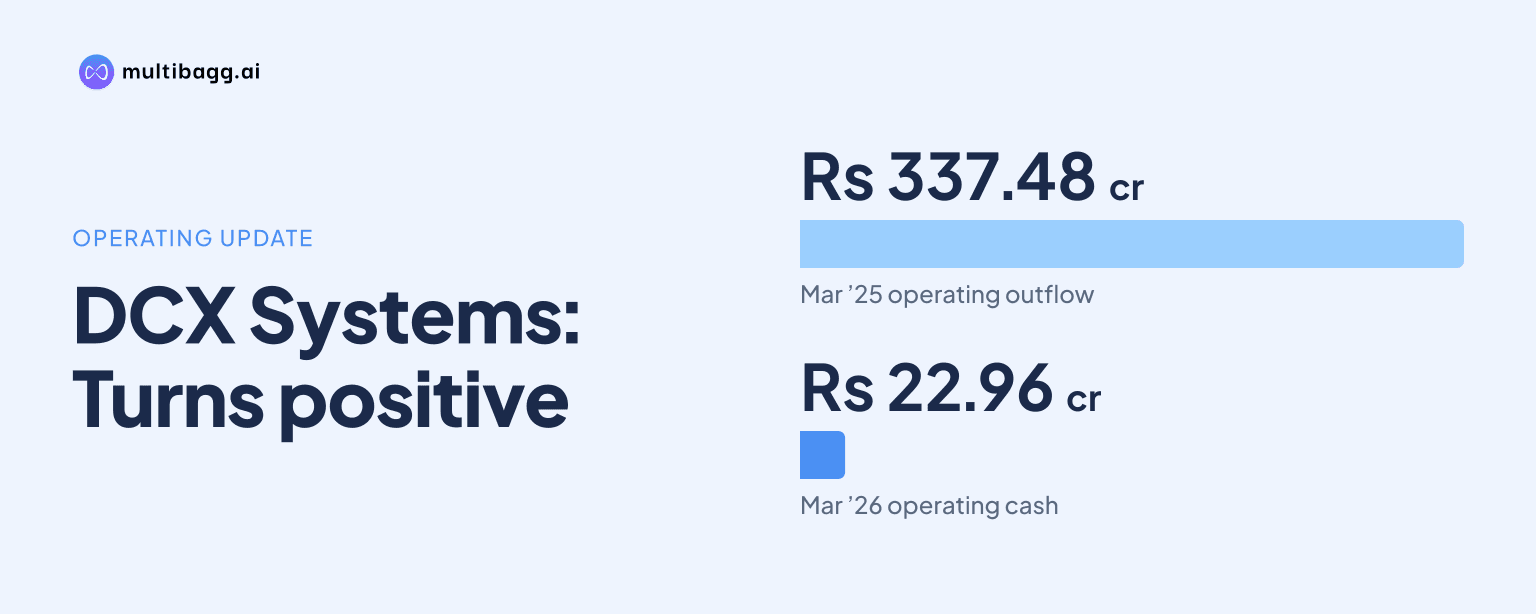
DCX Systems generated Rs 22.96 crore of cash from operating activities in March ’26, reversing a Rs 337.48 crore outflow in March ’25, while standalone inventory rose 144.60% to Rs 423.41 crore. The reported working-capital movement changed to a Rs 24.11 crore contribution from a Rs 336.56 crore use.
Know DCX Systems inside out
Results, valuation, peers and who's buying, in one view.
Why did DCX’s operating cash flow turn positive in FY26?
DCX’s operating cash flow turned positive because its reported working-capital movement shifted from a Rs 336.56 crore outflow in March ’25 to a Rs 24.11 crore inflow in March ’26. Operating profit before working-capital changes was Rs 13.84 crore in March ’26, compared with Rs 8.44 crore a year earlier.
Cash generated from operations consequently reached Rs 37.95 crore in March ’26, compared with a Rs 328.12 crore outflow in March ’25. Tax paid increased to Rs 14.99 crore from Rs 9.36 crore, leaving cash from operating activities at Rs 22.96 crore and producing a year-on-year swing of Rs 360.44 crore.
The operating-profit figure before working-capital changes rose by Rs 5.40 crore, whereas the working-capital line improved by Rs 360.67 crore. The cash-flow statement therefore indicates that the movement in working capital was the main contributor to the turnaround in reported operating cash generation.
How much did DCX’s inventory increase in FY26?
DCX’s standalone inventory increased by Rs 250.31 crore, or 144.60%, to Rs 423.41 crore at 31 March 2026 from Rs 173.10 crore at 31 March 2025. Inventory was therefore about 2.45 times the preceding year’s balance.
The inventory increase occurred as standalone revenue from operations fell 33.47% to Rs 739.87 crore in FY26 from Rs 1,112.06 crore in FY25. The FY26 income statement recorded Rs 841.35 crore of raw-material expenses, down from Rs 1,080.33 crore, and a negative Rs 153.73 crore under changes in inventory.
Those income-statement entries are distinct from the closing inventory balance on the balance sheet. The presentation does not provide a product-level, customer-level or order-level explanation for the Rs 250.31 crore increase, nor does it separately reconcile inventory movements to the working-capital cash-flow line.
What changed in DCX’s payables, receivables and current assets?
DCX’s trade payables increased by Rs 95.28 crore to Rs 180.51 crore at 31 March 2026 from Rs 85.23 crore a year earlier. This increase accompanied the Rs 24.11 crore positive working-capital movement, although the presentation does not identify the individual cash contribution from trade payables.
Trade receivables moved in the opposite direction, falling by Rs 27.38 crore to Rs 132.98 crore from Rs 160.36 crore. Other current liabilities declined by Rs 33.49 crore to Rs 352.04 crore, while other current assets increased by Rs 41.35 crore to Rs 239.31 crore.
Total current liabilities rose by Rs 64.03 crore to Rs 548.21 crore despite the decline in other current liabilities. Current tax liabilities increased to Rs 13.11 crore from Rs 10.67 crore, while short-term borrowings and lease liabilities were reported as nil in both balance-sheet periods.
Got a follow-up? Ask IRIS
Did positive operating cash flow increase DCX’s cash balance?
DCX’s positive operating cash flow did not increase year-end cash and cash equivalents because investing and financing cash flows remained negative. Cash and cash equivalents declined to Rs 109.13 crore in March ’26 from Rs 131.61 crore in March ’25.
Cash flow from investing activities was a Rs 45.10 crore outflow in March ’26, following a Rs 93.45 crore outflow in March ’25. Cash flow from financing activities was a Rs 0.33 crore outflow, compared with a Rs 272.23 crore outflow in the previous year, resulting in a total net cash outflow of Rs 22.47 crore.
Bank balances fell by Rs 225.47 crore to Rs 555.60 crore at 31 March 2026, while non-current investments rose by Rs 84.03 crore to Rs 242.66 crore. Total assets increased by Rs 97.46 crore to Rs 1,738.54 crore, and shareholders’ funds rose by Rs 32.83 crore to Rs 1,187.01 crore.
What do DCX’s later disclosures show about the working-capital backdrop?
DCX reported a consolidated order book of about Rs 3,190 crore as of 30 September 2026 and said it received purchase orders of more than Rs 50 crore from foreign and domestic customers during that quarter. The presentation does not disclose the expected delivery timing of this order book or an inventory target associated with it.
Standalone revenue from operations was Rs 239.34 crore in H1 FY27, down 41.96% from Rs 412.37 crore in H1 FY26. Standalone profit after tax was Rs 8.77 crore in H1 FY27, compared with Rs 18.29 crore a year earlier, while the income statement reported Rs 26.70 crore under changes in inventory.
The supplied material does not include a balance sheet or cash-flow statement for H1 FY27. As a result, it does not show whether the FY26 inventory balance, receivables, payables or operating-cash position changed after 31 March 2026.
Conclusion
DCX’s FY26 figures show a substantial reversal in reported operating cash flow, with a Rs 22.96 crore inflow following a Rs 337.48 crore outflow. The turnaround coincided with a Rs 24.11 crore positive working-capital movement, even as inventory rose by Rs 250.31 crore, trade payables increased by Rs 95.28 crore and receivables declined by Rs 27.38 crore.
What to watch next is how the about Rs 3,190 crore consolidated order book reported at 30 September 2026 affects inventory, revenue and operating cash flow. DCX disclosed more than Rs 50 crore of quarterly purchase orders but gave no delivery schedule, inventory target or cash-conversion forecast, while H1 FY27 revenue and profit were lower year on year.