










Deccan Gold advances critical-minerals development plans
Key highlights
- Bhalukona preliminary modelling indicates more than 4 million tonnes of potentially economic ore and more than 10,000 tonnes of nickel-equivalent metal.
- Logrosan’s Dehesa model suggests more than 2.3 million tonnes containing more than 2,000 tonnes of WO3 and 500 tonnes of SnO2.
- Mozambique covers about 150 square kilometres, with 4 to 5 pegmatite zones in one block and about 8 pegmatites in another.
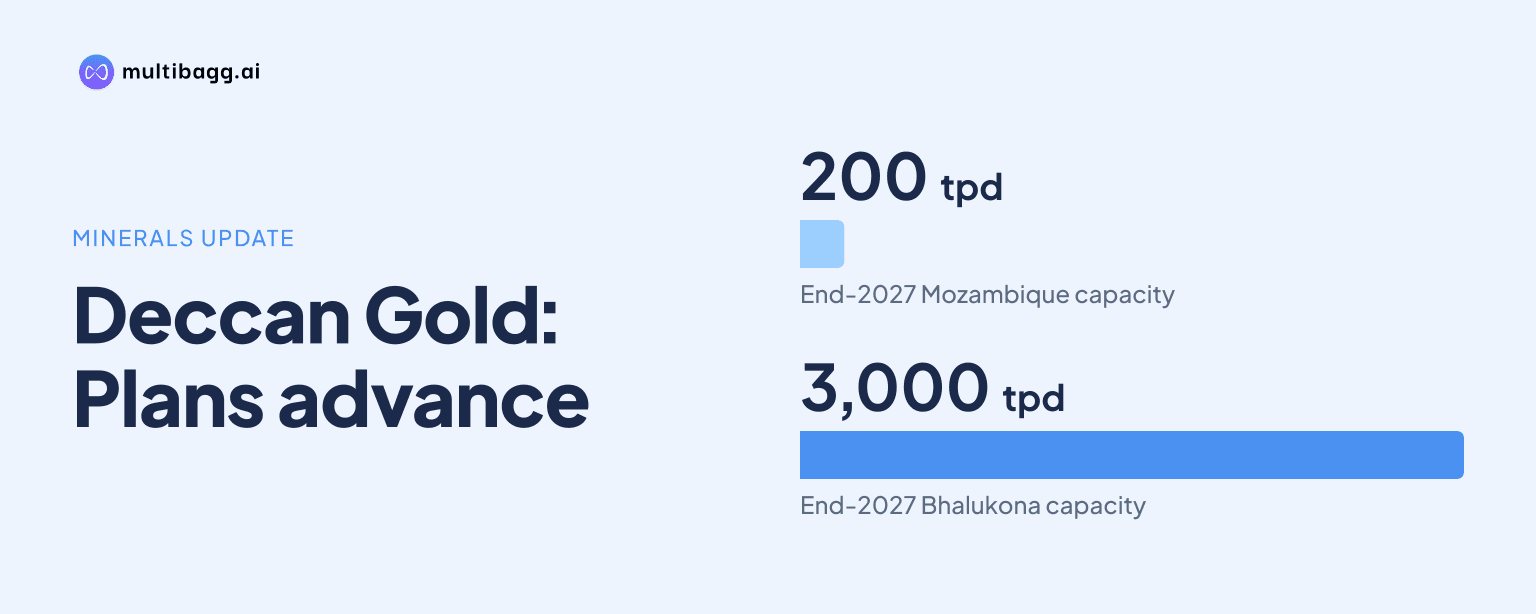
- Deccan Gold aims for a 200-tonnes-per-day Mozambique concentrate plant by end-2027 and a 3,000-tonnes-per-day Bhalukona plant.
powered by IRIS
Deccan Gold Mines is advancing a second growth vertical in critical minerals, led by preliminary Bhalukona modelling of more than 4 million tonnes of potentially economic ore containing more than 10,000 tonnes of nickel-equivalent metal. Deccan Gold also outlines drilling and processing ambitions for tungsten-tin in Spain and lithium-tantalum in Mozambique.
Know Deccan Gold Mines inside out
Results, valuation, peers and who's buying, in one view.
What is Deccan Gold’s critical-minerals strategy?
Deccan Gold’s strategy is to develop three critical-mineral opportunities alongside its gold business: Bhalukona in Chhattisgarh for nickel, copper and platinum-group elements, or PGE; Logrosan in Spain for tungsten and tin; and licences in Mozambique for lithium and tantalum. The company describes development, rather than discovery alone, as the objective across these projects.
The projects are at different stages of exploration. Bhalukona has a preliminary exploration model based on about 2,500 metres of diamond drilling, Logrosan has preliminary modelling at its Dehesa target after eight drill holes, and Mozambique has geological mapping, soil sampling and rock-chip results ahead of a planned 1,500-to-2,000-metre drilling programme.
Deccan Gold also presented commodity price changes since 2025 as context for the strategy, listing lithium at 134%, cobalt at 78%, and terbium at 698%. The presentation does not provide commodity price levels, dates within the period, project revenue forecasts or economic studies for the three mineral projects.
How does Bhalukona compare with Deccan Gold’s other projects?
Bhalukona carries the largest stated preliminary ore and nickel-equivalent metal indication in Deccan Gold’s critical-minerals portfolio. Preliminary modelling from 15 diamond core holes suggests more than 4 million tonnes of potentially economic ore at around 0.24% nickel-equivalent grade, containing more than 10,000 tonnes of nickel-equivalent metal.
Nickel equivalent is defined by Deccan Gold as the weighted sum of nickel, copper, platinum and palladium grades. The estimate includes near-surface mineralisation and, according to the company, barely covers 25% of the 1.3-kilometre mineralised corridor, equivalent to roughly 300 to 350 metres of the identified corridor.
Bhalukona’s proposed 3,000-tonnes-per-day plant would be larger than the 1,000-to-2,000-tonnes-per-day range outlined for Logrosan and the initial 200-tonnes-per-day Mozambique concept. These are stated aims rather than operating plants, and Deccan Gold has not disclosed capital costs, construction schedules or financing plans for any of them.
What work remains before Bhalukona can move toward mining?
Deccan Gold is targeting a mining-lease pathway for Bhalukona in 2027 or 2028, following an application to extend its composite licence for one year. The proposed programme includes testing for repeated mineralised zones to the southeast, establishing a permanent base camp, conducting large-scale resource drilling, and completing metallurgical and process-flow test work.
The company aims to define sufficient resources to support a 3,000-tonnes-per-day plant and plans flow-sheet design as part of that work. The current more-than-4-million-tonne figure is preliminary exploration-drilling modelling, not a formal mineral-resource statement, while the identified 1.3-kilometre corridor indicates the area that remains to be tested.
Bhalukona has about 2,500 metres of drilling in 15 holes, compared with about 5,400 metres completed across Logrosan. Deccan Gold does not disclose a timetable for the larger Bhalukona drilling programme, a resource classification target, or expected recoveries from the nickel, copper, platinum and palladium mineralisation.
Got a follow-up? Ask IRIS
What has Deccan Gold found at Logrosan in Spain?
Deccan Gold’s preliminary model at the Dehesa tungsten-tin target suggests more than 2.3 million tonnes containing more than 2,000 tonnes of tungsten trioxide, or WO3, and 500 tonnes of tin dioxide, or SnO2, at economic cut-off grades. The model follows eight diamond drill holes totalling 3,522 metres, averaging about 430 metres each, with the deepest reaching 626 metres.
The wider Logrosan programme includes a 553-metre first drill hole at Las Brujas, where Deccan Gold reported visible scheelite mineralisation from top to bottom. At the Maria Gold Prospect, five holes totalling 1,383 metres intersected visible antimony mineralisation, and the first analytical results confirmed antimony above 1,000 parts per million.
Deccan Gold expects outstanding assay results in December and plans 1,000 to 2,000 metres of resource-definition drilling at Dehesa after preliminary modelling is complete. Management is aiming to define enough resource for a 1,000-to-2,000-tonnes-per-day processing plant, but the presentation gives no resource classification, recovery assumption or construction timetable.
What is Deccan Gold planning for lithium and tantalum in Mozambique?
Deccan Gold holds about 150 square kilometres of licence area in Mozambique, where mapping and soil sampling identified 4 to 5 pegmatite zones in one block and a swarm of about 8 pegmatites in another licence area. The company plans a 1,500-to-2,000-metre drilling programme, subject to weather, and intends to send samples for beneficiation test work.
Reported anomalous rock-chip samples reached 426 parts per million lithium, 1,383 parts per million tantalum, 378 parts per million caesium and 1,828 parts per million rubidium. These are sampling results rather than a resource estimate, and Deccan Gold does not report ore tonnage, grade continuity, contained lithium, or contained tantalum for the licence areas.
Deccan Gold aims to establish a 200-tonnes-per-day lithium, plus or minus tantalum, concentrate plant by the end of 2027. Continued resource discovery is intended to raise capacity to 1,000 tonnes per day, although the presentation does not identify a plant location, processing route, funding source or development approval timetable.
Conclusion
Deccan Gold’s critical-minerals strategy combines a preliminary nickel-equivalent ore model at Bhalukona, a preliminary tungsten-tin model at Dehesa, and earlier-stage lithium-tantalum exploration in Mozambique. Bhalukona has the largest planned processing scale at 3,000 tonnes per day, while Mozambique has the earliest stated plant target, by the end of 2027.
The next disclosed milestones are the Bhalukona composite-licence extension and 2027 or 2028 mining-lease pathway, Logrosan assay results in December followed by resource-definition drilling, and weather-dependent drilling in Mozambique. Metallurgical, beneficiation and process-flow results will determine whether the projects can support the processing capacities outlined by Deccan Gold.