










Deccan Gold says production now spans two countries in FY27
Key highlights
- Swarnagiri produced 135 kg of gold in Q2 FY27, up 52% from 89 kg in Q1 FY27.
- Altyn Tor produced first gold doré on 5 August 2026 and dispatched a 1.2 kg doré bar for refining in November 2026.
- Deccan Gold reported Rs 20.57 crore as its share of Swarnagiri’s H1 FY27 profit.
- BSE approved a capital raise of more than Rs 137 crore for exploration, development and production expansion.
powered by IRIS
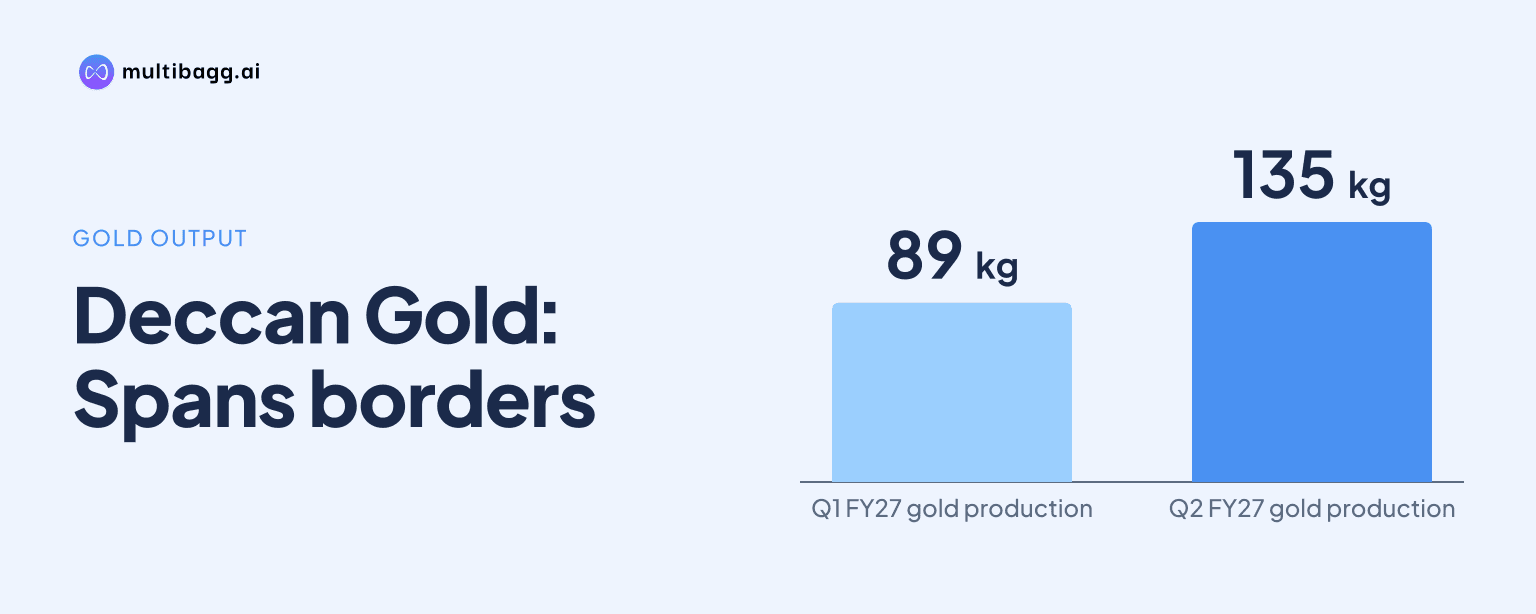
Deccan Gold Mines says production now spans India and Kyrgyzstan after Swarnagiri produced 135 kg in Q2 FY27, up 52% from 89 kg in Q1, and Altyn Tor reached production in September 2026 after first doré was produced on 5 August 2026.
Know Deccan Gold Mines inside out
Results, valuation, peers and who's buying, in one view.
How has Deccan Gold’s business model changed?
Deccan Gold says it has changed from an India-focused, primarily exploration-led and gold-centric company into a platform spanning gold and critical minerals, Indian and overseas jurisdictions, and exploration and production. The company was established in 2003 as a specialised gold exploration and development platform, before Swarnagiri entered production in July 2026.
The second stated inflection point was Altyn Tor reaching production in September 2026. Deccan Gold now identifies producing gold assets in two countries while retaining exploration, resource-licence and legal-process exposure in Finland, Tanzania, Mozambique and India. Its stated objective is to build a pipeline of gold assets rather than depend on one mine or geography.
Which Deccan Gold assets are producing gold?
Deccan Gold identifies Swarnagiri Gold Mines in Andhra Pradesh and Altyn Tor in Kyrgyzstan as in production. Swarnagiri produced 135 kg of gold in Q2 FY27, compared with 89 kg in Q1 FY27, representing a 52% quarter-on-quarter increase as the operation ramped up.
Swarnagiri was the larger disclosed operating contributor during H1 FY27. Gold recovery was reported at 90% to 95%, in line with the company’s predictions; Q2 bullion sales were 50.4 kg, H1 FY27 bullion sales were 108.9 kg, and inventory included 133 kg of doré and bullion. Total inventory, including run-of-mine ore, gold-in-circuit, doré and bullion, was valued at Rs 134 crore.
Altyn Tor remains at an earlier production and commissioning stage than Swarnagiri. First gold doré was produced on 5 August 2026, and a 1.2 kg doré bar was dispatched for refining in November 2026. Deccan Gold plans to commission the leach circuit and tailings facility, complete a revised mine design and life-of-mine plan, undertake further drilling and progress towards full-scale production.
Where does Deccan Gold retain exploration exposure?
Deccan Gold’s disclosed gold pipeline spans India, Central Asia and Europe, although asset stages differ. Finland is classified as holding exploration and resource licences, Tanzania holds exploration licences, and Ganajur in Karnataka is subject to a legal process rather than being described as a producing asset.
Altyn Tor combines production with further resource work. Deccan Gold reported 5,671 kg of gold inventory, comprising 1,097 kg in stockpiles and 4,574 kg in in-situ resources, and said in-situ resources had increased 15%. The company plans drilling in 2027 to test deeper parts of the deposit and assess potential extensions for underground mining.
Mozambique is shown as holding exploration licences in Deccan Gold’s broader portfolio map, while Finland is specifically associated with the Syrjö-Kovela Gold Project. These licence areas are not at the same disclosed stage as Swarnagiri’s 135 kg of Q2 FY27 output or Altyn Tor’s August 2026 first doré production.
Got a follow-up? Ask IRIS
What operating evidence supports Deccan Gold’s stated shift?
Deccan Gold links its strategic shift to Swarnagiri’s output ramp-up and profit contribution in H1 FY27. It reported standalone profit at Swarnagiri of Rs 79.13 crore for the half year and Deccan Gold’s share of that profit at Rs 20.57 crore. Its Q2 share of Swarnagiri profit was Rs 13.91 crore, more than double the preceding quarter, according to the presentation.
Standalone total income rose to Rs 17.24 crore in Q2 FY27 from Rs 11.44 crore in Q1 FY27, while standalone net profit increased to Rs 6.51 crore from Rs 1.18 crore. Consolidated total income increased to Rs 2.44 crore in Q2 from Rs 0.60 crore in Q1, although the consolidated net loss was Rs 0.55 crore in Q2 and Rs 9.28 crore in H1 FY27.
For Swarnagiri’s next phase, Deccan Gold states an ambition to expand resources to more than 40 tonnes of gold and target about 90 kg per quarter. It also plans to seek approvals to increase production towards 1,000 kg a year and has a long-term ambition of more than 2 tonnes a year by 2029. These are company ambitions and approval-dependent plans, not reported production levels.
How do critical minerals fit Deccan Gold’s strategy?
Deccan Gold presents critical minerals as a new growth platform alongside gold, naming lithium, tantalum, nickel, copper, PEG, tungsten and tin in its current portfolio narrative. The presentation connects these minerals with electric vehicles, batteries, energy storage, electronics, defence and advanced manufacturing, but discloses no production volume, resource estimate or revenue for the critical-minerals portfolio.
The company says India’s mineral security will increasingly require domestic production and global resource access. That rationale sits alongside the July 2026 Swarnagiri production milestone and the September 2026 Altyn Tor production milestone, while the reported 135 kg Q2 FY27 operating output relates to gold.
Deccan Gold also disclosed a capital raise of more than Rs 137 crore approved by BSE through compulsorily convertible debentures, equity shares and equity warrants. Management said completion was expected within about 15 days and that proceeds would be deployed across exploration, project development and production expansion, without a country, mine or commodity allocation.
Conclusion
Deccan Gold’s stated transition rests on two defined production milestones: Swarnagiri produced 135 kg of gold in Q2 FY27 in India, and Altyn Tor produced first doré in Kyrgyzstan on 5 August 2026. Finland, Tanzania, Mozambique and Ganajur extend the geographic pipeline, but their disclosed stages remain exploration, licences or legal process rather than current production.
The next developments to watch are commissioning of Altyn Tor’s leach circuit and tailings facility, completion of its revised mine design and life-of-mine plan, and drilling scheduled for 2027. At Swarnagiri, progress towards approvals for production approaching 1,000 kg a year and the stated ambition of more than 2 tonnes a year by 2029 will show whether the production platform develops as management plans.