










Deepak targets 14%-15% Advanced Intermediates EBIT margin
Key highlights
- Deepak targets a 14%-15% Advanced Intermediates EBIT margin next year.
- Management expects Advanced Intermediates EBIT of Rs 400 crore to Rs 420 crore next year, versus about Rs 240 crore this year.
- Deepak expects FY28 to be a normalised year for commissioned Advanced Intermediates assets.
- Deepak guided to total four-year capital expenditure of Rs 11,700 crore, with the lion's share focused on polycarbonate.
powered by IRIS
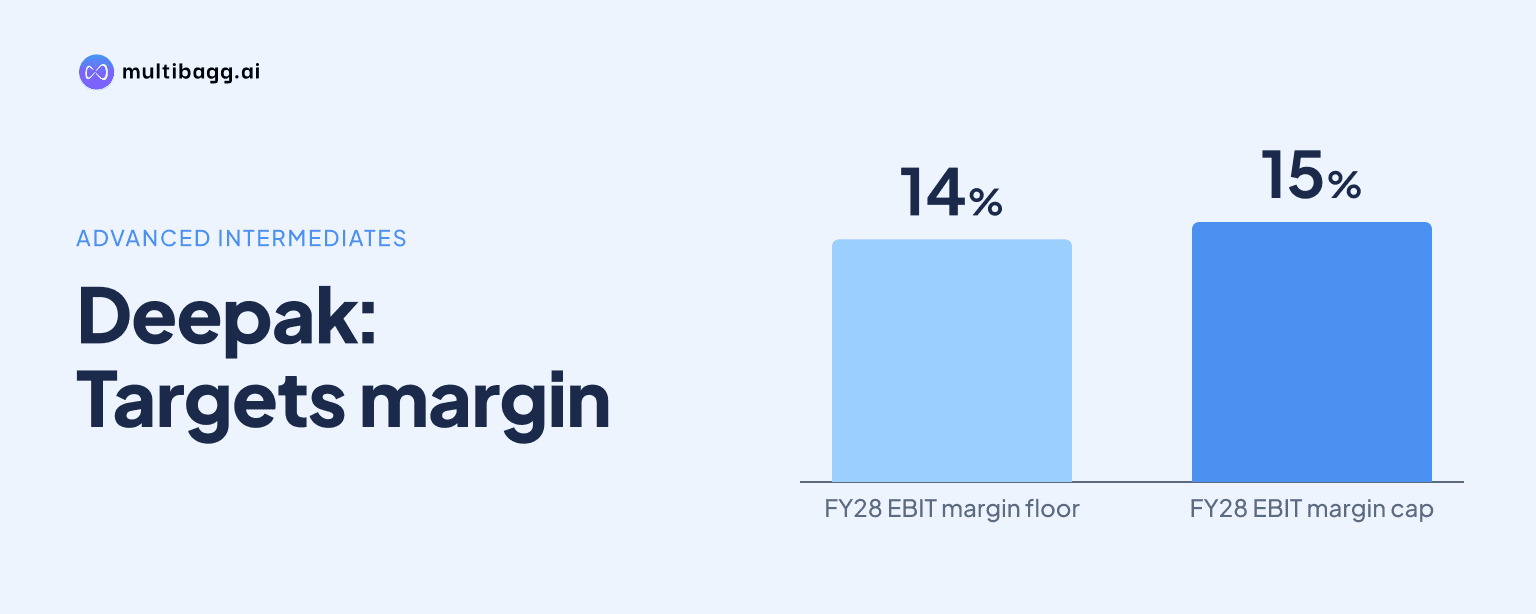
Deepak Nitrite targets a 14%-15% Advanced Intermediates EBIT margin next year, with management projecting segment EBIT of Rs 400 crore to Rs 420 crore as commissioned nitric acid, nitration, hydrogenation, fluorination and chlorination assets reach steady-state utilisation, compared with about Rs 240 crore expected this year.
Know Deepak Nitrite inside out
Results, valuation, peers and who's buying, in one view.
What EBIT margin is Deepak targeting in Advanced Intermediates?
Deepak is targeting an Advanced Intermediates earnings before interest and tax, or EBIT, margin of about 14% to 15% next year. Management linked the target to steady-state operation of the commissioned asset base, including nitric acid and downstream reaction facilities, rather than to a separate margin target for each new plant.
Management expects Advanced Intermediates EBIT to rise by about Rs 160 crore to Rs 180 crore next year from the stated Rs 240 crore level for this year. It also said it had visibility of roughly Rs 250 crore plus another Rs 250 crore at steady state from existing investments, while noting potential upside.
Management did not accept an analyst's calculation that the new capacity alone would necessarily earn an EBIT margin above 20%. It said the improvement would be balanced between the legacy product portfolio and new commissioned assets, making the 14%-15% target a blended segment objective.
Which plants will contribute to Deepak's EBIT increase?
Deepak expects the nitric acid, nitration, chlorination, photochlorination, hydrogenation and fluorination assets to underpin the Advanced Intermediates earnings increase. Management said the nitric acid plant, chlorination, photochlorination, hydrogenation and fluorination facilities had been commissioned, while its steady-state calculation also included nitration capacity.
Some agrochemical applications are connected to customers' annual procurement contracts and campaign schedules. However, management said the assets were engineered for multiple reactions and products, which can broaden the available customer and application base. It said the fluorination plant can handle aromatic and pyridine fluorination, with comparable flexibility in chlorination, photochlorination and specialty-chemical assets.
The end-market mix spans agrochemicals, electronics, solvents and personal care. Management identified agrochemical customers for certain chlorination and fluorination products, electronic chemicals for specialty capacity, and polyamide-related products for some hydrogenation and alcohol-condensation applications. It also cited skin-care and hair-care products among expanded personal-care applications.
How will contracts change Advanced Intermediates volatility?
Deepak expects a larger portion of incremental Advanced Intermediates business to be contractual, formula-linked and subject to cost pass-through clauses. Management confirmed those mechanisms when asked whether the additional EBIT from the commissioned capacities would be less volatile in absolute terms.
Management said it was already in customer discussions and, in many cases, had started supplying trial volumes from commercial assets after testing. It did not disclose the proportion of segment revenue or EBIT that will ultimately be covered by formula-linked contracts, so the scale of any reduction in earnings volatility cannot be quantified from the call.
The timing of sales conversion can still vary by customer. Management said annualised procurement agreements in agrochemicals follow campaign runs, meaning asset commissioning may precede full commercial absorption. The multiple-product design of fluorination, chlorination and specialty assets is intended to provide alternative applications when individual customer campaigns are not running.
Got a follow-up? Ask IRIS
When will Advanced Intermediates reach normal utilisation?
Deepak expects FY28 to be a normalised year for Advanced Intermediates, with all commissioned assets operating at relatively optimised utilisation. Management made that assessment while discussing ongoing customer negotiations and the expected ramp-up in trial and commercial supplies.
The nearer-term progression is expected to be gradual. Management said third-quarter EBIT percentage should fall between the first and second quarters, closer to the first quarter, while absolute EBIT should rise substantially from the third and fourth quarters as added assets contribute. It expects fourth-quarter EBIT percentage to be better than the third quarter.
Management also said certain assets had demonstrated more than 100% capacity utilisation from September onward. It did not identify those plants in that response, so this should not be treated as a segment-wide utilisation measure. The relevant target remains relatively optimised utilisation across the full commissioned Advanced Intermediates base in FY28.
What investment follows Deepak's Advanced Intermediates ramp-up?
Deepak said the lion's share of future investment will move to the integrated polycarbonate facility, while Advanced Intermediates spending will be marginal and focused mainly on debottlenecking. Management also referred to one or two fresh cases, including an anhydrous hydrogen fluoride, or AHF, and ultra-pure DHF plant in a separate entity.
Deepak will buy AHF from that separate entity for captive consumption, while the separate entity plans to sell into solar and electronics applications. Management said the entity is not a Deepak subsidiary. That arrangement could provide AHF supply to Deepak, but the proposed plant is not described as an Advanced Intermediates asset within Deepak.
For the wider programme, management guided to a further Rs 800 crore to Rs 900 crore of cash-flow capital expenditure in the second half after about Rs 700 crore in the first half. It indicated Rs 2,200 crore to Rs 2,400 crore next year, Rs 2,500 crore in FY2028-29 and Rs 2,500 crore to Rs 3,000 crore in the third year, for total four-year capital expenditure of Rs 11,700 crore.
Conclusion
Deepak's Advanced Intermediates plan combines a higher blended EBIT margin with a substantial rise in absolute earnings. Management's Rs 400 crore to Rs 420 crore EBIT target next year, versus about Rs 240 crore this year, depends on utilisation of newly commissioned multipurpose plants, legacy portfolio improvement and formula-linked customer contracts.
The next indicators are the conversion of trial supply into customer orders, third- and fourth-quarter EBIT progression, and the FY28 normalisation management expects. Management also plans to shift most subsequent capital spending toward the polycarbonate facility, while retaining limited Advanced Intermediates spending for debottlenecking and selected additions.