










Deepak Nitrite targets FY31 polycarbonate utilisation after FY30 start
Key highlights
- Deepak targets optimal polycarbonate utilisation in FY31 after expected FY30 commissioning.
- Management put four-year integrated-project capital expenditure at Rs 11,700 crore.
- Deepak expects Rs 2,200 crore to Rs 2,400 crore of cash spending in the following year.
- India imported more than 2 lakh tonnes of polycarbonate resin in the prior year, management said.
powered by IRIS
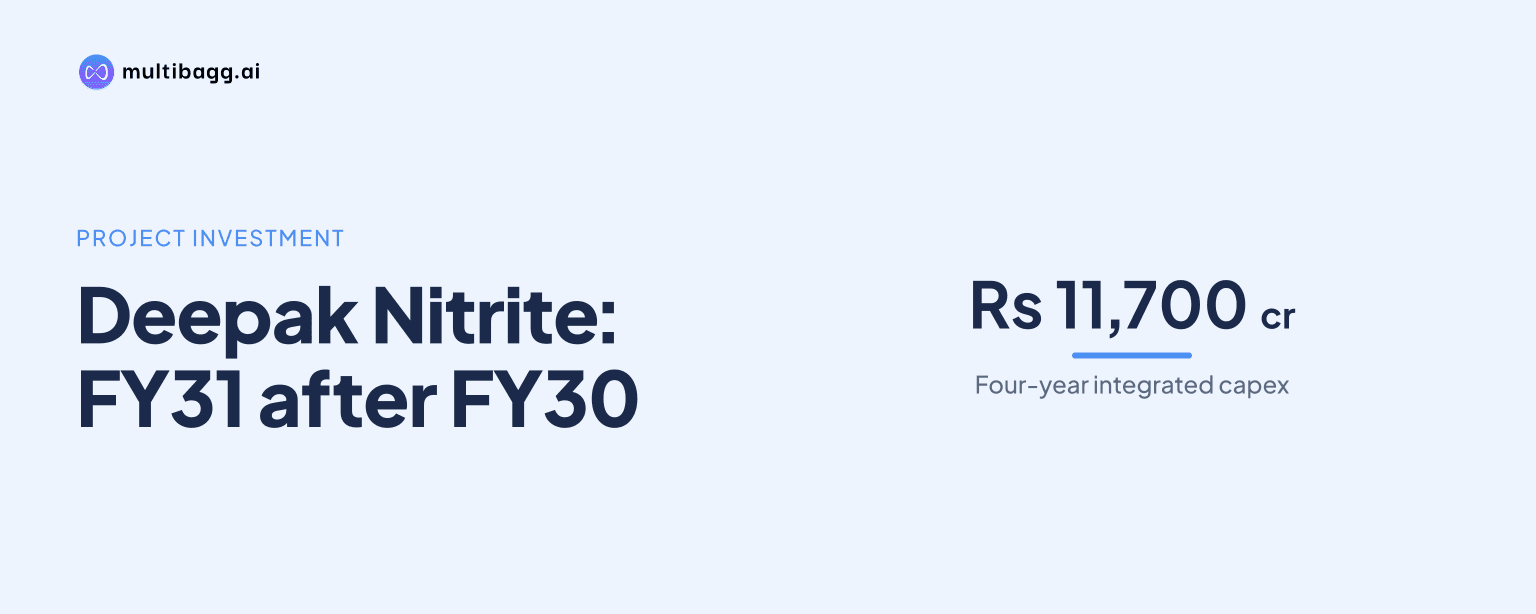
Deepak Nitrite said its polycarbonate operation should be optimally utilised by FY31 after the integrated asset’s expected FY30 commissioning, supported initially by bought-out intermediates and later by upstream integration. Management put total capital expenditure across four years at Rs 11,700 crore and said bank funding would begin after the equity requirement is substantially met.
Know Deepak Nitrite inside out
Results, valuation, peers and who's buying, in one view.
When will Deepak reach optimal polycarbonate utilisation?
Deepak expects polycarbonate to be optimally utilised in FY31, while the integrated asset is expected to be commissioned in FY30. Management said the resin operation should be close to optimal utilisation by the time upstream integration is completed, rather than waiting for the full value chain to become operational before building market volumes.
The initial model is designed to use bought-out intermediates before internal upstream supply is available. After integration, management expects the chain to include phenol, acetone, Bisphenol A, or BPA, and polycarbonate resin, with the upstream phenol, acetone and BPA facilities ramping in “extremely short order” because Deepak will be their consumer.
This sequencing separates the launch of resin sales from the completion of backward integration. Management said India imported more than 2 lakh tonnes of polycarbonate resin in the prior year and that imports are now higher, identifying an existing resin market while Deepak expands its downstream compounding business.
How will bought-out intermediates support the FY30-to-FY31 ramp-up?
Deepak plans to sell polycarbonate resin using bought-out intermediates before upstream integration is completed, then shift the economics to an integrated chain. Management said the current compounding operation is a pilot asset focused on approvals across end applications, especially electronics, mobility and defence, where acceptance cycles can take longer.
The approvals concern compounds rather than base resin. Management said resin already enters India through imports exceeding 2 lakh tonnes in the prior year, whereas compounds need validation for different performance properties and applications. Deepak said it has approvals in electronic-grade applications, some mobility applications and defence applications.
Management said the priority is the number of approved applications rather than pilot tonnes, which can range from 100 tonnes to 10,000 tonnes depending on a product and customer. It added that India’s defence market could be substantially larger 18 months later, although it did not provide a quantified demand forecast for polycarbonate compounds.
Deepak also plans to expand compounding capacity alongside customer approvals. Management said it already has compounding capacity and can expand it at short notice, enabling sales of both resin and compounds. It said compounds command a higher price than resin, but did not disclose expected compound volumes, margins or the planned expanded capacity.
What is Deepak’s Rs 11,700 crore spending schedule?
Deepak’s total capital expenditure across four years is Rs 11,700 crore, management said in response to a question on cash-flow spending. The disclosed annual ranges show expenditure rising after the current year, but management did not separately allocate the Rs 11,700 crore between polycarbonate resin, upstream units, compounding and site infrastructure.
Management said about Rs 50 crore of required equity remained to be injected, meaning equity funding was more or less complete. It said bank funding would then start and that financing had already been tied up with banks. The call did not disclose the debt amount, interest cost, repayment schedule or project-return expectations.
The spending timetable overlaps with the targeted FY30 commissioning and FY31 utilisation milestones. That means the project’s stated ramp-up has two elements: selling resin during the bought-out-intermediate phase and bringing upstream production and compounding capacity into operation. Management did not provide a monthly commissioning date or a nameplate polycarbonate resin capacity.
Got a follow-up? Ask IRIS
Which polycarbonate markets is Deepak developing first?
Deepak is developing electronics, mobility and defence applications first for polycarbonate compounds. Management said these segments were prioritised because the associated approvals can have long cycles, allowing the company to build validations before the full-scale resin plant starts operating in FY30.
The compound strategy differs from the broader resin opportunity. Management intends to sell resin into an Indian market that imported more than 2 lakh tonnes in the previous year, while compounds will be sold for applications requiring specific properties. The company said capacity additions in compounding would be made in line with approvals rather than to a disclosed fixed schedule.
The integrated project also retains options for merchant sales at intermediate stages. Management said Deepak could participate in markets for cumene, phenol, acetone, BPA and polycarbonate resin. It indicated that the new capacity could supply up to 100 KTPA, or kilotonnes per annum, of phenol to the market, though this could change with the pace of polycarbonate expansion.
Management subsequently described potential new phenol supply as about 80 KTPA to 100 KTPA. The range reflects the choice between merchant phenol sales and captive consumption for BPA and polycarbonate. The eventual split has not been fixed because it depends on how quickly Deepak expands polycarbonate production.
What could affect Deepak’s polycarbonate ramp-up?
Deepak’s FY31 target depends on upstream integration being completed and compound validations becoming commercial sales. Management identified imported resin volumes above 2 lakh tonnes in the prior year as a market opportunity, but did not disclose its expected polycarbonate output, market share, FY30 utilisation or the share of revenue expected from compounds.
Feedstock availability is another operating consideration raised elsewhere on the call. Management said volumes in the reported period were roughly the same as the prior year despite additional capacity headroom, because feedstock availability was limited and procurement required non-traditional sources. That observation related to the existing business, not the planned polycarbonate chain.
Deepak’s existing acetone downstream operations illustrate the importance of integrated economics. Management said its ability to consume acetone internally is about 60% to 65% of production, including a reasonable estimate of downstream capacity, while operating choices between acetone, isopropyl alcohol, methyl isobutyl ketone and methyl isobutyl carbinol depend on profitability across the chain.
For the new project, management said it would be able to place products at every stage, from cumene through polycarbonate resin. This flexibility may support different sales mixes, but it also leaves unresolved how much phenol and acetone will be sold externally rather than consumed in BPA and polycarbonate production once the FY30 asset is commissioned.
Conclusion
Deepak’s plan is a phased polycarbonate build-out: FY30 is the expected commissioning point, bought-out intermediates are intended to support initial resin sales, and FY31 is management’s target for optimal utilisation. The Rs 11,700 crore programme combines resin production with upstream phenol, acetone and BPA integration, while compounding approvals are being developed in electronics, mobility and defence.
The next disclosed milestones are Rs 800 crore to Rs 900 crore of further second-half spending, Rs 2,200 crore to Rs 2,400 crore planned for the following year, and the start of bank funding after roughly Rs 50 crore of remaining equity. Management’s FY30 commissioning timeline, the expansion of compounding capacity alongside approvals, and the eventual merchant-versus-captive phenol mix will determine the path to the FY31 target.