










Deepak Nitrite Phenolics EBIT Beats Prior Annual Record
Key highlights
- Deepak Nitrite’s Phenolics EBIT reached Rs 933 crore in H1 FY27, above the previous FY22 annual record of Rs 867 crore.
- Phenolics Q2 FY27 revenue was Rs 2,291 crore, up 29% sequentially and 72% year on year.
- Phenolics Q2 FY27 EBIT was Rs 515 crore with an EBIT margin of about 22%.
- Advanced Intermediates Q2 FY27 EBIT was Rs 49 crore, down from Rs 67 crore in Q1 FY27.
powered by IRIS
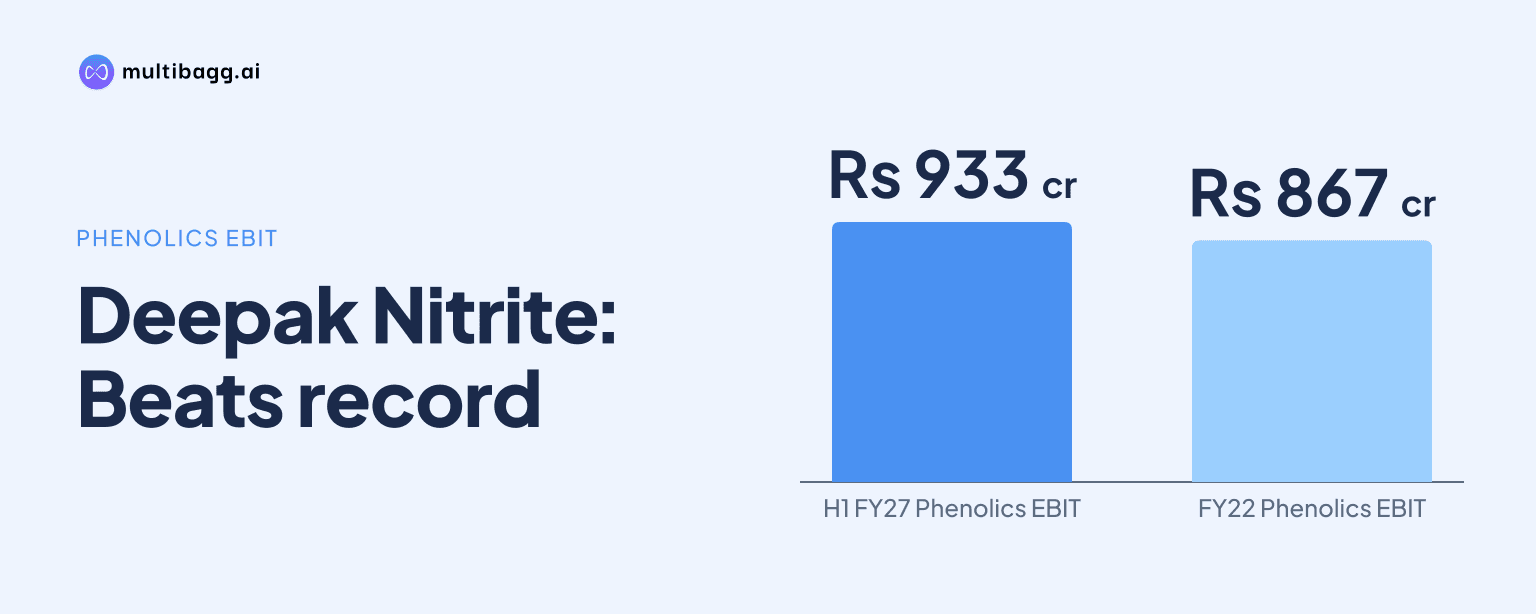
Deepak Nitrite Limited’s Phenolics segment reported EBIT of Rs 933 crore in the six months ended September 30, 2026, exceeding its previous full-year high of Rs 867 crore in FY22. Management attributed the result to high capacity utilisation, favourable domestic realisations and procurement efficiencies amid disrupted imports and higher landed costs.
Know Deepak Nitrite inside out
Results, valuation, peers and who's buying, in one view.
What did Deepak Nitrite’s Phenolics segment earn in H1 FY27?
Deepak Nitrite’s Phenolics segment earned Rs 933 crore of earnings before interest and tax, or EBIT, in H1 FY27, surpassing its prior annual record by Rs 66 crore. The earlier record of Rs 867 crore was reported for FY22, meaning the segment exceeded that level within the first six months of FY27 rather than over a full financial year.
The segment generated revenue of Rs 4,066 crore in H1 FY27. Management did not disclose a corresponding H1 FY26 Phenolics revenue or EBIT figure in the call, but said the H1 result was supported by healthy capacity utilisation, domestic product realisations and more effective feedstock procurement. The result formed part of group H1 revenue of Rs 5,682 crore and group EBITDA, or earnings before interest, tax, depreciation and amortisation, of Rs 1,197 crore.
The Q2 FY27 contribution was Rs 515 crore of EBIT on Rs 2,291 crore of revenue. Quarterly revenue increased 29% sequentially and 72% year on year, while EBIT rose 23% quarter on quarter. The stated EBIT margin was about 22%, showing that the record half-year outcome included a higher-profit second quarter rather than only a volume-led increase.
Why did Deepak Nitrite’s Phenolics EBIT rise so sharply?
Deepak Nitrite said Phenolics benefited from disrupted international supply chains, higher landed costs on imports and firm domestic demand in Q2 FY27. These market conditions improved the setting for domestic supply, while management said its teams procured critical feedstocks proactively, kept operating rates consistently high and maintained customer deliveries.
Several Phenolics assets operated at or above rated capacity during Q2 FY27, according to management. The company linked this to its domestic manufacturing footprint, integrated operations and large-scale production base. It also said that product spreads remain subject to market conditions, so the reported Rs 933 crore H1 EBIT reflected both market economics and operating actions rather than a stated permanent pricing outcome.
Availability of propylene was disturbed during the latest six months, and Deepak Nitrite said it sometimes bought from non-traditional sources at higher prices to sustain market presence. Management said Phenolics came close to its approximately 4 lakh-tonne annual volume capability in Q2 FY27, but did not say the plant ran consistently at that level; it described utilisation as below, though not significantly below, that rate.
How did Phenolics compare with Deepak Nitrite’s other businesses?
Phenolics was Deepak Nitrite’s principal driver of Q2 FY27 performance, while Advanced Intermediates delivered lower sequential profitability. Phenolics recorded Rs 2,291 crore of Q2 revenue and Rs 515 crore of EBIT, compared with Advanced Intermediates revenue of Rs 811 crore and EBIT of Rs 49 crore.
Advanced Intermediates’ Q2 EBIT fell from Rs 67 crore in Q1 FY27 to Rs 49 crore, and its EBIT margin was 6%. Management attributed the moderation to input prices, variations in customer volumes, duties, logistics and freight rates. By contrast, the same supply-chain and import conditions that weighed on parts of Advanced Intermediates were described as favourable for Phenolics.
For H1 FY27, Advanced Intermediates reported revenue of Rs 1,615 crore and EBIT of Rs 116 crore, with EBIT doubling year on year. The segment’s revenue was less than half of Phenolics’ Rs 4,066 crore, while its H1 EBIT was Rs 817 crore lower. Management said customers had imported sodium nitrite and nitroaromatics in July, reducing utilisation at some plants, but reported that customers had subsequently returned to Deepak Nitrite as a preferred supplier.
Got a follow-up? Ask IRIS
Can Deepak Nitrite maintain Phenolics throughput and margins?
Deepak Nitrite said its priority is to sustain high Phenolics throughput, increase downstream value addition and grow wallet share, but it did not provide an EBIT or margin target. Management expects winter months to support throughput and said raw-material cost management and product placement should support profitability in Q3 FY27.
The company has an integrated phenol-acetone chain and produces isopropyl alcohol, or IPA, through an acid route rather than the propylene route used by some global producers. Management said disruption in propylene supply could therefore affect other producers more than Deepak Nitrite. IPA was run at about 100% utilisation, although management said it optimises the integrated platform among acetone, IPA and newly commissioned methyl isobutyl ketone, or MIBK, and methyl isobutyl carbinol, or MIBC.
On local competition, management said it did not expect significant disruption from increased domestic manufacturing. It argued that higher freight, insurance costs, delayed imports and currency depreciation can favour local supply, while a wider Indian manufacturing base could stimulate phenol, acetone and derivatives consumption. This was management’s view, not a volume or pricing forecast for the industry.
What expansion plans could affect Deepak Nitrite’s next results?
Deepak Nitrite is debottlenecking Phenolics and pursuing downstream integration, while also ramping new assets in other businesses. During Q2 FY27, Deepak Chemtech commissioned chlorination assets, alongside photochlorination and specialty chemicals facilities at Dahej, with capital investment of about Rs 300 crore including utilities and infrastructure.
Management said those assets are expected to add revenue, improve utilisation and create operating efficiencies as customer requirements become commercial volumes. It also said the nitric acid facility was being ramped up and MIBK, MIBC and derivatives were being commercialised and scaled up. For Advanced Intermediates, management expects Q3 EBIT percentage to be between Q1 and Q2 levels, closer to Q1, and said Q4 percentage should be better than Q3.
The integrated polycarbonate project is progressing at Dahej, with dismantling and relocation activities in Germany under way. Deepak Nitrite is also conducting customer qualifications for polycarbonate compounds across multiple applications. These are execution-stage activities, and management did not disclose a commissioning date, revenue contribution or capital amount for the polycarbonate project on this call.
Conclusion
The central result is that Phenolics delivered Rs 933 crore of EBIT in H1 FY27, Rs 66 crore above Deepak Nitrite’s previous full-year peak in FY22. The segment’s Rs 515 crore Q2 EBIT and about 22% quarterly margin were supported by high utilisation, domestic realisations, procurement actions and import disruption, while Advanced Intermediates’ Q2 EBIT declined to Rs 49 crore from Rs 67 crore in Q1.
Next, investors will watch whether Phenolics sustains throughput through Q3 FY27 as winter conditions and feedstock management develop, and whether the Rs 300 crore Dahej chlorination, photochlorination and specialty-assets programme begins adding commercial volumes. Management also expects Advanced Intermediates’ Q4 EBIT percentage to improve from Q3, while polycarbonate customer qualifications and project execution remain unresolved milestones.