










Delhi Discoms report Rs 16,202.90 crore LPSC difference
Key highlights
- Delhi Discoms disclosed a Rs 16,202.90 crore difference in recognised and claimed LPSC at September 30, 2026.
- APTEL directed regulatory-asset liquidation from June 16, 2026, but Supreme Court status quo has remained in place since July 2026.
- The Supreme Court directed Delhi Discoms in May 2016 to pay 70% of current dues until further orders.
- The August 2025 Supreme Court judgment recorded that 18% LPSC rates were compared with bank lending rates of 6%-7%.
powered by IRIS
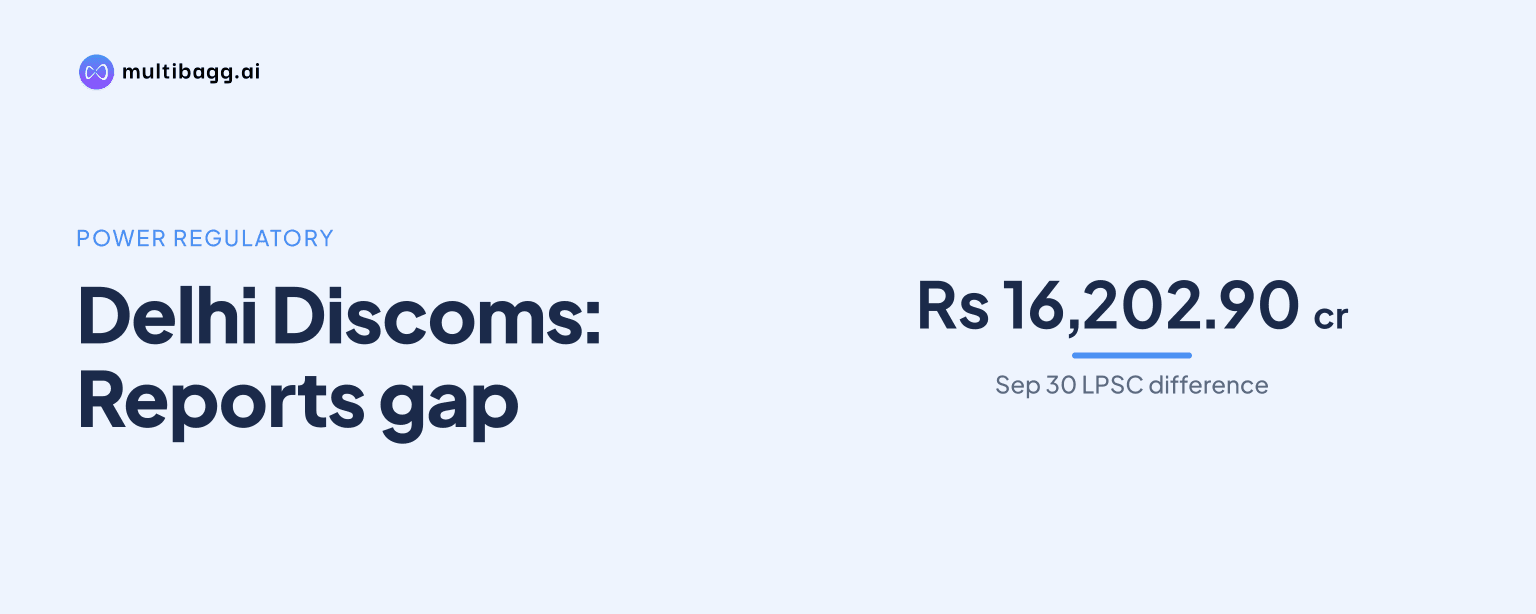
BSES Rajdhani Power Ltd. and BSES Yamuna Power Ltd., together called Delhi Discoms, reported a Rs 16,202.90 crore difference at September 30, 2026 between late-payment surcharge recognised in their accounts and amounts claimed by some power utilities, while Supreme Court status-quo orders continued to prevent regulatory-asset liquidation.
Know Reliance Infrastructure inside out
Results, valuation, peers and who's buying, in one view.
What is the Rs 16,202.90 crore LPSC difference at Delhi Discoms?
The Rs 16,202.90 crore figure is the difference at September 30, 2026 between late-payment surcharge, or LPSC, recognised by Delhi Discoms and LPSC claimed by some power generators and transmission companies. The disclosure does not state the separate amount booked by Delhi Discoms or the separate aggregate amount sought by the utilities.
Delhi Discoms said power utilities can levy LPSC for delayed payments under regulations of the Central Electricity Regulatory Commission, or CERC, and the Delhi Electricity Regulatory Commission, or DERC, together with power purchase agreements, or PPAs, and bulk power transmission agreements, or BPTAs. The difference reflects competing interpretations of those regulations and contracts, applicable laws, Ministry of Power advisories and rules, court orders, and reconciliation or agreed terms with individual utilities.
Delhi Discoms attributed the payment delays to financial constraints that they said were beyond their reasonable control. The stated causes include creation and non-liquidation of regulatory assets, non-implementation of superior-court judgments and tariffs that Delhi Discoms said were not cost reflective. The LPSC calculation also remains subject to petitions before various forums as of September 30, 2026.
Delhi Discoms said they recognised LPSC on a prudent and conservative basis, using the accounting assessment that a financial liability should be measured at the amount more likely than not to be settled. They said the exact obligation depends on uncertain future events that are not wholly within their control, rather than on a disclosed final settlement or judicially determined surcharge amount.
Why is regulatory-asset liquidation stayed for Delhi Discoms?
Regulatory-asset liquidation remains stayed because the Supreme Court ordered status quo on all aspects on July 3, 2026 in DERC's civil appeal against appellate directions. On July 15, 2026, the Court recorded the parties' consent to extend that status quo until an appropriate bench is constituted.
The Appellate Tribunal for Electricity, or APTEL, had ruled on April 20, 2026 that a Comptroller and Auditor General audit was not legally permissible and directed appointment of a chartered accountant firm. It also instructed DERC to begin liquidation from June 1, 2026. After dismissing DERC's review petitions on May 27, 2026, APTEL directed that liquidation commence from June 16, 2026.
The matter was listed on October 28, 2026 but was not taken up because the special bench did not assemble, according to the disclosure. The Government of the National Capital Territory of Delhi also filed a civil appeal on July 14, 2026 challenging the April 20 and May 27 orders. The next hearing date was awaited when Delhi Discoms made the disclosure.
The Supreme Court's August 6, 2025 regulatory-assets judgment had prompted APTEL to begin suo motu monitoring of implementation. The judgment also called for strict and intensive audit of the circumstances in which Delhi Discoms continued to operate without recovering regulatory assets. Delhi Discoms said their auditors included the issue as an emphasis-of-matter item in the limited review report.
Got a follow-up? Ask IRIS
How have Supreme Court payment orders affected Delhi Discoms?
Supreme Court orders have imposed interim payment requirements on Delhi Discoms while the underlying disputes have continued since 2014. Power utilities issued notices on February 1, 2014 for regulation or suspension of supply because of delayed power-purchase payments, after which Delhi Discoms sought protection and directions on tariff recovery and adjustment of mutual dues.
In interim orders dated March 26, 2014 and May 6, 2014, the Supreme Court directed Delhi Discoms to pay current dues from March 1, 2014, relating to billing beginning January 1, 2014. In contempt proceedings brought by Delhi utilities, the Court directed Delhi Discoms on May 12, 2016 to pay 70% of current dues until further orders.
A September 28, 2022 Supreme Court order required parties to maintain status quo following communications warning of supply regulation and requiring letters of credit. Delhi Discoms' writ petitions and pending applications were disposed of on August 6, 2025, but civil appeals linked to the March 2014 order and contempt petitions linked to the May 2016 order remained pending.
The August 6, 2025 judgment recorded the Ministry of Power's December 12, 2022 affidavit that LPSC rates of 18% set by various state commissions were “usurious” compared with bank lending rates of 6%-7%. The Court observed that LPSC should be linked to bank lending rates to make it reasonable and described the disproportionate growth and long pendency of regulatory assets as a regulatory failure affecting consumers.
Which LPSC proceedings remain unresolved for Delhi Discoms?
The accounting, rate and reconciliation issues surrounding LPSC remain unresolved before DERC and APTEL. In April 2024, Delhi utilities filed petitions before DERC seeking, among other relief, recasting of Delhi Discoms' accounts to recognise LPSC under applicable DERC regulations.
Delhi Discoms argued that the requested account recasting would breach the September 28, 2022 Supreme Court status-quo order and fall outside DERC's jurisdiction. Delhi power generators IPGCL and PPCL subsequently said they were no longer pressing the account-recasting relief, focusing instead on reconciliation and the applicable LPSC rate.
Delhi Discoms said they were willing to accept reconciliation strictly under Clause 6.8 of the PPAs and relevant BPTA clauses. The related applications were listed on June 3, 2025, when DERC reserved orders. On October 9, 2026, counsel for IPGCL and PPCL sought a rehearing after a change in DERC's composition, leaving the proceedings sub judice.
Separately, DERC dismissed Delhi Discoms' review petition on June 5, 2025 because the LPSC issue was pending before the Supreme Court. Delhi Discoms appealed that order to APTEL. They also said they made several settlement proposals on power-purchase overdues to Delhi utilities, but those proposals had not fructified by the September 30, 2026 reporting date.
Conclusion
The Rs 16,202.90 crore difference shows that Delhi Discoms' recognised LPSC liability and the claims made by some power utilities remain materially apart as of September 30, 2026. The difference is tied to delayed payments, unrecovered regulatory assets, tariff issues, competing readings of regulations and contracts, and pending reconciliation proceedings rather than a disclosed final amount payable.
The next matter to watch is the constitution of the appropriate Supreme Court bench and the hearing date for appeals filed by DERC and the Government of the National Capital Territory of Delhi. Those appeals have preserved the July 2026 status quo and prevented the June 16, 2026 regulatory-asset liquidation start directed by APTEL.