










Reliance Infrastructure reports ₹7,043 crore September income
Key highlights
- Reliance Infrastructure reported ₹7,043.30 crore in consolidated total income for the quarter ended September 30, 2026.
- Quarterly total income was ₹733.82 crore higher than ₹6,309.48 crore in the corresponding 2025 quarter.
- Half-year consolidated total income stood at ₹13,451.73 crore as of September 30, 2026.
- The board approved the results on November 13, 2026, while auditors cited evidence limitations involving Odisha discoms, unlisted entities and MMOPL.
powered by IRIS
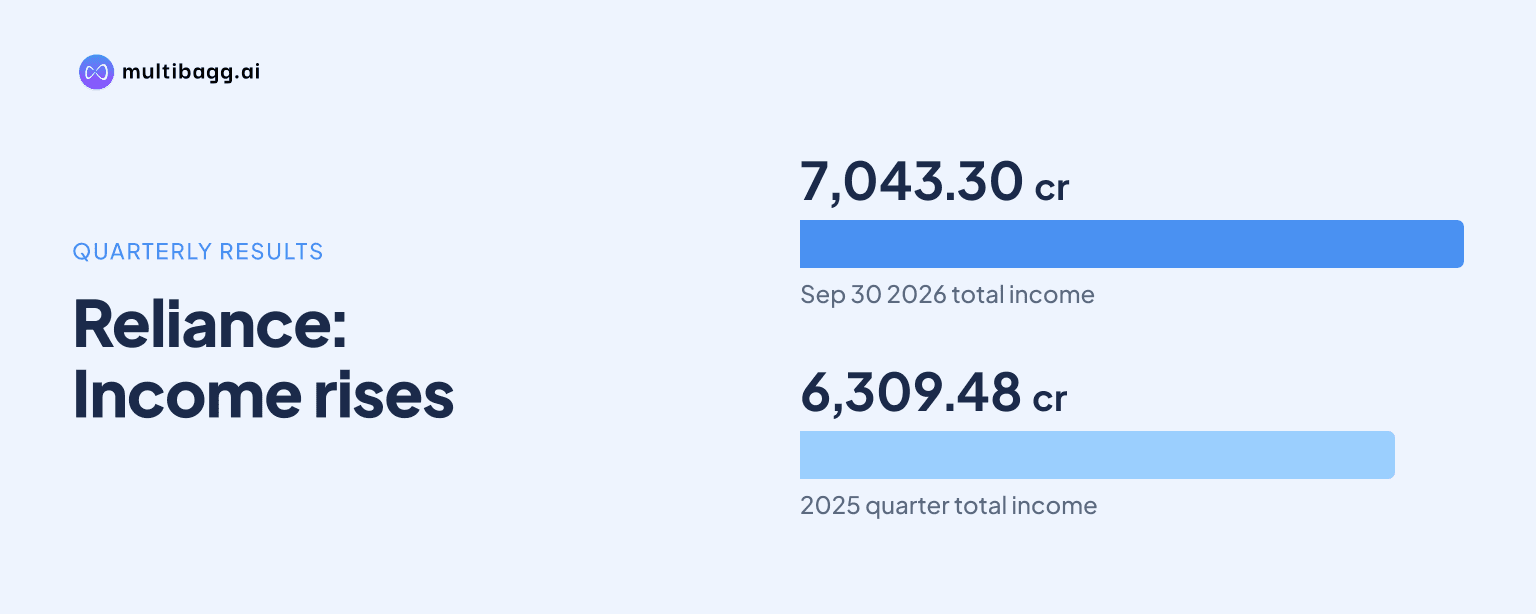
Reliance Infrastructure Limited reported consolidated total income of ₹7,043.30 crore for the quarter ended September 30, 2026, compared with ₹6,309.48 crore a year earlier, while its auditors said they could not obtain sufficient appropriate evidence to provide a conclusion on the results because of significant identified uncertainties.
Know Reliance Infrastructure inside out
Results, valuation, peers and who's buying, in one view.
What did Reliance Infrastructure report for the September 2026 period?
Reliance Infrastructure reported consolidated total income of ₹7,043.30 crore for the quarter ended September 30, 2026, and ₹13,451.73 crore for the half year ended on that date. The quarterly income figure was ₹733.82 crore higher than the ₹6,309.48 crore reported for the corresponding quarter a year earlier.
The company disclosed the unaudited consolidated financial results after its Board of Directors approved them at a meeting held on November 13, 2026. The results cover the quarter and half year ended September 30, 2026, and were accompanied by the independent auditors' limited review reports.
The information provided does not specify the company's consolidated net profit or loss for the September 2026 quarter. It also does not provide a detailed split of income by business, project, subsidiary or geography. The reported income figures therefore offer a view of the group's scale of operations during the period but do not, by themselves, establish changes in profitability.
Why did the auditors highlight uncertainties in the results?
The independent auditors highlighted that they were unable to obtain sufficient appropriate evidence to provide a conclusion on the consolidated financial results. The matters cited include recoverability of economic rights in Odisha discoms and unlisted entities, legal proceedings involving multiple regulatory agencies, and the modified review conclusion of subsidiary Mumbai Metro One Private Limited.
The regulatory bodies named in the disclosure are the Enforcement Directorate, Central Bureau of Investigation, Securities and Exchange Board of India and Serious Fraud Investigation Office. The stated issue is not simply the existence of proceedings, but the auditors' inability to obtain evidence sufficient for a review conclusion in relation to the matters identified.
The auditors also referred to the modified review conclusion associated with Mumbai Metro One Private Limited, or MMOPL. A modified conclusion in a subsidiary's review can be relevant to a parent's consolidated reporting because the subsidiary's financial information is included in the group results.
The disclosure does not quantify the possible financial effect of these matters on Reliance Infrastructure's assets, liabilities, income or cash flows. It also does not state that the matters have been resolved. Investors assessing the results will therefore need to consider both the reported income and the limitations described in the review report.
How did the board process unfold before the results announcement?
Reliance Infrastructure had informed the exchanges on November 6, 2026 that its board would meet on November 13 to consider the unaudited standalone and consolidated results for the quarter and half year ended September 30, 2026. The meeting agenda also included consideration of raising long-term resources.
The company had said designated persons would face a trading-window closure from October 1, 2026 until 48 hours after the meeting outcome. Such a closure is a routine governance measure intended to restrict trading by specified persons while unpublished price-sensitive information is being considered.
On November 13, the board approved the financial results. The material provided confirms the approval of the results but does not confirm a decision to raise long-term resources at that meeting, nor does it disclose the amount, instrument or terms of any new fundraising proposal.
This distinction is important because an agenda item does not itself amount to a completed financing transaction. The available information supports that fundraising was under consideration, while the approved financial results are the confirmed board outcome described in the disclosure.
Got a follow-up? Ask IRIS
What is the context from Reliance Infrastructure's previous September results?
Reliance Infrastructure's reported ₹6,309.48 crore total income in the September 2025 quarter provides the direct comparison base for the latest quarterly figure. In that earlier period, the company reported consolidated net profit of ₹1,911.19 crore, compared with ₹4,082.53 crore in the September 2024 quarter, according to the historical information provided.
The September 2025 results were approved by the board on November 11, 2025. At that meeting, the company approved seeking shareholder authorisation to issue foreign currency convertible bonds, or FCCBs, of up to US$600 million, subject to required approvals.
The prior-year data also showed consolidated net worth of ₹16,921 crore as of September 30, 2025, compared with ₹14,855 crore as of June 30, 2025. These figures are historical and should not be treated as September 2026 balance-sheet data, because the current disclosure supplied does not provide an updated net-worth figure.
The earlier period illustrates that income and profit can move differently. While September 2025 income was lower than the preceding year's figure cited in the historical report, the current 2026 release provides only income figures and no current-period profit number in the material available.
What does the disclosure mean for investors and operations?
For investors, the immediate positive data point is the increase in quarterly total income to ₹7,043.30 crore from ₹6,309.48 crore. But the limited review report is equally material because it identifies evidence limitations related to economic rights, unlisted entities, regulatory proceedings and MMOPL's modified review conclusion.
The release does not provide a share-price reaction, order-book update, project-operating data, customer impact or guidance. It also does not quantify the recoverability issues highlighted by the auditors. As a result, any assessment of the company's financial position based solely on the income increase would be incomplete.
For the infrastructure business, recoverability of rights and financial positions in investee entities can affect the valuation and accounting treatment of group assets. The disclosure establishes that these are areas requiring audit evidence, rather than establishing a final financial outcome from them.
The proposed consideration of long-term resources is another relevant item for market participants. However, the supplied material does not say that a fresh capital-raising plan was approved on November 13, 2026. The confirmed facts remain the board's approval of results and the auditors' stated review limitations.
Conclusion
Reliance Infrastructure's September 2026 disclosure combines a year-on-year rise in quarterly consolidated total income with significant qualifications around the evidence available to its independent auditors. Total income reached ₹7,043.30 crore for the quarter and ₹13,451.73 crore for the half year, but the available release does not disclose current-period profit or quantify the effect of the issues identified in the review report.
The next point to watch is whether Reliance Infrastructure provides further disclosures on the recoverability of economic rights in Odisha discoms and unlisted entities, the regulatory proceedings, and MMOPL's modified review conclusion. Investors can also monitor whether the board's consideration of long-term resource raising results in a specific proposal, instrument or approval request.