








Delta Autocorp shifts FY27 mix to Rs 80 crore two-wheelers
MAX Plan at ₹4,999/yr

Find your next multibaggerBe a Pro Investor
Research stocks and track your picks on the go. Download the app.
Key highlights
- Delta Autocorp targets about Rs 80 crore of two-wheeler revenue within its Rs 105 crore FY27 plan.
- New two-wheeler models are expected to contribute Rs 35 crore to Rs 40 crore in FY28.
- Delta Autocorp targets Rs 110 crore to Rs 120 crore of FY28 two-wheeler revenue and about Rs 15 crore from three-wheelers.
- Management plans to deploy about Rs 17 crore toward new-product development.
powered by IRIS
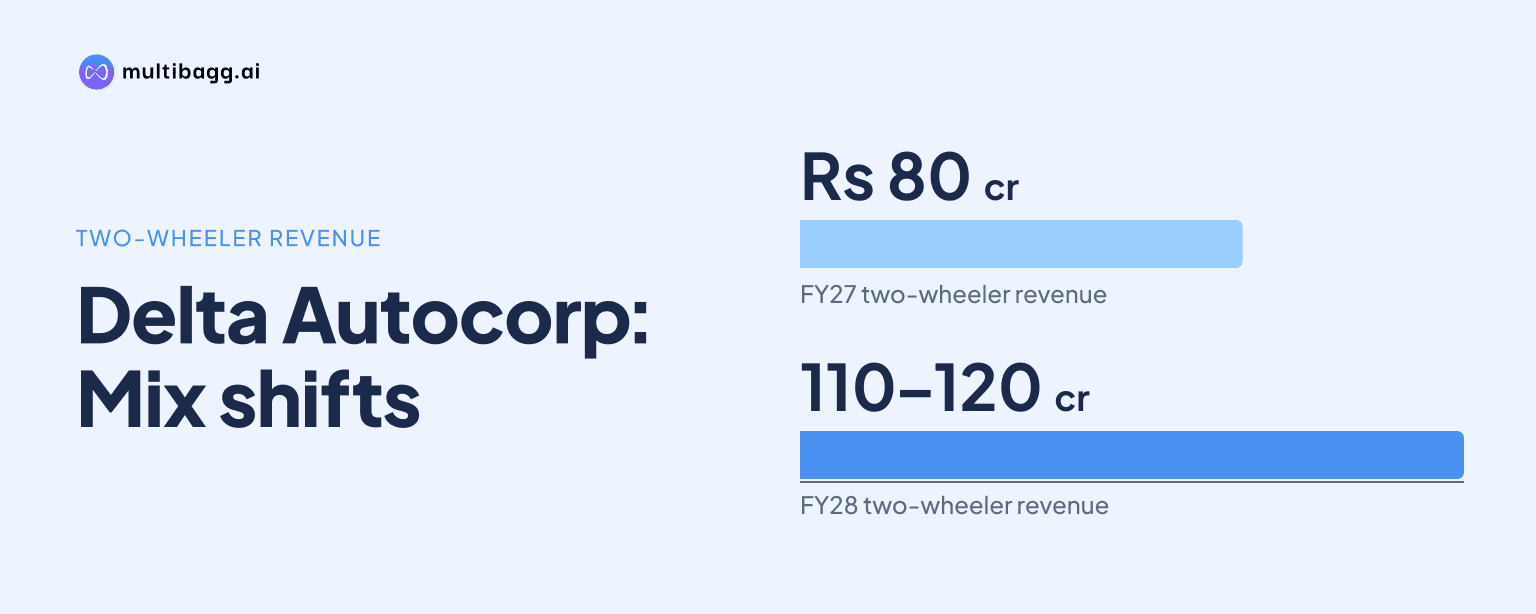
Delta Autocorp is targeting Rs 80 crore of two-wheeler revenue in FY27 within its Rs 105 crore company revenue plan, after management said two-wheelers outperformed its expectations while three-wheelers did not. For FY28, management expects Rs 35 crore to Rs 40 crore of two-wheeler revenue to come from new models.
Know Delta Autocorp inside out
Results, valuation, peers and who's buying, in one view.
How has Delta Autocorp changed its FY27 revenue mix?
Delta Autocorp has shifted its FY27 growth plan toward two-wheelers, which management expects to contribute about Rs 80 crore of the Rs 105 crore revenue target. Business-to-government, or B2G, revenue is expected to add Rs 20 crore to Rs 21 crore, while white-label work for original equipment manufacturers, spares and three-wheeler sales together are expected to contribute Rs 4 crore to Rs 5 crore.
The revised mix differs from the FY27 framework cited by an analyst from the end of FY26: Rs 60 crore from two-wheelers, Rs 20 crore from government business, Rs 15 crore from three-wheelers and Rs 10 crore from spares. Management said two-wheelers had performed better than envisaged, while three-wheelers had not met expectations.
The comparison is not fully like-for-like because the revised Rs 4 crore to Rs 5 crore category also includes white-label work. Still, it shows that the two-wheeler expectation rose by Rs 20 crore while the planned contribution from three-wheelers and related residual businesses was materially reduced.
Why did Delta Autocorp reduce its three-wheeler expectations?
Delta Autocorp reduced its near-term three-wheeler expectations because government and institutional orders that contributed in the first half of the prior year did not recur at the same level, while the broader L3 three-wheeler market declined across most players, according to management. The updated FY27 plan assigns only Rs 4 crore to Rs 5 crore to three-wheelers, spares and white-label revenue combined.
Management said it is shifting attention toward L5 vehicles, having introduced the Deltic Express passenger vehicle and Deltic Airavat cargo vehicle. It said initial response had been good, but creating a market for the new products would take time; management is also planning a dedicated three-wheeler sales team and additional L5 models in the next financial year.
For FY28, management is targeting about Rs 15 crore of three-wheeler revenue. That would be higher than the Rs 4 crore to Rs 5 crore FY27 residual category, but remains well below the Rs 110 crore to Rs 120 crore FY28 two-wheeler target, indicating that management does not expect three-wheelers to be the main growth driver next year.
B2G execution remains part of the FY27 plan. Delta Autocorp said it delivered 83 vehicles in the first half of FY27 under a tender and had received a work order and advance payment for the remaining 240 vehicles, which it expects to complete in the second half; management described that 240-vehicle order book as worth about Rs 8 crore.
What will Delta Autocorp's new models contribute in FY28?
Delta Autocorp expects new two-wheeler models to generate Rs 35 crore to Rs 40 crore in FY28, equal to about 30% to 35% of its Rs 110 crore to Rs 120 crore two-wheeler revenue target. Management therefore expects products not yet contributing to carry roughly one-third of FY28 two-wheeler sales.
Management said a line of products should begin reaching the market from the fourth quarter of FY27. It identified SS01 as a flagship model under development and said it intends for the product to help it move from a mid-tier to a top-tier company, but the transcript gives no launch volume, selling price, production-capacity or order-commitment details.
The FY28 two-wheeler target implies an increase of Rs 30 crore to Rs 40 crore from the Rs 80 crore FY27 target. At the lower end, the Rs 35 crore new-model contribution would exceed the Rs 30 crore increase in the overall two-wheeler target, making continued sales from existing products relevant to the plan.
Management said first-half FY27 revenue had already exceeded the roughly Rs 40 crore achieved in the full preceding financial year, and said revenue grew 207% in the first half from the comparable prior period. It attributed the percentage growth partly to a small base and said the Rs 110 crore to Rs 120 crore FY28 two-wheeler goal was a level it was confident of achieving.
Got a follow-up? Ask IRIS
Why are scooters central to Delta Autocorp's revised plan?
Delta Autocorp said scooters generate an earnings before interest, tax, depreciation and amortisation, or EBITDA, margin of about 14% to 15%, compared with about 11% to 12% for both L3 and L5 three-wheelers. The transcript does not provide reported segment revenue or segment profit, but management's margin comparison aligns with the greater two-wheeler weight in its FY27 and FY28 plans.
Management said it had reduced scooter cost of goods sold, or COGS, by about 4% to 5% through value engineering after a 5% to 6% price correction. It then raised scooter prices by about 4% to 5% in the second half as raw-material costs increased, saying the increase would not raise EBITDA because material costs had risen proportionately.
At company level, management said COGS was 72% in the current year against 71.1% in the previous year, while transportation costs declined by about 3% to 4%. It attributed the transport-cost change to the prior year's delivery of 1,443 government vehicles to remote locations and said the higher two-wheeler volume share supported first-half profitability.
Six COCO outlets generated about Rs 35 lakh of average monthly revenue during the first six months of FY27, management said. Three older outlets generated about Rs 11 lakh to Rs 12 lakh each monthly, versus Rs 2 lakh to Rs 3 lakh for three newer outlets that started in the second quarter of FY27, producing a blended Rs 6 lakh to Rs 7 lakh per outlet.
How is Delta Autocorp funding its product roadmap?
Delta Autocorp plans to deploy about Rs 17 crore toward new-product development, including engineering, tooling, mould development, testing, validation, homologation and product refinement. Management expects a further Rs 3.5 crore to Rs 4 crore of deployment in the second half of FY27 and around Rs 7 crore to Rs 9 crore in the next financial year as products reach mould-development stages.
Management said the next-year spending would cover development for plastic parts, lights and chassis. It said funds were being deployed in line with the objects of its initial public offering and development milestones, while marketing investment was also under consideration; it did not disclose a marketing budget, timing or channel plan.
The explanation followed an investor's question about approximately Rs 44 crore of cash on the books. Management did not announce an acquisition, strategic alliance or external funding plan, saying it was not actively looking for alliances with major original equipment manufacturers, although it remained open to discussions if an opportunity emerged.
Conclusion
Delta Autocorp has retained its Rs 105 crore FY27 revenue target but materially changed the intended mix. Two-wheelers are now expected to provide about Rs 80 crore, supported by higher scooter volumes and a stated 14% to 15% EBITDA margin, while three-wheelers, spares and white-label work have been reduced to a combined Rs 4 crore to Rs 5 crore expectation.
The next disclosed milestones are product launches from the fourth quarter of FY27, completion of the remaining 240 tender vehicles in the second half of FY27, and Rs 3.5 crore to Rs 4 crore of further product-development spending in that half. Management's FY28 framework also depends on Rs 35 crore to Rs 40 crore from new two-wheeler models and about Rs 15 crore from the three-wheeler business.

