








Delta Autocorp’s H1 margin rose as institutional three-wheeler sales fell
MAX Plan at ₹4,999/yr

Find your next multibaggerBe a Pro Investor
Research stocks and track your picks on the go. Download the app.
Key highlights
- Delta Autocorp reported H1 FY27 revenue from operations of Rs 44.09 crore, up 4.9% from Rs 42.05 crore.
- Electric two-wheeler volume rose 207% to 9,636 units in H1 FY27 from 3,135 units a year earlier.
- Operating EBITDA rose 48.6% to Rs 5.05 crore and operating EBITDA margin reached 11.45% from 8.08%.
- Trade receivables declined approximately 60% to Rs 4.93 crore as of September 30, 2026.
powered by IRIS
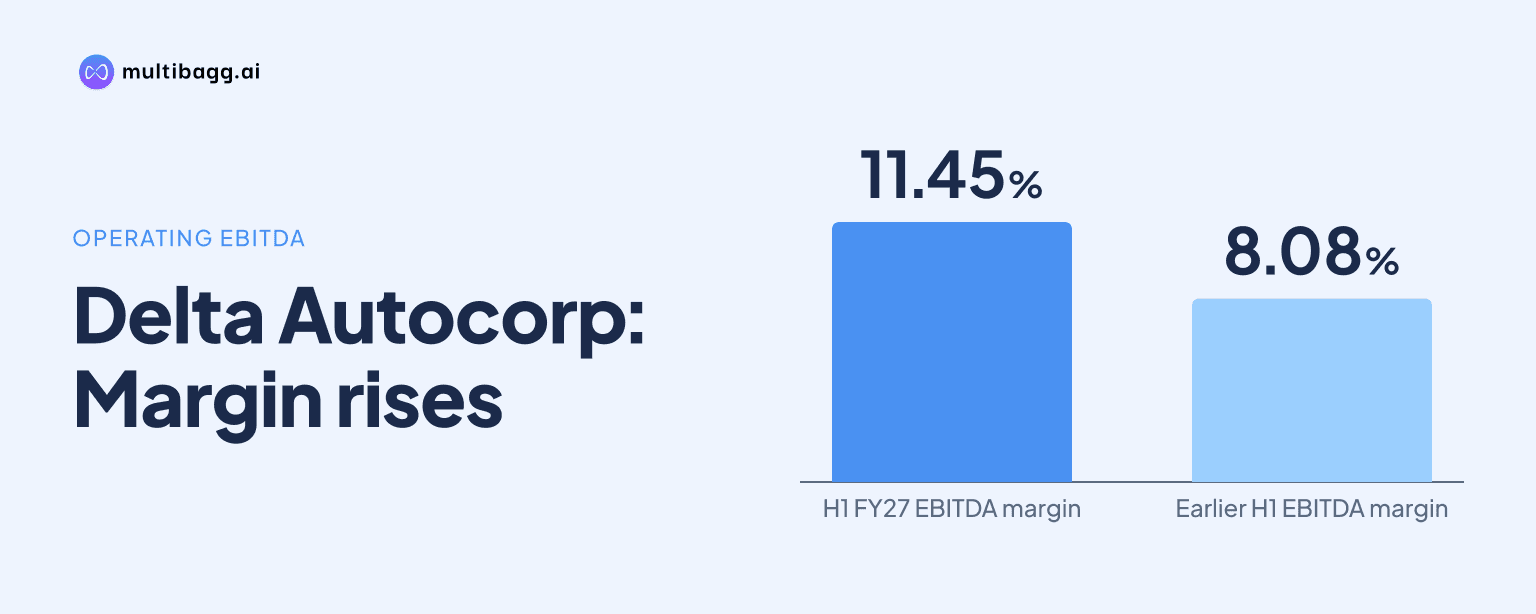
Delta Autocorp Limited raised its operating EBITDA margin to 11.45% in H1 FY27 from 8.08% a year earlier, while revenue rose 4.9% to Rs 44.09 crore as electric two-wheeler volume increased 207% but institutional three-wheeler deliveries were significantly lower than the prior-year period.
Know Delta Autocorp inside out
Results, valuation, peers and who's buying, in one view.
Why did Delta Autocorp’s revenue grow only 4.9% despite higher scooter volumes?
Delta Autocorp’s revenue growth was limited because H1 FY26 included an institutional supply of 1,443 three-wheelers, while institutional deliveries were significantly lower in H1 FY27. Revenue from operations was Rs 44.09 crore in the six months ended September 30, 2026, compared with Rs 42.05 crore in H1 FY26. The lower institutional contribution changed the business mix despite growth in electric two-wheelers.
Electric two-wheeler volume rose to 9,636 units in H1 FY27 from 3,135 units in H1 FY26, an increase of approximately 207%. Management said it is shifting its focus from primary sales to dealers towards retail throughput, consumer demand and dealer conversions. The company is seeking to improve sales productivity at its existing dealer network rather than focus only on expanding dealer numbers.
The three-wheeler market is also moving gradually from the L3 category towards L5 passenger, cargo and municipal applications, according to management. Delta Autocorp said it is preparing for that transition through its Express and Airavat offerings. This product shift comes after the 1,443-unit institutional supply made the prior-year half a high comparison base.
How did Delta Autocorp improve profitability in H1 FY27?
Delta Autocorp improved profitability through operating efficiencies, cost management and financial discipline, according to management. Operating EBITDA, or earnings before interest, tax, depreciation and amortisation, increased 48.6% to Rs 5.05 crore in H1 FY27 from Rs 3.40 crore in H1 FY26. The operating EBITDA margin rose by 337 basis points to 11.45% from 8.08%.
Profit before tax increased 27.1% to Rs 5.80 crore, while profit after tax rose 26.9% to Rs 4.33 crore. Earnings per share increased to Rs 2.83 in H1 FY27 from Rs 2.23 in H1 FY26. Management said profit after tax for the half was broadly in line with its planned trajectory, despite moderate revenue growth.
Trade receivables fell to Rs 4.93 crore as of September 30, 2026, from Rs 12.46 crore at the end of FY26, a reduction of approximately 60%. Delta Autocorp generated positive operating cash flow of Rs 7.75 crore during H1 FY27, reported net worth of Rs 84.15 crore and borrowings of Rs 1.35 crore. Management linked the receivables movement and cash flow to collections and working-capital management.
What is Delta Autocorp doing to improve scooter retail sales?
Delta Autocorp is seeking to improve electric-scooter retail sales through dealer support, local activation and tighter dealer selection after selling 9,636 electric two-wheelers in H1 FY27. Management said it is working with dealers on sales, finance, marketing, service, lead generation and customer conversion. The stated aim is to create consumer demand and make dealer businesses sustainable.
The company said it is becoming more selective while onboarding dealers, with emphasis on their financial capability, market understanding and ability to operate a sustainable business. Marketing activities have also been brought in-house to improve control over communication, creative quality and execution speed. Management cited regional camps, local marketing, digital visibility and influencer initiatives as components of demand generation.
Delta Autocorp also operates six company-owned and company-operated outlets, two directly and four through subsidiary Electrofine Motors Private Limited. Those six outlets generated approximately Rs 2.06 crore of sales in H1 FY27, compared with approximately Rs 0.37 crore in H1 FY26. Management is working towards 12 to 15 such locations by the end of March 2027, subject to location readiness and commercial viability.
Got a follow-up? Ask IRIS
How is Delta Autocorp addressing the L5 three-wheeler market?
Delta Autocorp is addressing the L5 market with its Express and Airavat products and a confirmed institutional order for 240 L5 electric three-wheelers. Management said the 240-vehicle order is scheduled for execution in H2 FY27. It described initial responses to the new L5 offerings as encouraging, without giving a value for the order.
The scheduled 240-unit H2 FY27 order is smaller than the 1,443 institutional three-wheelers supplied in H1 FY26, although the deliveries relate to different half-year periods. Management said it wants to build dealer-led three-wheeler business alongside institutional and government opportunities, reducing dependence on any single sales channel or segment.
Management said it will remain selective about institutional business and prioritise commercial viability rather than pursue turnover at the expense of profitability. It also said Delta Autocorp would wait for consistent L5 demand and volumes before committing significant capital to dedicated paint and fabrication facilities. That plan leaves the pace of manufacturing investment dependent on product demand.
Can Delta Autocorp meet its FY27 revenue objective?
Delta Autocorp needs a substantially higher H2 FY27 to achieve management’s revenue objective of approximately Rs 105 crore for FY27. With H1 FY27 revenue from operations of Rs 44.09 crore, the implied remaining revenue is approximately Rs 60.91 crore. Management said significant execution is required to meet the objective.
Management identified continued dealer-business growth, stronger dealer productivity, new product launches and institutional-commercial execution as the intended H2 drivers. The company is targeting phased commercial introductions of Lido, Jetster, Crossberg, Vagator and Legion GT from Q4 FY27, subject to production readiness, validation and dealer preparedness. The scheduled execution of 240 L5 three-wheelers is also part of that plan.
Delta Autocorp is targeting the prototyping stage for its SS01 flagship scooter in Q1 FY28. Management said it has created a product-development studio near its office, strengthened engineering resources and is pursuing greater component and engineering standardisation across suitable models. It said standardisation should support sourcing, quality control, development costs and after-sales support, but provided no financial estimate.
Conclusion
Delta Autocorp’s H1 FY27 performance reflects a material shift in sales mix. Electric two-wheeler volume increased 207% to 9,636 units, but the absence of a comparable institutional three-wheeler delivery to the 1,443 units supplied in H1 FY26 held revenue growth to 4.9%. Meanwhile, operating EBITDA rose 48.6% to Rs 5.05 crore, profit after tax rose 26.9% to Rs 4.33 crore and receivables declined to Rs 4.93 crore.
The next disclosures to watch are execution of the 240-unit L5 three-wheeler order in H2 FY27, phased scooter launches from Q4 FY27 and progress towards the 12 to 15 company-owned and company-operated outlet target by March 2027. Management’s approximately Rs 105 crore FY27 revenue objective also depends on stronger second-half dealer sales, new-model introductions and commercial-business execution.

