










Dhabriya Plywood investment outflow exceeded operating cash
Key highlights
- Dhabriya Plywood reported Rs 14.88 crore of operating cash flow and Rs 36.51 crore of investing outflow in H1 FY27.
- Total borrowings rose Rs 24.57 crore in six months to Rs 101.05 crore at September 2026.
- Non-current borrowings more than doubled to Rs 50.81 crore at September 2026 from Rs 24.80 crore at March 2026.
- H1 FY27 profit after tax rose 27.6% year on year to Rs 18.06 crore.
powered by IRIS
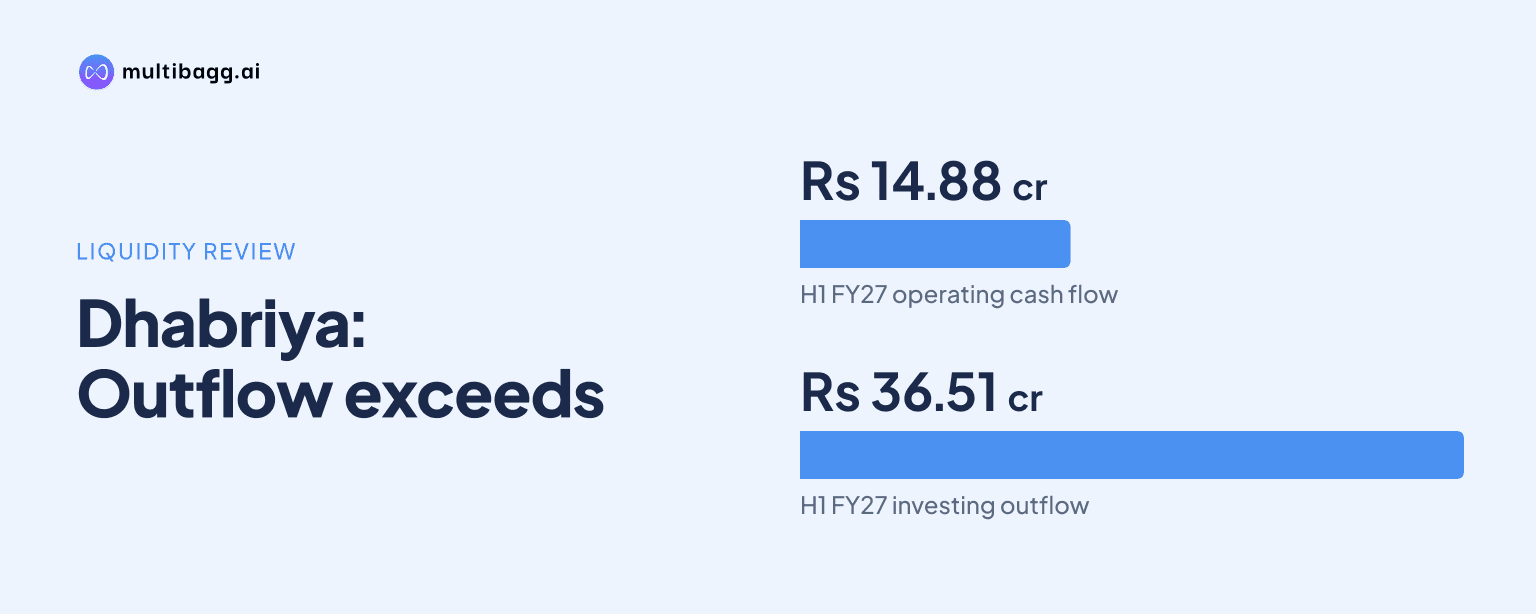
Dhabriya Plywood Limited’s investment outflow exceeded operating cash generation in H1 FY27: cash flow from investing activities was Rs 36.51 crore, against Rs 14.88 crore of net operating cash flow, while total borrowings reached Rs 101.05 crore at September 2026, even as profit after tax rose to Rs 18.06 crore.
Know Dhabriya Polywood inside out
Results, valuation, peers and who's buying, in one view.
Why is Dhabriya Plywood’s cash flow under pressure?
Dhabriya Plywood’s cash flow is under pressure because investing activity and working-capital absorption exceeded operating cash generation in H1 FY27. Net cash from operating activities was Rs 14.88 crore at September 2026, while investing cash flow was an outflow of Rs 36.51 crore. Financing cash flow provided Rs 21.65 crore, and cash and cash equivalents remained broadly unchanged at Rs 6.46 crore from Rs 6.43 crore at March 2026.
The operating cash figure was reduced by a Rs 12.93 crore working-capital outflow in H1 FY27. Operating profit before working-capital changes was Rs 32.39 crore, while cash generated from operations was Rs 19.46 crore before direct taxes paid of Rs 4.58 crore. Profit before tax was Rs 24.34 crore, showing that working-capital movements reduced cash available for investment and financing.
Working-capital requirements rose with the balance sheet. Inventory increased by Rs 12.86 crore in the six months to Rs 82.27 crore, trade receivables increased by Rs 5.49 crore to Rs 37.28 crore, and other current assets rose by Rs 3.11 crore to Rs 11.66 crore. Dhabriya Plywood reported working-capital turnover of 4.5 times in H1 FY27, down from 4.9 times in FY26.
How much has Dhabriya Plywood invested in assets?
Dhabriya Plywood increased property, plant and equipment to Rs 117.18 crore at September 2026 from Rs 88.42 crore at March 2026. Capital work-in-progress also rose to Rs 8.94 crore from Rs 6.33 crore over the same six months. The combined Rs 31.36 crore increase in these two asset lines accompanied the Rs 36.51 crore investing cash outflow, although the presentation does not give an investing-cash-flow breakdown.
The pace of investment had already increased in FY26. Property, plant and equipment rose by Rs 11.01 crore from Rs 77.41 crore at March 2025 to Rs 88.42 crore at March 2026, while capital work-in-progress increased by Rs 6.00 crore to Rs 6.33 crore. Investing outflow was Rs 26.16 crore in FY26, compared with Rs 11.59 crore in FY25; the H1 FY27 outflow was higher than the FY26 full-year amount.
Total non-current assets reached Rs 138.64 crore at September 2026, up Rs 33.08 crore from Rs 105.56 crore at March 2026. Non-current loans increased by Rs 1.61 crore to Rs 9.86 crore. Total assets rose to Rs 280.52 crore from Rs 225.55 crore, reflecting increases in both non-current and current assets.
Got a follow-up? Ask IRIS
How has Dhabriya Plywood funded the cash gap?
Dhabriya Plywood funded part of the gap through financing inflows and higher non-current borrowings. Total borrowings were Rs 101.05 crore at September 2026, comprising Rs 50.81 crore of non-current borrowings and Rs 50.24 crore of current borrowings. This was Rs 24.57 crore above Rs 76.48 crore at March 2026, when non-current borrowings were Rs 24.80 crore and current borrowings were Rs 51.68 crore.
The debt composition changed more than the total borrowing figure. Non-current borrowings increased by Rs 26.02 crore in six months, more than doubling from Rs 24.80 crore, while current borrowings declined by Rs 1.44 crore. Financing cash flow was a Rs 21.65 crore inflow in H1 FY27, following a Rs 16.93 crore inflow in FY26 and an Rs 4.87 crore outflow in FY25. The presentation does not identify lenders, repayment schedules or interest rates.
Equity also increased without a change in share capital. Total equity rose by Rs 18.06 crore to Rs 147.66 crore at September 2026, while equity share capital remained Rs 10.82 crore. Other equity was Rs 136.84 crore, compared with Rs 118.78 crore at March 2026. Total current liabilities increased by Rs 10.54 crore to Rs 76.51 crore.
Are Dhabriya Plywood’s profits still growing?
Dhabriya Plywood’s profits and operating earnings grew in H1 FY27 despite the higher cash requirement. Revenue from operations rose 13.2% year on year to Rs 146.10 crore from Rs 129.08 crore. Earnings before interest, tax, depreciation and amortisation, or EBITDA, increased 23.5% to Rs 32.14 crore, while profit after tax increased 27.6% to Rs 18.06 crore from Rs 14.15 crore.
Margins improved from H1 FY26. EBITDA margin was 22.0%, up 180 basis points from 20.2%, while profit-after-tax margin increased 140 basis points to 12.4%. Gross profit rose 15.2% to Rs 75.46 crore and gross margin reached 51.7%, compared with 50.8% a year earlier. Finance cost was Rs 2.92 crore, compared with Rs 2.86 crore in H1 FY26.
What should Dhabriya Plywood investors monitor in the balance sheet?
Dhabriya Plywood investors should monitor whether operating cash flow grows sufficiently to meet investing and working-capital needs without further comparable borrowing growth. At September 2026, inventory of Rs 82.27 crore was the largest current-asset balance, followed by receivables of Rs 37.28 crore and cash of Rs 6.46 crore. Working-capital turnover declined from 7.2 times in FY24 to 4.5 times in H1 FY27.
Investors should also track the relationship between the larger asset base, earnings and finance cost. Property, plant and equipment plus capital work-in-progress totalled Rs 126.12 crore at September 2026. Return on capital employed, or ROCE, was reported at 24.0% in H1 FY27 against 25.7% in FY26, while return on equity, or ROE, was 26.1% against 26.3%.
Conclusion
Dhabriya Plywood reported rising revenue, margins and profit in H1 FY27, but investment and working-capital needs consumed more cash than operations generated. Operating cash flow of Rs 14.88 crore did not cover investing outflow of Rs 36.51 crore, while financing inflow of Rs 21.65 crore coincided with total borrowings rising to Rs 101.05 crore. The increase was concentrated in non-current borrowings, which reached Rs 50.81 crore.
The next reporting period will show whether the September 2026 asset additions produce higher operating cash generation. Dhabriya Plywood disclosed no capital-expenditure target, borrowing-repayment schedule or investment completion date. The unresolved items to monitor are inventory and receivable movements, working-capital turnover, investing cash outflow, financing cash flow and non-current borrowings relative to operating cash flow.