










Dhampur Bio Organics Limited proposes Rs 50 crore buyback
Key highlights
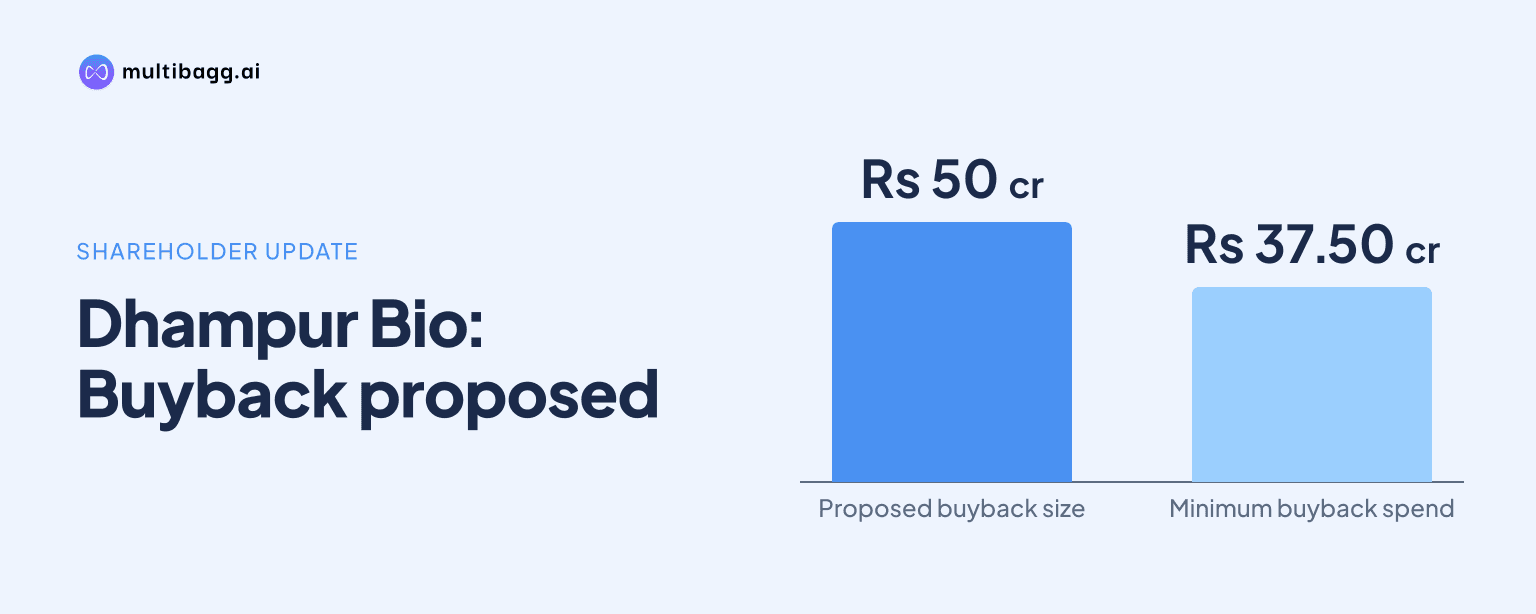
- Dhampur Bio Organics proposed an open-market buyback of up to Rs 50 crore at a maximum Rs 200 per share.
- The proposal indicates 25 lakh shares, or 3.76% of paid-up equity capital, if purchases occur at Rs 200 per share.
- Dhampur Bio Organics must use at least Rs 37.50 crore, equal to 75% of the Rs 50 crore buyback size.
- Promoters and the promoter group held 51.00% of equity shares before the proposal and cannot participate.
powered by IRIS
Dhampur Bio Organics Limited has proposed an open-market buyback of up to Rs 50 crore at a maximum price of Rs 200 per equity share, potentially covering 25 lakh shares or 3.76% of its paid-up equity capital. The November 14, 2026 board proposal requires shareholder approval through a special resolution before purchases can begin.
Know Dhampur Bio Organics inside out
Results, valuation, peers and who's buying, in one view.
What are Dhampur Bio Organics' proposed buyback terms?
Dhampur Bio Organics proposes to buy back fully paid equity shares with a face value of Rs 10 each for an aggregate amount not exceeding Rs 50 crore. Its board approved the proposal on November 14, 2026, through the open-market route on the stock exchanges where the shares are listed. The purchase price cannot exceed Rs 200 per share.
The Rs 50 crore maximum buyback size represents 13.76% of the aggregate of paid-up share capital and free reserves as at September 30, 2026. The company said this is below 15% of that aggregate, based on its interim condensed audited financial statements for the quarter and half year ended September 30, 2026. The maximum amount excludes transaction costs and taxes associated with the programme.
How many shares could Dhampur Bio Organics repurchase?
Dhampur Bio Organics could repurchase up to 25 lakh equity shares if it spends the full Rs 50 crore at the maximum price of Rs 200 per share. That indicative number represents 3.76% of the company’s total paid-up equity share capital as at September 30, 2026. The actual number and percentage bought back will be known only after completion.
If the market price is below Rs 200, Dhampur Bio Organics could buy more than 25 lakh shares while remaining within the Rs 50 crore spending ceiling. The filing therefore identifies 25 lakh shares as an estimate based on the maximum price, rather than a fixed upper limit on the number of shares. Any larger purchase volume remains subject to the Rs 50 crore maximum buyback size.
Dhampur Bio Organics must use at least 75% of the Rs 50 crore amount earmarked, setting a minimum buyback size of Rs 37.50 crore. At the maximum price of Rs 200 per share, that minimum utilisation would purchase 18.75 lakh shares. As with the maximum figure, the eventual minimum number of shares can be higher if purchases occur below Rs 200.
Who can sell shares in the Dhampur Bio Organics buyback?
Dhampur Bio Organics cannot buy shares from promoters, promoter-group members or persons in control under this open-market proposal. The company cited Regulation 16(ii) of the Securities and Exchange Board of India Buy-back of Securities Regulations, 2018 for this exclusion. Purchases are consequently directed at eligible non-promoter holders through stock exchanges.
Before the buyback, the promoter and promoter group held 33,858,475 equity shares, or 51.00% of the 66,387,590 total shares. Public shareholders held 31,754,732 shares, or 47.83%, and the Employee Benefit Trust held 774,383 shares, or 1.17%. The filing does not provide a post-buyback ownership pattern because it says this will be determined after the buyback is completed.
The announcement does not state how many shares an individual eligible shareholder may sell through the open-market mechanism. It also does not state the eventual purchase price below the Rs 200 ceiling. These outcomes will depend on the purchases made after the required approvals and the subsequent public announcement.
Got a follow-up? Ask IRIS
What approvals are still required for Dhampur Bio Organics' buyback?
Dhampur Bio Organics needs members to approve the buyback through a special resolution, along with all applicable statutory and regulatory approvals. The board’s November 14, 2026 approval therefore initiates the proposal but does not authorise immediate market purchases. The company said postal-ballot procedures, timelines and other details will be communicated in due course.
The board has authorised its Management Committee to undertake acts, deeds and matters it considers necessary in connection with the Rs 50 crore buyback. Dhampur Bio Organics also said it will issue a public announcement covering the process, timelines and statutory details in accordance with the buyback regulations. The filing does not give a postal-ballot date, a record date or a buyback commencement date.
The company separately identifies costs that are outside the Rs 50 crore maximum buyback size. These include brokerage, filing fees, advisory and intermediary fees, public-announcement publication costs, printing and dispatch expenses, buyback tax, securities transaction tax, goods and services tax, stamp duty and related incidental expenses. The stated Rs 37.50 crore minimum and Rs 50 crore maximum thus apply to shares purchased rather than total programme expenses.
What financial position accompanied Dhampur Bio Organics' proposal?
Dhampur Bio Organics reported total equity of Rs 1,077.99 crore as at September 30, 2026, compared with Rs 1,026.64 crore as at March 31, 2026. The company’s proposed Rs 50 crore maximum is a separate regulatory measure equal to 13.76% of paid-up capital and free reserves at September 30, 2026. The filing does not identify a specific funding source for the buyback.
Cash and cash equivalents stood at Rs 49.54 crore on September 30, 2026, against Rs 8.71 crore on March 31, 2026. Bank balances other than cash equivalents rose to Rs 73.35 crore from Rs 27.45 crore over the same period. The balance-sheet comparison reflects the company’s reported positions at two dates and does not establish how much cash will be used for the proposed buyback.
For the six months ended September 30, 2026, Dhampur Bio Organics reported Rs 305 crore in proceeds from the sale of an undertaking, while net cash generated from operating activities was Rs 723.01 crore. The company also reported Rs 879.63 crore of net cash used in financing activities in that six-month period. Its announcement does not link any of these cash-flow lines to the Rs 50 crore buyback proposal.
Conclusion
Dhampur Bio Organics has set a Rs 50 crore maximum outlay and a Rs 200-per-share purchase ceiling for an open-market buyback that could cover 25 lakh shares, or 3.76% of paid-up equity capital. At least Rs 37.50 crore must be deployed, while promoters, the promoter group and persons in control are excluded from selling into the programme.
The next disclosed steps are the special-resolution vote, postal-ballot communication and the public announcement required under the buyback regulations following the November 14, 2026 board approval. Those events should establish the timetable and process, while the market purchase price, up to Rs 200 per share, will determine the final number of shares repurchased.