










Dhampur Bio Organics Returns to Operating Profit in September
Key highlights
- Dhampur Bio Organics reported Rs 39.22 crore pre-tax profit from continuing operations in the quarter ended September 30, 2026, versus a Rs 12.24 crore loss a year earlier.
- Revenue from operations rose to Rs 993.15 crore in the September 2026 quarter from Rs 791.18 crore in September 2025.
- Sugar segment profit rose to Rs 47.58 crore from Rs 9.61 crore a year earlier, while segment revenue reached Rs 468.67 crore.
- The board approved a proposed buyback of up to Rs 50 crore at a maximum price of Rs 200 per share, subject to shareholder approval.
powered by IRIS
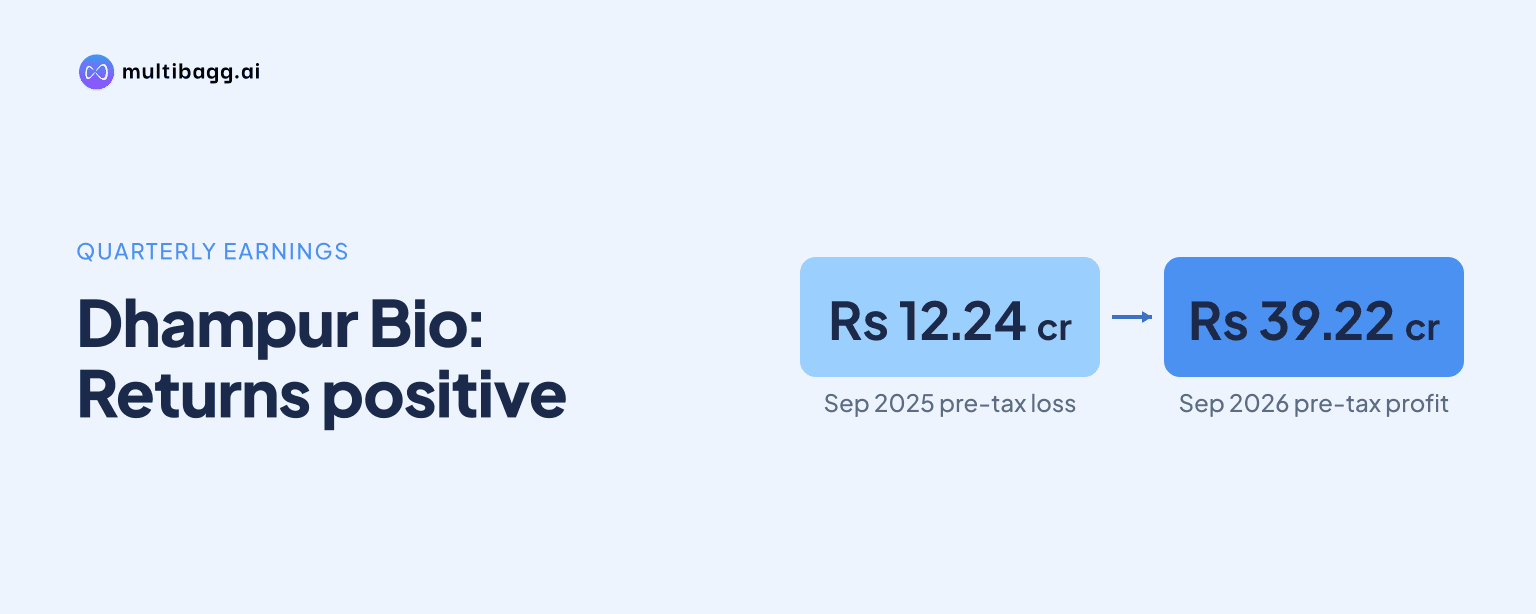
Dhampur Bio Organics Limited reported Rs 39.22 crore profit before exceptional items and tax from continuing operations for the quarter ended September 30, 2026, reversing a Rs 12.24 crore loss a year earlier, led by sugar segment profit of Rs 47.58 crore versus Rs 9.61 crore. Standalone revenue from operations increased to Rs 993.15 crore from Rs 791.18 crore.
Know Dhampur Bio Organics inside out
Results, valuation, peers and who's buying, in one view.
How did Dhampur Bio Organics perform in the September 2026 quarter?
Dhampur Bio Organics returned to profit in continuing operations during the September 2026 quarter. Profit before exceptional items and tax was Rs 39.22 crore, compared with losses of Rs 16.15 crore in the quarter ended June 30, 2026 and Rs 12.24 crore in the quarter ended September 30, 2025. Revenue from operations reached Rs 993.15 crore, compared with Rs 939.55 crore sequentially and Rs 791.18 crore a year earlier.
Profit after tax from continuing operations was Rs 26.62 crore, against losses of Rs 12.14 crore in June 2026 and Rs 8.30 crore in September 2025. Total income, including Rs 2.47 crore of other income, was Rs 995.62 crore, while total expenses were Rs 956.40 crore. Tax expense was Rs 12.60 crore, including current tax of Rs 5.92 crore and deferred tax of Rs 6.68 crore.
For the six months ended September 30, 2026, revenue from continuing operations rose to Rs 1,932.70 crore from Rs 1,579.33 crore in the corresponding 2025 period. The six-month pre-tax result turned to a Rs 23.07 crore profit from a Rs 29.74 crore loss, while profit after tax from continuing operations was Rs 14.48 crore compared with a Rs 19.76 crore loss.
What drove Dhampur Bio Organics' return to profit?
Sugar was the largest contributor to the quarterly improvement. The sugar segment recorded a result of Rs 47.58 crore before finance costs, exceptional items and tax, compared with Rs 4.73 crore in June 2026 and Rs 9.61 crore in September 2025. Sugar segment revenue was Rs 468.67 crore, rising from Rs 392.31 crore sequentially and Rs 415.86 crore a year earlier.
Bio Fuels & Spirits produced a Rs 5.56 crore segment result, reversing a Rs 4.43 crore loss in the September 2025 quarter, though it was below the Rs 6.60 crore result in June 2026. Country Liquor reported Rs 3.63 crore, compared with Rs 3.45 crore sequentially and Rs 4.70 crore a year earlier. Country Liquor revenue increased to Rs 437.91 crore from Rs 296.43 crore in September 2025.
The three operating segments generated a combined Rs 56.77 crore result, up from Rs 9.88 crore a year earlier. Finance costs fell to Rs 7.87 crore from Rs 12.76 crore, while other unallocable expenses net of unallocable income were Rs 9.68 crore versus Rs 9.36 crore. After these deductions, Dhampur Bio Organics reported the Rs 39.22 crore continuing-operations pre-tax profit.
How did costs change during the September quarter?
Excise duty on sale of goods was Rs 330.10 crore in the September 2026 quarter, compared with Rs 385.67 crore in June 2026 and Rs 267.19 crore a year earlier. Changes in inventories of finished goods, work in progress and stock in trade were Rs 387.68 crore, against Rs 296.94 crore sequentially and Rs 399.24 crore in September 2025.
Raw-material consumption rose to Rs 56.12 crore from Rs 40.38 crore a year earlier, while purchases of stock in trade increased to Rs 59.77 crore from Rs 20.22 crore. Employee benefits expense was Rs 29.77 crore compared with Rs 22.19 crore, and depreciation and amortisation was Rs 12.95 crore compared with Rs 12.43 crore. Dhampur Bio Organics said sugar is a seasonal industry and quarterly performance may not be representative of annual performance.
The expense pattern differed from the preceding quarter as purchases of stock in trade fell from Rs 88.62 crore and excise duty fell from Rs 385.67 crore, while inventory changes increased from Rs 296.94 crore. Total expenses therefore declined marginally from Rs 956.65 crore in June 2026 to Rs 956.40 crore, despite revenue rising by Rs 53.60 crore over that period.
Got a follow-up? Ask IRIS
What was the effect of the Meerganj unit sale?
The September 2026 quarter had no reported profit or loss from discontinued operations because the Meerganj unit was transferred on June 18, 2026. In the June 2026 quarter, the sale generated a Rs 63.89 crore gain and a Rs 50.54 crore after-tax profit from discontinued operations. This lifted total profit for that quarter to Rs 38.40 crore despite a Rs 12.14 crore continuing-operations loss after tax.
Dhampur Bio Organics sold the Meerganj unit on a slump-sale basis for Rs 305.00 crore after shareholder approval at the extraordinary general meeting held on May 18, 2026. The company said it received the full consideration. It has restated profit-and-loss, earnings-per-share and segment information for the September 2025 quarter and the year ended March 31, 2026 to classify Meerganj as discontinued operations.
The September 30, 2026 balance sheet excluded the Meerganj unit, and Dhampur Bio Organics said those balances are not comparable with earlier periods. Total assets were Rs 1,476.87 crore at September 30, 2026, compared with Rs 2,320.85 crore at March 31, 2026. Total borrowings were Rs 212.12 crore, comprising Rs 76.87 crore of non-current borrowings and Rs 135.25 crore of current borrowings.
What other disclosures should readers note?
Dhampur Bio Organics disclosed an Income Tax Department action under Section 132 of the Income Tax Act, 1961, conducted at its premises on October 29, 2025. In its return for the block period from April 1, 2019 to December 27, 2025, the company offered Rs 4.30 crore as additional income, including Rs 0.53 crore recorded as other income in the September 2026 quarter.
The related tax liability of Rs 2.68 crore was included in current-tax provisions for the September 2026 quarter and six-month period. Dhampur Bio Organics said it had not received an order or demand notice as of November 14, 2026. Management stated that it did not expect a material adverse impact on the company’s financial position and therefore made no material adjustment in the financial statements.
The board approved a proposed buyback of up to Rs 50 crore on November 14, 2026, subject to shareholder approval, at a maximum price of Rs 200 per share. Separately, interest-free loans outstanding to the DBO Employee Welfare Trust were Rs 7.15 crore at September 30, 2026. The trust had acquired 774,383 shares at an average price of Rs 91.77 per share.
Conclusion
Dhampur Bio Organics moved back to a continuing-operations pre-tax profit in the September 2026 quarter as revenue rose and sugar segment earnings increased sharply. Sugar generated Rs 47.58 crore of segment result, while Bio Fuels & Spirits returned to a Rs 5.56 crore profit. Lower finance costs of Rs 7.87 crore also reduced deductions from the combined segment result.
The next disclosed matters to watch are whether the September sugar performance is sustained through the seasonal cycle, shareholder approval for the proposed Rs 50 crore buyback, and any order or demand notice connected with the tax proceedings. The company has also said that post-sale balance-sheet figures excluding Meerganj are not comparable with earlier reporting periods.