










Dhampur Bio Organics books Rs 63.89 crore Meerganj sale gain
Key highlights
- Dhampur Bio Organics received the full Rs 305 crore consideration for the Meerganj unit sale completed on June 18, 2026.
- The Meerganj disposal generated a Rs 63.89 crore gain and Rs 50.54 crore post-tax profit from discontinued operations in the six months ended September 30, 2026.
- Reported non-current and current borrowings fell by a combined Rs 842.05 crore between March 31 and September 30, 2026.
- Continuing operations recorded Rs 14.48 crore post-tax profit in the six months ended September 30, 2026, versus a Rs 19.76 crore loss a year earlier.
powered by IRIS
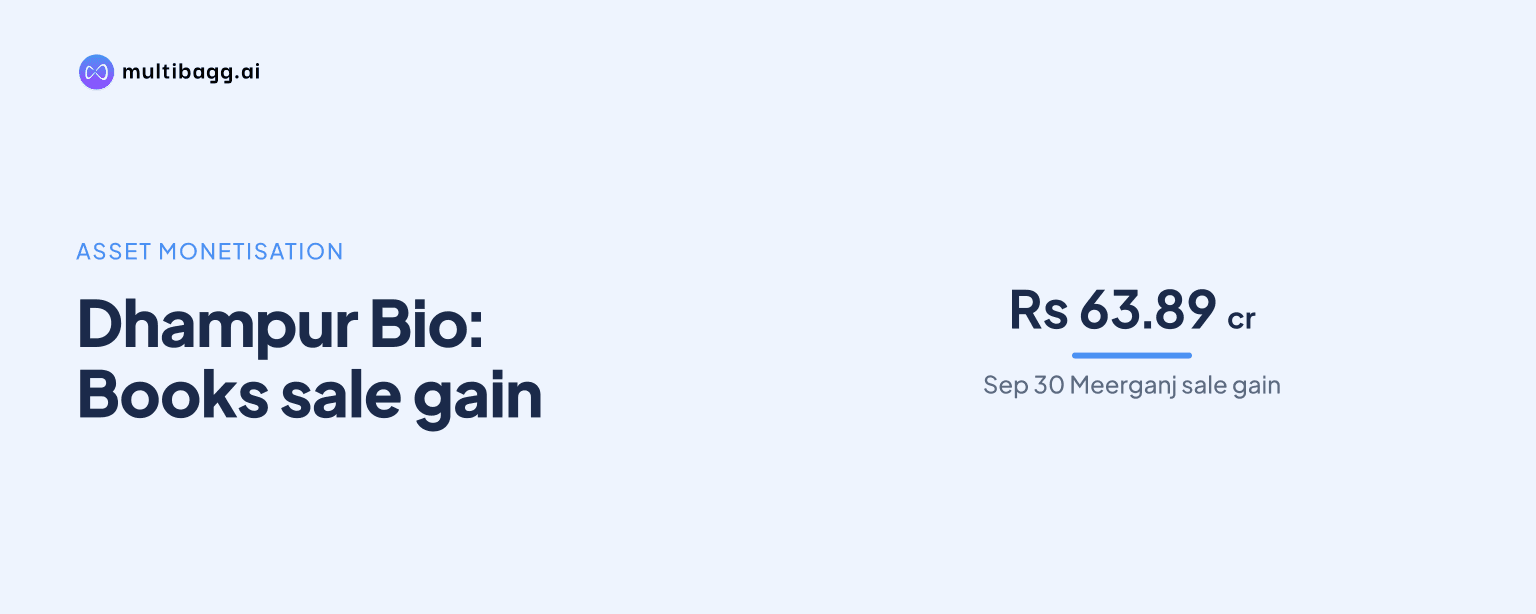
Dhampur Bio Organics Limited recorded a Rs 63.89 crore gain on the completed sale of its Meerganj unit in the six months ended September 30, 2026, after receiving the full Rs 305 crore consideration on June 18, 2026. The disposal produced Rs 50.54 crore of post-tax profit in discontinued operations and coincided with borrowings falling by Rs 842.05 crore from March 31.
Know Dhampur Bio Organics inside out
Results, valuation, peers and who's buying, in one view.
What did Dhampur Bio Organics sell and when did the deal close?
Dhampur Bio Organics sold its sugar manufacturing facility in Meerganj, Uttar Pradesh, on a slump-sale basis for aggregate consideration of Rs 305 crore, with the transfer taking effect on June 18, 2026. Shareholders had approved the transaction at an extraordinary general meeting held on May 18, 2026, and the company said it had received the full consideration by the reporting date.
Dhampur Bio Organics classified the Meerganj unit as discontinued operations in its standalone results under applicable accounting standards. The unit’s results were therefore reported separately from continuing operations, which comprise the Sugar, Bio Fuels & Spirits and Country Liquor segments.
The sale gain was recognised in the quarter ended June 30, 2026, rather than the September quarter. Discontinued operations reported Rs 78.50 crore of revenue and other income and a Rs 1.71 crore loss before the sale gain in the June quarter. Adding the Rs 63.89 crore gain produced Rs 62.18 crore of profit before tax from discontinued operations for the six months ended September 30, 2026.
How much profit did the Meerganj sale add after tax?
Dhampur Bio Organics reported Rs 50.54 crore of post-tax profit from discontinued operations for the six months ended September 30, 2026, compared with a Rs 15.14 crore loss in the corresponding six months of 2025. The reported result includes the Rs 63.89 crore gain on sale, a Rs 1.71 crore loss from discontinued operations before tax, and Rs 11.64 crore of tax expense.
The accounting treatment changes comparisons with earlier reported results. Dhampur Bio Organics restated its standalone profit-and-loss statement, earnings per share and segment information for the quarter and six months ended September 30, 2025, and for the year ended March 31, 2026, by excluding Meerganj from continuing operations. The company also said its September 30, 2026 balance sheet excludes the unit and is not comparable with earlier balance sheets.
How did borrowings change after the Meerganj transaction?
Dhampur Bio Organics’ non-current borrowings declined to Rs 76.87 crore at September 30, 2026 from Rs 206.98 crore at March 31, 2026, while current borrowings fell to Rs 135.25 crore from Rs 847.19 crore. Together, these two reported borrowing categories decreased by Rs 842.05 crore over the six-month period.
The cash-flow statement shows repayments of Rs 179 crore of long-term borrowings and net repayment of Rs 663.31 crore of short-term borrowings during the six months. It also records Rs 305 crore of proceeds from the sale of the undertaking under investing activities. The filing does not allocate sale proceeds to individual repayments, so it shows that the disposal and debt reduction occurred in the same half-year without providing a direct use-of-proceeds breakdown.
Cash and cash equivalents rose to Rs 26.04 crore at September 30, 2026 from Rs 4.50 crore at March 31, 2026, despite a Rs 879.68 crore financing cash outflow. Operating activities generated Rs 723.16 crore of net cash in the six months and investing activities generated Rs 178.06 crore, including undertaking-sale proceeds and Rs 35.83 crore of property, plant and equipment purchases.
Got a follow-up? Ask IRIS
What were Dhampur Bio Organics’ continuing operations after the sale?
Dhampur Bio Organics earned Rs 14.48 crore after tax from continuing operations in the six months ended September 30, 2026, reversing a Rs 19.76 crore loss in the prior-year period. Continuing-operations revenue increased to Rs 1,932.70 crore from Rs 1,579.33 crore, while profit before tax and exceptional items rose to Rs 23.07 crore from a loss of Rs 29.74 crore.
The September quarter accounted for Rs 26.62 crore of continuing-operations profit after tax, following a Rs 12.14 crore loss in the June quarter. Sugar was the largest continuing segment by September-quarter revenue at Rs 468.67 crore, followed by Country Liquor at Rs 437.91 crore and Bio Fuels & Spirits at Rs 104.42 crore. Sugar segment result increased to Rs 47.58 crore in the September quarter from Rs 9.61 crore a year earlier.
Country Liquor delivered Rs 926.99 crore of segment revenue in the first six months ended September 30, 2026, up from Rs 582.77 crore in the comparable prior-year period. Sugar revenue was Rs 860.98 crore versus Rs 871.17 crore, while Bio Fuels & Spirits revenue declined to Rs 185.20 crore from Rs 223.20 crore. Dhampur Bio Organics noted that sugar is seasonal, so quarterly performance may not represent annual performance.
What other disclosed items could affect the reported position?
Dhampur Bio Organics disclosed a Rs 2.68 crore current-tax provision connected with Income Tax Department action taken at its premises on October 29, 2025. The company filed a return for the April 1, 2019 to December 27, 2025 block period and offered Rs 4.30 crore as additional taxable income, including Rs 0.53 crore recognised as other income during the September 2026 quarter.
The company said it had not received an order or demand notice as of November 14, 2026. Management stated that it did not expect a material adverse effect on the financial position and therefore made no material financial-statement adjustment beyond the tax provision. Separately, the board on November 14, 2026 approved a proposed share buyback of up to Rs 50 crore at a maximum price of Rs 200 per share, subject to shareholder approval.
Conclusion
The Meerganj disposal resulted in a Rs 63.89 crore accounting gain and Rs 50.54 crore of post-tax discontinued-operations profit in the six months ended September 30, 2026. In the same reporting period, reported non-current and current borrowings fell by a combined Rs 842.05 crore, while continuing operations returned to a Rs 14.48 crore post-tax profit from a prior-year loss.
The next disclosed event to watch is shareholder consideration of the board-approved buyback of up to Rs 50 crore at a maximum Rs 200 per share. Investors can also monitor whether the Income Tax Department issues an order or demand notice following the company’s block-period return and Rs 2.68 crore tax provision.