










Divgi-TTS sets Rs 2,000 crore revenue aspiration beyond FY33
Key highlights
- Divgi-TTS aspires to reach about Rs 2,000 crore of revenue beyond FY33.
- Divgi-TTS lists approximately Rs 2,050 crore of planned investment across five growth areas.
- Automatic and hybrid transmissions have the largest allocation at about Rs 1,000 crore.
- Divgi-TTS reported Rs 280.2 crore of H1FY27 revenue from operations, up 81% year on year.
powered by IRIS
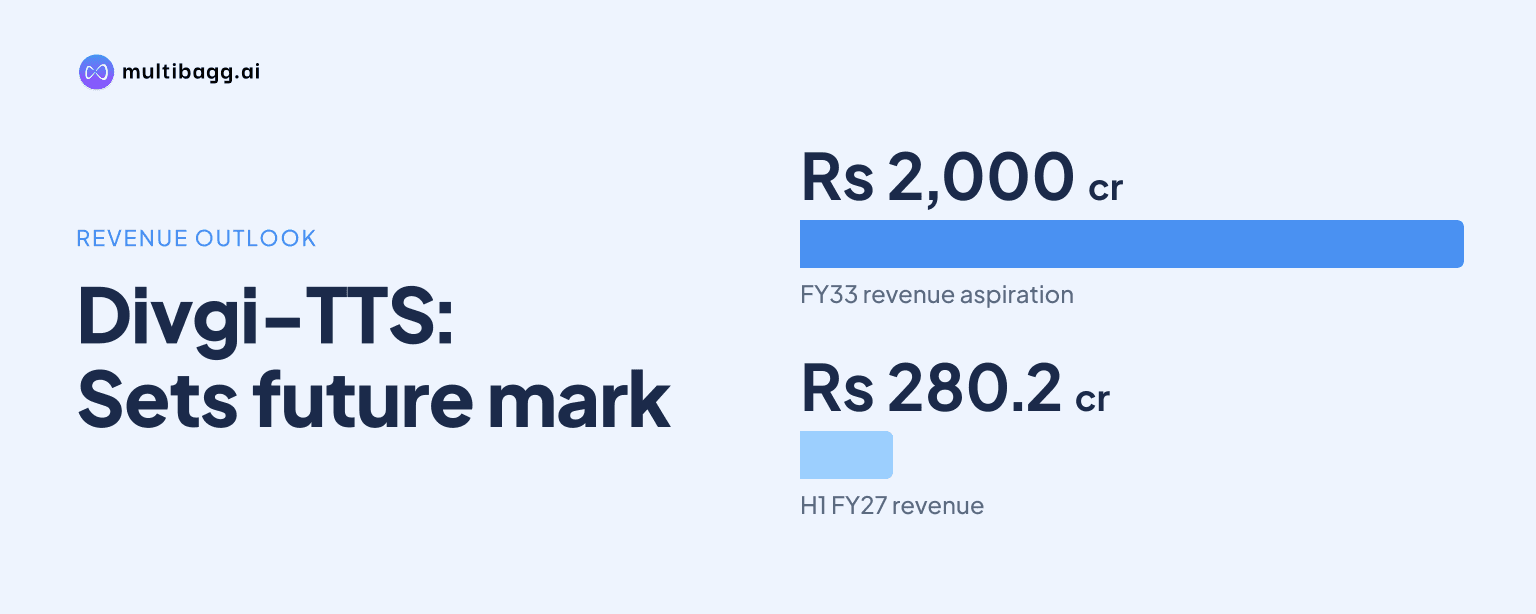
Divgi TorqTransfer Systems Private Limited has set a revenue aspiration of about Rs 2,000 crore beyond FY33, following a Rs 500 crore FY27 target and a Rs 1,000 crore FY29-30 aspiration. Divgi-TTS has outlined approximately Rs 2,050 crore of planned investment, led by Rs 1,000 crore for automatic and hybrid transmissions.
Know Divgi Torqtransfer Systems inside out
Results, valuation, peers and who's buying, in one view.
What is Divgi-TTS's revenue aspiration beyond FY33?
Divgi-TTS aspires to generate about Rs 2,000 crore of revenue beyond FY33. Its presentation sets out an interim revenue target of about Rs 500 crore for FY27 and an aspiration of about Rs 1,000 crore for FY29-30. Management labels the latter two milestones as a target and aspiration, respectively, rather than as reported revenue or confirmed orders.
The progression calls for revenue to double from the FY29-30 aspiration of about Rs 1,000 crore to about Rs 2,000 crore beyond FY33. The source does not specify the fiscal year in which the post-FY33 revenue level would be reached, nor does it disclose annual growth assumptions, programme volumes or the contribution expected from each product line.
The FY27 milestone is set against revenue from operations of Rs 280.2 crore in H1FY27, up 81% from Rs 154.6 crore in H1FY26. Q2FY27 revenue from operations was Rs 143.1 crore, compared with Rs 83 crore in Q2FY26, while Q1FY27 revenue was Rs 137.1 crore. These reported results provide the current revenue base for management's longer-term roadmap.
Divgi-TTS reported H1FY27 total income of Rs 290.5 crore, compared with Rs 165.1 crore a year earlier. Earnings before interest, tax, depreciation and amortisation, or EBITDA, increased 108% to Rs 85.4 crore from Rs 41.1 crore, and profit after tax increased 162% to Rs 51.6 crore from Rs 19.7 crore. The presentation does not connect these half-year results to a quantified funding schedule for the planned investments.
How is Divgi-TTS allocating its planned investment?
Divgi-TTS has outlined planned investment of approximately Rs 2,050 crore across five growth areas, based on the allocations listed in its long-term outlook. Automatic and hybrid transmission accounts for about Rs 1,000 crore, nearly half of the stated allocations, followed by Rs 300 crore each for four-wheel-drive systems and manual transmission and synchronizer systems.
For automatic and hybrid transmissions, Divgi-TTS plans technology transfer to bring globally proven automatic systems to India and partnerships with Tier 1 suppliers for local subsystems. The plan also includes local software, hardware and validation infrastructure, with sport utility vehicle, or SUV, and light commercial vehicle, or LCV, applications in India identified as the focus.
The Rs 300 crore four-wheel-drive allocation is intended for next-generation products, additional driveline products, customer engagement before development and localisation. The other Rs 300 crore allocation covers manufacturing solutions for original equipment manufacturers, or OEMs, outsourcing full manual transmissions, indigenously developed manual transmissions and synchronizer-system solutions for SUVs, LCVs and off-highway applications in India and global markets.
Got a follow-up? Ask IRIS
Which products and geographies support Divgi-TTS's plan?
Divgi-TTS's growth strategy covers four-wheel-drive and all-wheel-drive products, electric-vehicle powertrains, manual transmissions and synchronizers, automatic transmissions and geographic diversification. The company cites technology-led innovation, product and application diversity, customer and geographic diversity, financial discipline, manufacturing excellence and collaboration as the operating mechanisms behind these areas.
The EV transmission programme has a planned investment of about Rs 250 crore and is based on a tooled, production-ready transmission range for motor systems from 10 kilowatts to 150 kilowatts. Divgi-TTS says it is assessing partnerships with Tier 1 suppliers that have motor and inverter technology but lack transmission engineering depth. Its stated application set includes three-wheelers, passenger cars, SUVs and off-highway vehicles.
In domestic partnerships, Divgi-TTS identifies Mahindra & Mahindra as a route to opportunities in Indonesia, South Africa and the United States, alongside transfer-case and manual-transmission development. Its Tata Motors relationship covers a broad EV transmission ecosystem, and Divgi-TTS states that it has in-house capability in India to conceive, design, develop, manufacture and supply ground-up EV transmissions.
The export plan carries an allocation of about Rs 200 crore and seeks to move toward system solutions in four-wheel drive, manual transmission, synchronizers and EV transmission. Divgi-TTS names the United States, European Union, South Africa, Indonesia and Thailand as target markets. It also cites relationships with BorgWarner, Magna and Toyota Tsusho as potential channels to global drivetrain technology, OEM platforms and sourcing opportunities.
What are Divgi-TTS's near-term execution milestones?
Divgi-TTS expects EV transmission series-production supplies to begin in H2 FY27 after receiving customer approval for production supplies. The company says it expects production to ramp across several models of one of India's preeminent EV manufacturers and has secured a prototype order from an India-China joint-venture OEM manufacturing in India.
The customer approval followed work on the Sigma prototype and its noise, vibration and harshness, or NVH, assessment. H2 FY27 is therefore the presentation's clearest scheduled operating milestone. Divgi-TTS does not disclose the programme's anticipated production volumes, customer name, pricing or revenue contribution.
Within components, Divgi-TTS says it is expanding its product portfolio with a North American Tier 1 transfer-case manufacturer and has completed all global programmes. It is also working on new requests for quotation, or RFQs, for hybrid-transmission components. For transfer cases, management says it will evaluate a United States manufacturing footprint; for automatic transmission, it plans to demonstrate a proof of concept on a customer vehicle.
The balance sheet and cash-flow statement show investment activity before the broader long-term programme is detailed. Property, plant and equipment rose to Rs 269.3 crore in September 2026 from Rs 247.1 crore in March 2026, while capital work-in-progress increased to Rs 21.1 crore from Rs 17.7 crore. Net cash from operating activities was Rs 33.9 crore for the six months to September 2026, compared with Rs 16.6 crore a year earlier, and net cash used in investing activities was Rs 23.2 crore versus Rs 0.1 crore.
Conclusion
Divgi-TTS has attached numerical milestones to a multi-product expansion plan: about Rs 500 crore of revenue in FY27, about Rs 1,000 crore in FY29-30 and about Rs 2,000 crore beyond FY33. The listed investment of approximately Rs 2,050 crore concentrates most heavily on automatic and hybrid transmissions, while also funding four-wheel drive, manual systems, EV transmissions and exports.
The next disclosed checkpoint is the expected H2 FY27 start of EV transmission series production. Progress on the automatic-transmission proof of concept, hybrid-component RFQs, expansion with the North American Tier 1 customer and the assessment of a United States transfer-case footprint will indicate how Divgi-TTS advances the product and export elements of its plan.