










Gaja Capital Q2 PAT rises 138% on Fund II carry and tax reversal
Key highlights
- Gaja Capital reported Q2 FY27 PAT of ₹64.7 crore, up 138% quarter on quarter.
- Performance income rose 55% sequentially to ₹46.2 crore, with Fund II carry a significant driver.
- A ₹15 crore deferred-tax reversal was included in Q2 FY27 consolidated results.
- H1 FY27 cost-to-income ratio declined to 29% from 38% in H1 FY26.
powered by IRIS
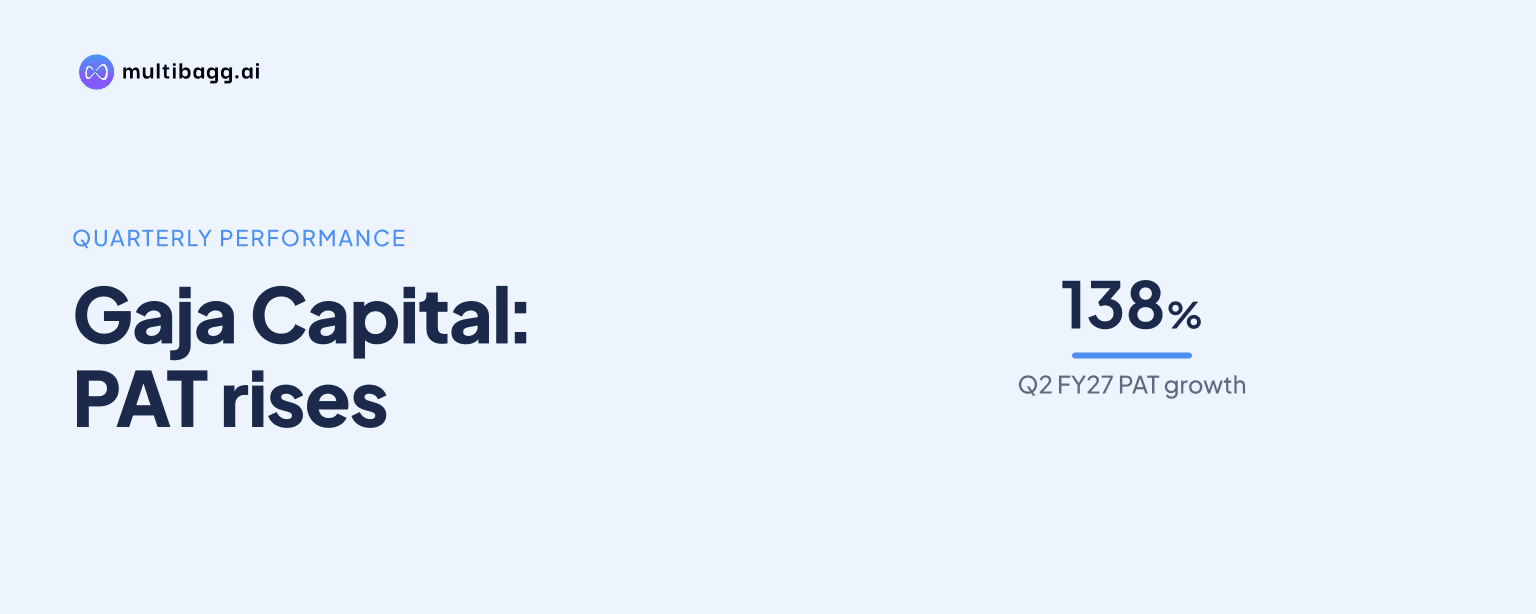
Gaja Capital reported profit after tax of ₹64.7 crore in Q2 FY27, up 138% quarter on quarter, as ₹46.2 crore of performance income, significantly driven by Fund II carried interest, combined with a ₹15 crore deferred-tax reversal and lower costs. Total income rose 26% to ₹65.5 crore, while fee income declined 4%.
Know Gaja Alternative Asset Management inside out
Results, valuation, peers and who's buying, in one view.
What drove Gaja Capital’s 138% sequential PAT increase?
Gaja Capital’s ₹64.7 crore Q2 FY27 profit after tax, or PAT, was ₹37.5 crore higher than the ₹27.2 crore reported in Q1 FY27. Profit before tax, or PBT, rose 59% sequentially to ₹50.8 crore from ₹31.9 crore, while tax expense became a tax credit of ₹13.9 crore, compared with a ₹4.7 crore tax expense in Q1 FY27. Gaja Capital said its consolidated results include a ₹15 crore reversal of deferred tax charge following a revised estimate of potential tax liability on fair-value gains from sponsor commitments.
The income increase was principally in performance income, which climbed 55% quarter on quarter to ₹46.2 crore from ₹29.7 crore. Gaja Capital specifically identified carried interest generated from Fund II as a significant driver of the growth in performance income. Carried interest is the firm’s share of fund profits above the hurdle rate, rather than a fixed periodic management fee, so its recognition can differ across quarters as exits and fund economics develop.
Costs also contributed to the increase in quarterly PBT. Total expenses fell 26% to ₹14.7 crore from ₹19.9 crore, led by a 71% decline in other expenses to ₹2 crore from ₹7 crore. Employee benefit expense declined 4% to ₹10.3 crore and finance costs fell 12% to ₹1.1 crore, although depreciation and amortization rose 41% to ₹1.3 crore. Thus, the PAT increase reflected both higher performance income and lower operating expenses, with the deferred-tax reversal further increasing profit after tax.
How did recurring fee income compare with performance income?
Gaja Capital’s fee income was ₹15 crore in Q2 FY27, down 4% from ₹15.6 crore in Q1 FY27 but 1% above ₹14.8 crore in Q2 FY26. By contrast, performance income of ₹46.2 crore was more than three times quarterly fee income and accounted for most of total income of ₹65.5 crore. This shows that the sequential earnings increase came from variable fund-performance income rather than from the recurring management-fee stream.
For H1 FY27, fee income increased 4% year on year to ₹30.6 crore from ₹29.4 crore, while performance income declined 3% to ₹75.9 crore from ₹78.5 crore. Total H1 income nevertheless rose 6% to ₹117.3 crore because treasury income increased 347% to ₹10.8 crore. The half-year result therefore presents a different mix from the second quarter: recurring fees grew modestly over the prior-year period, whereas the performance-income comparison remained lower.
The year-on-year Q2 comparison also tempers the sequential picture. Q2 FY27 total income was 5% below the ₹69.2 crore recorded in Q2 FY26 because performance income declined 13% from ₹53 crore, despite fee income rising 1% and treasury income increasing 254% to ₹4.3 crore. PAT still rose 54% year on year from ₹42 crore, as total expenses fell 39% from ₹24.2 crore and the quarter included the ₹15 crore deferred-tax reversal.
Got a follow-up? Ask IRIS
What does Fund II’s position mean for carried interest?
Gaja Capital’s Fund II was substantially realized at a gross multiple of invested capital, or MOIC, of 3.8x as of the September 2026 quarter. The 2008-vintage fund had made eight investments and was ranked in the first quartile according to Pitchbook, as presented by Gaja Capital. Its advanced realization status distinguishes it from Fund IV, which remains in its growth and value-creation phase and was 87% deployed.
The company’s fund economics explain why Fund II could contribute carry in the quarter. Management fees are fixed on committed or invested capital, while carried interest is earned during the exit period after crossing the hurdle rate. Gaja Capital says it has full catch-up provisions across its funds and uses a European waterfall methodology that it says is not exposed to clawbacks. The presentation does not quantify Fund II’s carry recognised in Q2 FY27, so the ₹46.2 crore performance-income figure should not be read as Fund II carry alone.
Fund III, a 2016-vintage fund, was fully deployed across 10 investments and partially realized, with a gross MOIC of 1.9x. Fund IV, the 2023 vintage, had nine investments and a gross MOIC of 2x, though Gaja Capital cautioned that its MOIC is not representative of mature fund performance because the fund remains under deployment. Gaja Capital said it earned income from Fund II, Fund III and Fund IV during the September 2026 quarter.
How did costs, capital and balance sheet change?
Gaja Capital’s H1 FY27 cost-to-income ratio was 29%, down from 38% in H1 FY26. Total H1 expenses declined 17% to ₹34.6 crore, while total income rose 6% to ₹117.3 crore. Other expenses fell 47% to ₹9 crore and employee benefit expense decreased 4% to ₹21 crore, although finance costs increased 45% to ₹2.5 crore and depreciation and amortization more than doubled to ₹2.2 crore.
As of September 2026, net worth was ₹1,106.2 crore, compared with ₹574.6 crore a year earlier and ₹606.5 crore at March 2026; Gaja Capital said the September figure includes initial public offering proceeds. Cash and bank balances were ₹450.7 crore, up from ₹106.1 crore at March 2026, and current investments were ₹165.4 crore. Borrowings were ₹20 lakh versus ₹33.4 crore at March 2026.
The larger capital base coincided with a change in reported return on equity, or RoE. Gaja Capital showed last-twelve-month RoE of 13% at September 2026, compared with 19% at September 2025, while net worth increased to ₹1,106 crore from ₹575 crore. Last-twelve-month PAT rose 28% to ₹111.8 crore and earnings per share increased 18% to ₹9.3, based on weighted-average shares for the period.
Conclusion
Gaja Capital’s Q2 FY27 PAT increase was driven by several identifiable items: Fund II carry helped lift performance income to ₹46.2 crore, total expenses declined by ₹5.2 crore sequentially, and the revised tax estimate produced a ₹15 crore deferred-tax reversal. Its underlying fee income, at ₹15 crore, was lower sequentially and only 1% higher year on year, making it distinct from the quarter’s variable performance-income outcome.
Next, investors can watch whether Fund II’s substantial realization continues to generate performance income and how Fund III and Fund IV progress through realization and value creation. Gaja Capital also disclosed plans to launch its ₹2,500 crore Fund V and ₹1,500 crore Fastgate Secondaries Fund I in 2026-27, with both proposed as close-ended funds that would add to the platform’s future fundraising activity.