










Gaja Capital says AIF commitments rose sixfold through FY26
Key highlights
- India’s AIF commitments rose 6.0x from Rs 2.8 lakh crore in FY19 to Rs 16.9 lakh crore in FY26.
- Gaja Capital shows FY30P AIF commitments of Rs 41-44 lakh crore, implying a projected 25-27% CAGR from FY26.
- FY26 bank deposits were Rs 260.8 lakh crore, mutual fund AUM was Rs 81.5 lakh crore, and retirement pools were Rs 45 lakh crore.
- NPS was permitted to invest in Category I and II AIFs from January 2026, with active commitments beginning in October 2026.
powered by IRIS
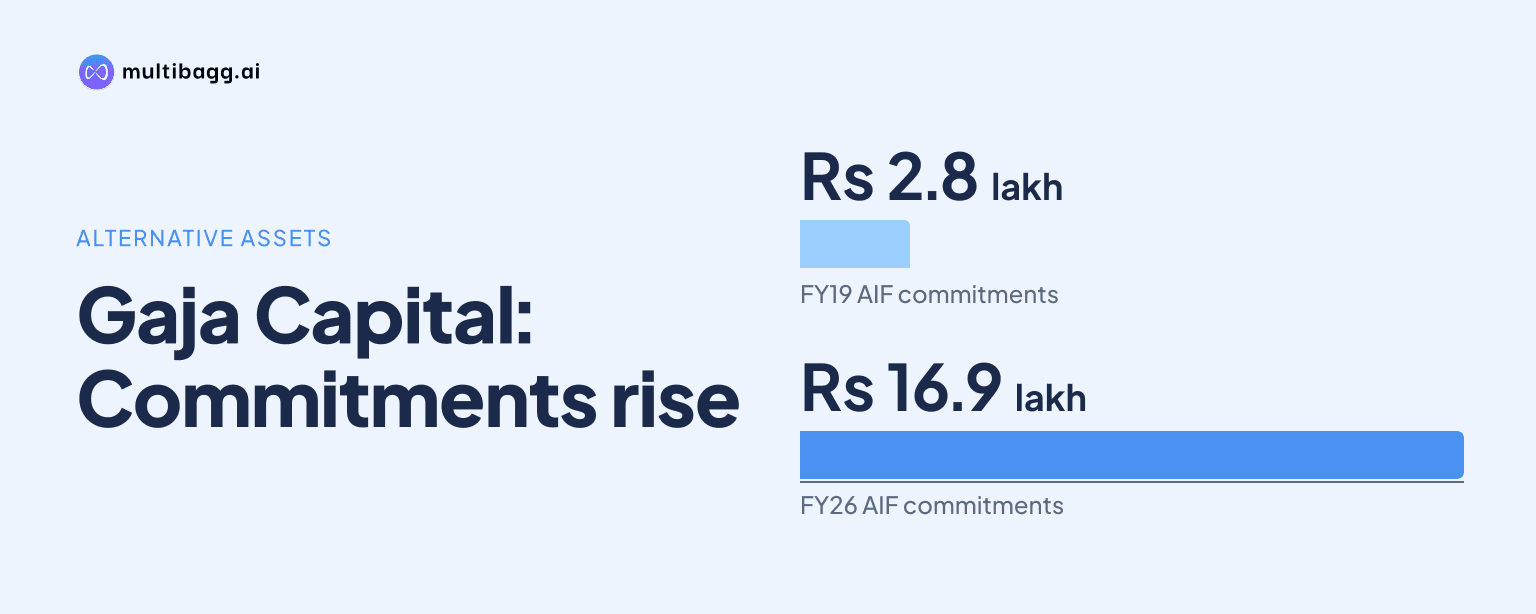
Gaja Capital’s presentation reports that India’s alternative investment fund (AIF) commitments rose sixfold from Rs 2.8 lakh crore in FY19 to Rs 16.9 lakh crore in FY26, and it projects Rs 41-44 lakh crore by FY30P while identifying pensions, insurers and banks as potential domestic capital sources.
Know Gaja Alternative Asset Management inside out
Results, valuation, peers and who's buying, in one view.
How fast did India’s AIF commitments grow?
India’s AIF commitments grew at a reported compound annual growth rate (CAGR) of 29.2% between FY19 and FY26. Commitments increased in every fiscal year shown, rising from Rs 2.8 lakh crore in FY19 to Rs 3.7 lakh crore in FY20, Rs 4.5 lakh crore in FY21 and Rs 6.4 lakh crore in FY22. By FY23, the total had reached Rs 8.3 lakh crore.
The pace continued through the next three reported years. AIF commitments rose from Rs 8.3 lakh crore in FY23 to Rs 11.3 lakh crore in FY24, Rs 13.5 lakh crore in FY25 and Rs 16.9 lakh crore in FY26. Gaja Capital’s FY30P range of Rs 41-44 lakh crore implies a further increase of Rs 24.1-27.1 lakh crore from FY26. The presentation applies a projected CAGR range of 25-27% for FY26-FY30P, below the reported 29.2% CAGR for FY19-FY26.
Why did AIF commitments outpace deposits and mutual funds?
AIF commitments were the fastest-growing category in Gaja Capital’s FY19-FY26 comparison, expanding 6.0 times over the period. Bank deposits increased 2.1 times, from Rs 125.7 lakh crore to Rs 260.8 lakh crore, while mutual fund assets under management (AUM) increased 3.3 times, from Rs 24.5 lakh crore to Rs 81.5 lakh crore. The presentation places AIF growth at nearly three times the growth multiple reported for bank deposits.
The comparison also reflects substantially different starting scales. In FY19, AIF commitments of Rs 2.8 lakh crore were below mutual fund AUM of Rs 24.5 lakh crore and bank deposits of Rs 125.7 lakh crore. By FY26, AIF commitments had reached Rs 16.9 lakh crore but remained below the Rs 81.5 lakh crore mutual fund industry and Rs 260.8 lakh crore bank-deposit pool. Gaja Capital’s finding is therefore that alternatives grew faster, not that AIFs overtook traditional savings categories by size.
Which domestic pools could add alternatives capital?
Retirement pools were Rs 45 lakh crore, compared with Rs 16.9 lakh crore of AIF commitments in FY26, making them the largest pool identified after bank deposits and mutual funds. Gaja Capital groups the retirement figure across the National Pension System (NPS), Employees’ Provident Fund Organisation (EPFO) and Atal Pension Yojana (APY). This made retirement assets Rs 28.1 lakh crore larger than the AIF commitment base presented for FY26.
Bank deposits remain the largest pool in the presentation at Rs 260.8 lakh crore, followed by mutual funds at Rs 81.5 lakh crore and retirement pools at Rs 45 lakh crore. These totals do not represent existing allocations to AIFs. Instead, Gaja Capital presents them alongside the Rs 16.9 lakh crore AIF market to show the scale of domestic savings and institutional capital relative to alternatives. The company’s case rests on potential participation from these pools, rather than a disclosed commitment to invest a specified amount.
Got a follow-up? Ask IRIS
What developments could broaden domestic participation in AIFs?
Gaja Capital identifies NPS permission from January 2026, active NPS commitments from October 2026, insurer eligibility and the Reserve Bank of India’s (RBI) January 2026 bank-rule easing as developments that could broaden participation. NPS was permitted to invest in Category I and Category II AIFs from January 2026, while active commitments to AIFs began from October 2026. The presentation treats those milestones as a potential channel through which part of the Rs 45 lakh crore retirement pool could enter alternatives.
Insurers and banks are also permitted to invest within applicable regulatory limits, but Gaja Capital describes exposure in both groups as still nascent or low. For banks, the presentation says the RBI’s January 2026 easing of norms is driving penetration. For insurers, it notes that HDFC Life and SBI Life are Gaja Capital shareholders. Neither point quantifies current insurer or bank allocations to AIFs, so these groups are presented as possible future contributors rather than established large allocators.
Ultra-high-net-worth individuals (UHNIs) are another domestic source identified by Gaja Capital. The presentation says the number of UHNIs increased 63% over the last five years and that managed wealth is expected to nearly double by 2030. This differs from pension, insurance and banking capital because it concerns private wealth rather than regulated institutional pools. Together, the January and October 2026 changes and the reported 63% UHNI increase form the basis for Gaja Capital’s view of a broader domestic investor base.
Conclusion
Gaja Capital’s central finding is that India’s AIF commitments grew from Rs 2.8 lakh crore in FY19 to Rs 16.9 lakh crore in FY26, a 6.0x increase that exceeded the 2.1x growth of bank deposits and the 3.3x increase in mutual fund AUM. The comparison also shows the remaining scale gap: bank deposits stood at Rs 260.8 lakh crore and retirement pools at Rs 45 lakh crore in FY26.
The next measure to watch is whether the January 2026 easing of bank norms and the October 2026 start of NPS commitments translate into disclosed allocations. Gaja Capital’s FY30P range of Rs 41-44 lakh crore, based on a projected 25-27% CAGR from FY26, provides the presentation’s stated benchmark for how quickly the alternatives market could develop.