










Gaja Alternative Asset Management Limited: 52% Performance Income
Key highlights
- Gaja Capital reported Rs 164.8 crore of total income in LTM September 2026.
- Performance income was Rs 85.4 crore, representing 52% of Gaja Capital’s LTM total income.
- Gaja Capital reported Rs 589 crore of sponsor commitments, equal to 7.1% of fund size.
- Fund II reported a 3.8x gross MOIC and was a significant quarterly driver of performance-income growth.
powered by IRIS
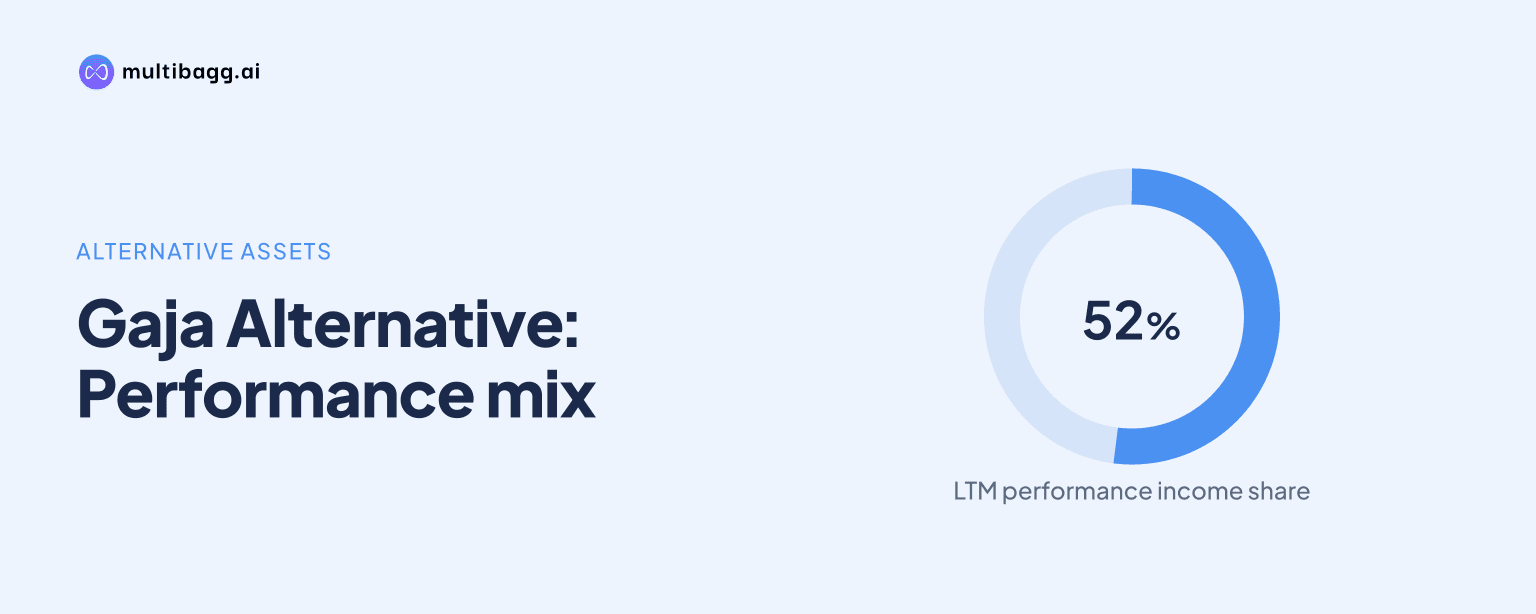
Gaja Alternative Asset Management Limited reported Rs 85.4 crore of performance income, representing 52% of Rs 164.8 crore total income in the last twelve months, or LTM, to September 2026. Gaja Capital’s performance income, comprising carried interest and sponsor-commitment returns, exceeded its Rs 61.3 crore fee income by Rs 24.1 crore.
Know Gaja Alternative Asset Management inside out
Results, valuation, peers and who's buying, in one view.
What generated Gaja Capital’s income in the last twelve months?
Gaja Capital generated its largest LTM September 2026 income category from performance income at Rs 85.4 crore, ahead of Rs 61.3 crore from fee income and Rs 18.1 crore from treasury income. Performance income accounted for 52% of total income, compared with 37% for fees and 11% for treasury income.
Gaja Capital defines management fees as fixed charges on committed or invested fund capital. Its performance income combines carried interest, or the share of fund profit above a hurdle rate, with income from its own sponsor commitments. Treasury income is the return on surplus balance-sheet cash and investments, and the presentation says each of these streams is fully captured by the asset management company, or AMC.
The Rs 24.1 crore difference between performance income and fee income indicates that the LTM mix was led by fund-return-linked sources rather than fixed fees. The presentation does not provide a rupee split between carried interest and sponsor-commitment income within the Rs 85.4 crore total, so it does not quantify either contributor separately.
How does Gaja Capital’s sponsor commitment produce income?
Gaja Capital earns income on sponsor commitments by investing alongside limited partners, or LPs, and receiving the full multiple on invested capital, or MOIC, on that capital. It reported Rs 589 crore of sponsor commitments, equal to 7.1% of fund size, and says this average is above Securities and Exchange Board of India, or SEBI, minimum thresholds.
Fund IV has the largest existing disclosed sponsor commitment at Rs 150 crore, compared with Rs 70 crore in Fund III and Rs 54 crore in Fund II. The proposed Fund V commitment is Rs 210 crore and proposed Secondaries I is Rs 105 crore; commitment percentages range from 4.4% in Fund III to 8.5% in Fund IV.
Unlike management fees, sponsor-commitment income represents fair-value gains on Gaja Capital’s own fund investments during the investment cycle until a fund is fully exited. The company says it follows a SEBI-prescribed valuation framework, with valuations audited at multiple levels, while describing its approach as comprehensive and conservative.
Gaja Capital also links sponsor capital to fundraising economics. It says sponsor commitments earn full MOIC and lower fundraising costs, while its network of about 900 global and domestic investors includes 298 existing LPs across more than 20 countries and supports direct fundraising without distributors or intermediaries.
When are Gaja Capital’s income streams earned?
Gaja Capital says management fees recur through a fund’s life, sponsor-commitment gains accrue through the investment cycle, and carried interest is earned during exits after the hurdle rate is crossed. These different timing mechanisms distinguish the Rs 61.3 crore of fee income from the Rs 85.4 crore performance-income category in LTM September 2026.
A fund begins with direct fundraising and Gaja Capital committing capital alongside LPs, then deploys into mid-market companies. Its four sector themes are intelligent software, automation, deeptech and artificial intelligence; financial services; consumer; and education, employment and employability.
During the value-creation stage, portfolio companies are marked to fair value before strategic or financial exits return capital to LPs. Gaja Capital says management fees are fixed on committed or invested capital, whereas sponsor-commitment income reflects fair-value gains on its own capital and carried interest is a share of profits above the hurdle rate.
Gaja Capital states that it has full catch-up provisions for carried interest and uses a European waterfall methodology that it says is insusceptible to claw-backs. The LTM reporting nevertheless combines carried interest and sponsor gains in one performance-income line, leaving the timing and size of each source undisclosed.
Got a follow-up? Ask IRIS
Which funds supported Gaja Capital’s performance income?
Gaja Capital said it earned income from Fund II, Fund III and Fund IV during the quarter ending September 2026, and identified carried interest from Fund II as a significant driver of overall performance-income growth. Fund II was substantially realised at a 3.8x gross MOIC, compared with 1.9x for Fund III and 2.0x for Fund IV.
Fund II’s 3.8x gross MOIC was higher than the two other active disclosed funds, and it was further advanced in its realisation cycle. Fund III was fully deployed across 10 investments and partially realised, while Fund IV was 87% deployed and had nine portfolio companies after two new investments during the September 2026 quarter.
Fund IV’s 2.0x gross MOIC should not be treated as mature-fund performance because the presentation says it remains under deployment. Gaja Capital reports Fund II, Fund III and Fund IV as first-quartile performers for their vintages, citing the latest Nifty AIF Benchmarking Reports for Funds III and IV and Pitchbook for Fund II.
The timing of Fund II’s realisations is relevant because carried interest is earned in the exit period after the hurdle is achieved. Gaja Capital does not disclose Fund II’s carried-interest amount or allocate the Rs 85.4 crore LTM performance-income total among Fund II, Fund III and Fund IV.
What could expand Gaja Capital’s income base next?
Gaja Capital lists Fund V and Fastgate Secondaries Fund I as planned 2026–27 launches, with target sizes of Rs 2,500 crore and Rs 1,500 crore, respectively. The proposed sponsor commitments of Rs 210 crore for Fund V and Rs 105 crore for Secondaries I would extend the capital committed alongside LPs if the funds are launched and raised.
Fund V is planned as a 10+2-year close-ended flagship fund for growth-stage minority investments and management buy-outs in mid-market businesses. Fastgate Secondaries Fund I is planned as a 5+2-year close-ended vehicle acquiring private-company portfolio stakes from private equity and venture capital fund general partners.
Gaja Capital reported net worth of Rs 1,106 crore and cash and liquid investments of Rs 690 crore as of September 2026. Management estimates fundraising potential of about Rs 8,000 crore at an 8.4% sponsor commitment, but this is a capital-raising estimate rather than a forecast for fees, performance income or treasury income.
Conclusion
Gaja Capital’s LTM September 2026 income mix was led by Rs 85.4 crore of performance income, or 52% of Rs 164.8 crore total income. Fixed management fees contributed Rs 61.3 crore and treasury income contributed Rs 18.1 crore, while the company’s Rs 589 crore sponsor commitment links its balance sheet directly to fund-level valuation gains and realised investment returns.
The next disclosed items to watch are the planned 2026–27 launches of Fund V and Fastgate Secondaries Fund I, including progress on their Rs 2,500 crore and Rs 1,500 crore targets. Investors can also monitor realisations from Fund II, Fund III and Fund IV, since the presentation identifies Fund II carried interest as a significant quarterly driver but does not disclose the fund-by-fund composition of performance income.