










Dollar Lakshya enrolment reaches 174,953 retailers in H1 FY27
Key highlights
- Project Lakshya enrolled 1,74,953 retailers and had 81,447 active retailers in H1 FY27.
- Lakshya distributors contributed 29% of Dollar's reported value contribution and 29% of volume contribution in H1 FY27.
- Dollar reported 324 Lakshya distributors across 14 states in H1 FY27.
- Enrolled Project Lakshya retailers increased by 9,027 from 1,65,926 in FY25 to 1,74,953 in H1 FY27.
powered by IRIS
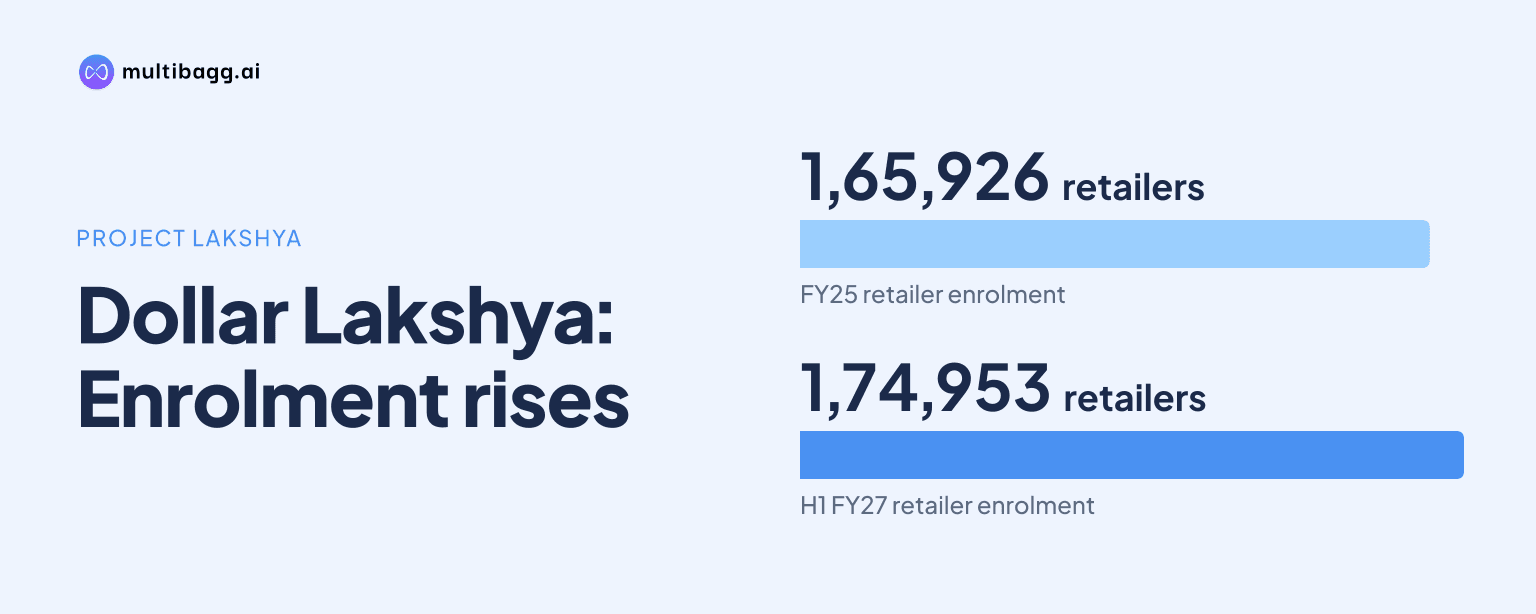
Dollar Industries Limited reported 174,953 enrolled Project Lakshya retailers in H1 FY27, while its 324 Lakshya distributors accounted for 29% each of reported value and volume contribution. Enrolment increased from 172,260 in FY26, but value contribution was one percentage point below the 30% disclosed for FY25 and FY26.
Know Dollar Industries inside out
Results, valuation, peers and who's buying, in one view.
How many retailers has Dollar enrolled in Project Lakshya?
Dollar enrolled 174,953 retailers in Project Lakshya in H1 FY27, including 81,447 retailers classified as active. Enrolment rose by 2,693 retailers from 172,260 in FY26 and by 9,027 from 165,926 in FY25. Active retailers increased by 2,693 from 78,754 in FY26 and by 7,536 from 73,911 in FY25.
The active share of enrolled retailers was about 46.6% in H1 FY27, calculated from 81,447 active retailers and 174,953 enrolled retailers. That compares with about 45.7% in FY26 and 44.5% in FY25 using the presentation figures. The calculation shows that active retailers increased faster than total enrolment over the two-year comparison, although Dollar does not define the activity threshold used for the active-retailer count.
Is Dollar's Project Lakshya contribution increasing?
Dollar's Project Lakshya volume contribution remained at 29% in H1 FY27, while value contribution declined to 29% from 30% in each of FY25 and FY26. The presentation reports the two measures separately for Lakshya distributors and does not provide the underlying rupee value of sales or unit volumes.
The one-percentage-point movement means Lakshya's reported value share was lower in H1 FY27, while its volume share did not change over the three disclosed periods. Since Dollar does not disclose total value or volume behind the percentages, the presentation does not show whether Lakshya distributors increased or decreased in absolute value or volume terms. It shows their share of the respective company measure.
How broad is Dollar's Lakshya distributor coverage?
Dollar reported 324 Lakshya distributors in H1 FY27 across 14 states, compared with 319 distributors in 14 states in FY26 and 317 distributors in 13 states in FY25. The distributor network therefore added five distributors from FY26 to H1 FY27 and seven from FY25, while state coverage increased by one from the FY25 level.
A separate Project Lakshya status slide identifies 324 distributors as of September 2026, consistent with the H1 FY27 table. Based on the disclosed figures, there were about 540 enrolled retailers per distributor in H1 FY27, calculated by dividing 174,953 retailers by 324 distributors. The corresponding figure was also about 540 in FY26, based on 172,260 retailers and 319 distributors, indicating that distributor additions broadly kept pace with retailer enrolment.
The 14-state footprint in H1 FY27 was unchanged from FY26 despite the increase in distributors to 324 from 319. In contrast, the move from FY25 to H1 FY27 added seven distributors and expanded coverage from 13 to 14 states. Dollar does not disclose the states covered, distributors outside the programme, or the share of its total distributor base represented by Lakshya.
Got a follow-up? Ask IRIS
How is Dollar changing its distribution model through Lakshya?
Dollar says Project Lakshya is intended to move its distribution system from a push model to a replenishment-based model that creates a demand-pull environment. The stated actions include mapping the retail network in each distributor's allocated area, enrolling retailers, running retailer bonding programmes, implementing distributor-level systems, and setting standard operating procedures for distributors.
Dollar lists increased market penetration, primary and secondary sales, retailer-level last-mile data, distributor performance analysis, product planning, inventory management and distributor working capital as programme outcomes. These are stated objectives rather than separately quantified results in the presentation. The 29% H1 FY27 contribution from Lakshya distributors provides a disclosed measure of programme scale, but Dollar does not split the retailer base between completely enrolled, work-in-progress and not-enrolled status categories.
The initiative operates within a business where domestic general trade represented 85% of trade-channel revenue contribution on Dollar's FY27 revenue-contribution slide. Quick commerce represented 5%, exports and e-commerce each represented 4%, and modern trade represented 2%. Dollar does not assign the 29% Lakshya contribution to individual trade channels, so the presentation does not establish that this contribution comes solely from domestic general trade.
What does the Lakshya retailer and distributor data indicate for Dollar?
Dollar's disclosed figures show that Project Lakshya expanded its retailer and distributor footprint while maintaining a 29% volume contribution. From FY25 to H1 FY27, enrolled retailers rose from 1,65,926 to 1,74,953, active retailers rose from 73,911 to 81,447, distributors rose from 317 to 324 and state coverage increased from 13 to 14. Over the same comparison, value contribution moved from 30% to 29%.
The data separates network expansion from contribution share. A larger retailer base and more active retailers are consistent with Dollar's stated plan to obtain retailer-level data and support replenishment, but the presentation does not quantify order frequency, inventory turns, distributor working capital, primary sales or secondary sales. It also does not disclose a target retailer count, target contribution percentage or timetable for completing the shift to replenishment-based distribution.
The FY25-to-H1 FY27 comparison also shows different rates of change among the disclosed measures. Enrolled retailers increased by 9,027, active retailers increased by 7,536, and distributors increased by seven, whereas volume contribution remained unchanged at 29%. Dollar's presentation therefore provides evidence of network growth but not enough underlying sales or volume data to link that growth directly to an absolute increase in Lakshya business.
Conclusion
Project Lakshya represented 29% of Dollar's reported value and volume contribution in H1 FY27, supported by 1,74,953 enrolled retailers, 81,447 active retailers and 324 distributors. The programme expanded its retailer, active-outlet and distributor counts from FY25 and FY26, while value contribution moved one percentage point below the 30% reported in both earlier periods and volume contribution stayed at 29%.
The next point to watch is whether Dollar's stated move from push-led distribution to replenishment changes the relationship between retailer enrolment, active retailers and contribution share. Management identifies retailer mapping, bonding programmes, distributor-level systems and standard operating procedures as the mechanisms, but the presentation does not disclose a numerical target or timetable for these measures.