










Dollar's quick commerce, exports and rainwear outpace sales
Key highlights
- Dollar Protect recorded 208.1% year-on-year value growth in Q2 FY27, supported by a favourable monsoon.
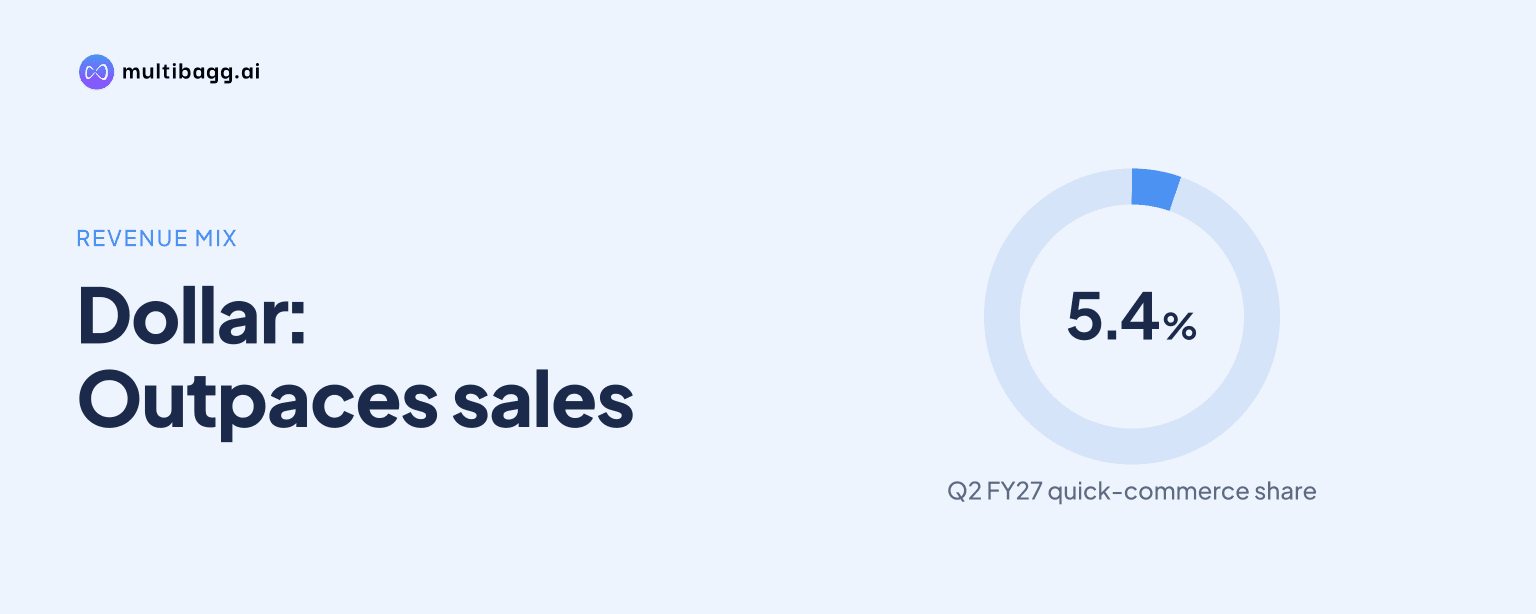
- Dollar quick-commerce value grew 58.5% year on year in Q2 FY27, with revenue contribution rising to 5.4%.
- Dollar generated Rs 36.4 crore of export revenue in H1 FY27 across 15 countries.
- Domestic general trade accounted for 85% of Dollar’s H1 FY27 revenue.
powered by IRIS
Dollar Industries Limited reported Q2 FY27 value growth of 208.1% in Dollar Protect rainwear, 58.5% in quick commerce and 56.8% in exports, all above its 14.3% rise in operating income to Rs 539.3 crore. Dollar’s faster-growing channels and seasonal products supplemented a business that still drew 85% of H1 FY27 revenue from domestic general trade.
Know Dollar Industries inside out
Results, valuation, peers and who's buying, in one view.
How fast did Dollar's newer sales engines grow?
Dollar Protect was Dollar’s fastest-growing reported sales engine in Q2 FY27, with value rising 208.1% year on year, supported by a favourable monsoon season. Quick commerce grew 58.5% in value and 52.4% in volume, while exports increased 56.8% in value and 45.5% in volume. Each reported value-growth rate exceeded Dollar’s 14.3% rise in quarterly operating income.
Dollar Thermal, the winterwear segment, recorded Q2 FY27 value growth of 17.7% and volume growth of 10.2%. Value growth exceeded volume growth in quick commerce, exports and thermalwear, indicating higher sales value growth than unit growth in those three areas. Dollar did not provide prior-year revenue amounts for the individual channels or product segments.
Management attributed quick-commerce growth to consumer preference for convenient, on-demand access to everyday essentials. It linked Dollar Protect’s growth to weather conditions during the monsoon. Management described international markets, where Dollar was present in 15 countries in H1 FY27, as a long-term opportunity but did not disclose an export-revenue target.
How dependent is Dollar on domestic general trade?
Dollar remained dependent on domestic general trade, which contributed 85% of H1 FY27 revenue. Quick commerce accounted for 5%, exports for 4%, e-commerce for 4% and modern trade for 2%; Dollar defines modern trade as including revenue from exclusive brand outlets. Those four channels collectively represented 15% of first-half revenue.
Quick commerce increased its contribution to overall revenue to 5.4% in Q2 FY27 from 4.0% in Q2 FY26, a gain of 1.4 percentage points. Its 5% contribution in H1 FY27 was measured over a different period from the 5.4% quarterly figure, while the export channel accounted for 4% of first-half revenue. The disclosed data therefore shows both quarterly progress and the first-half channel structure.
Dollar Always generated 42% of H1 FY27 revenue and Dollar Man contributed 36%, compared with 7.3% from Dollar Thermals and 3% from Dollar Protect. Innerwear represented 83% of H1 FY27 category revenue, while outerwear was 17%. The seasonal products grew faster in Q2 FY27, but the first-half mix remained centred on innerwear.
Got a follow-up? Ask IRIS
How is Dollar changing its general-trade distribution model?
Dollar is using Project Lakshya to shift its distribution model from a push approach to a replenishment-based model, with 324 distributors as of September 2026. Lakshya distributors generated 29% of both value and volume contribution in H1 FY27. That compared with a 30% value contribution and 29% volume contribution in FY26, leaving volume contribution unchanged and value contribution down 1 percentage point.
Project Lakshya had 174,953 enrolled retailers in H1 FY27, compared with 172,260 in FY26 and 165,926 in FY25. Active retailers increased to 81,447 from 78,754 in FY26 and 73,911 in FY25. The distributor count rose to 324 from 319 in FY26, while geographic coverage remained at 14 states.
Dollar says the programme includes mapping retailers within distributor territories, enrolling retailers, retailer-bonding programmes and distributor-level implementation of systems identified as ARS and DMS in the presentation. Management lists improved access to last-mile retailer data, inventory planning, distributor analysis and distributor working capital among the intended outcomes. It did not disclose a project completion date or quantified financial savings.
What do exports and seasonal products contribute to Dollar?
Dollar generated export revenue of Rs 36.4 crore in H1 FY27 across 15 countries, and exports represented 4% of first-half revenue. Its listed markets included the United Arab Emirates, Saudi Arabia, Nepal, Nigeria, Tanzania and Mozambique. Q2 FY27 export value growth of 56.8% and volume growth of 45.5% were above Dollar’s reported H1 FY27 volume growth of 3.5%.
Dollar Thermals contributed 7.3% of H1 FY27 revenue by brand, while Dollar Protect contributed 3%. The thermals product category represented 8% of year-to-date category contribution. Dollar Thermal accounted for 12.6% of overall revenue in Q2 FY27, but that quarterly measure is not directly comparable with the 7.3% first-half brand contribution.
The faster-growing sales engines expanded during a quarter in which margins declined from the prior year. Gross profit rose 4.5% to Rs 171.4 crore in Q2 FY27, while gross margin fell to 31.8% from 34.8% in Q2 FY26. Operating earnings before interest, tax, depreciation and amortisation rose 0.4% to Rs 60.5 crore, and its margin declined to 11.2% from 12.8%; management cited higher cotton prices as the main reason for pressure on gross margin.
Conclusion
Dollar’s Q2 FY27 disclosures show that quick commerce, exports and seasonal products were growing faster than its Rs 539.3 crore operating-income base. However, domestic general trade remained the main route to market at 85% of H1 FY27 revenue, and innerwear accounted for 83% of category sales. The data points to additional growth engines alongside, rather than replacing, Dollar’s established general-trade and innerwear business.
The next disclosed developments to watch are management’s H2 FY27 focus on higher volumes, operating efficiencies and cost discipline, following the 298-basis-point year-on-year contraction in gross margin. Project Lakshya had reached 324 distributors and 174,953 enrolled retailers by H1 FY27, while management also intends to expand Dollar’s international presence from its current 15-country export footprint.