










Dr. Lal PathLabs holds prices as CGHS benefit supports costs
Key highlights
- Dr. Lal PathLabs has not taken a diagnostic price increase for more than 4 years.
- CGHS pricing is providing a temporary 2% to 3% benefit this year and fades after 4 quarters.
- Management expects patient-volume growth of 6% to 7% over the longer term.
- Dr. Lal PathLabs opened 32 laboratories in 2 years and plans about 15 to 18 more this year.
powered by IRIS
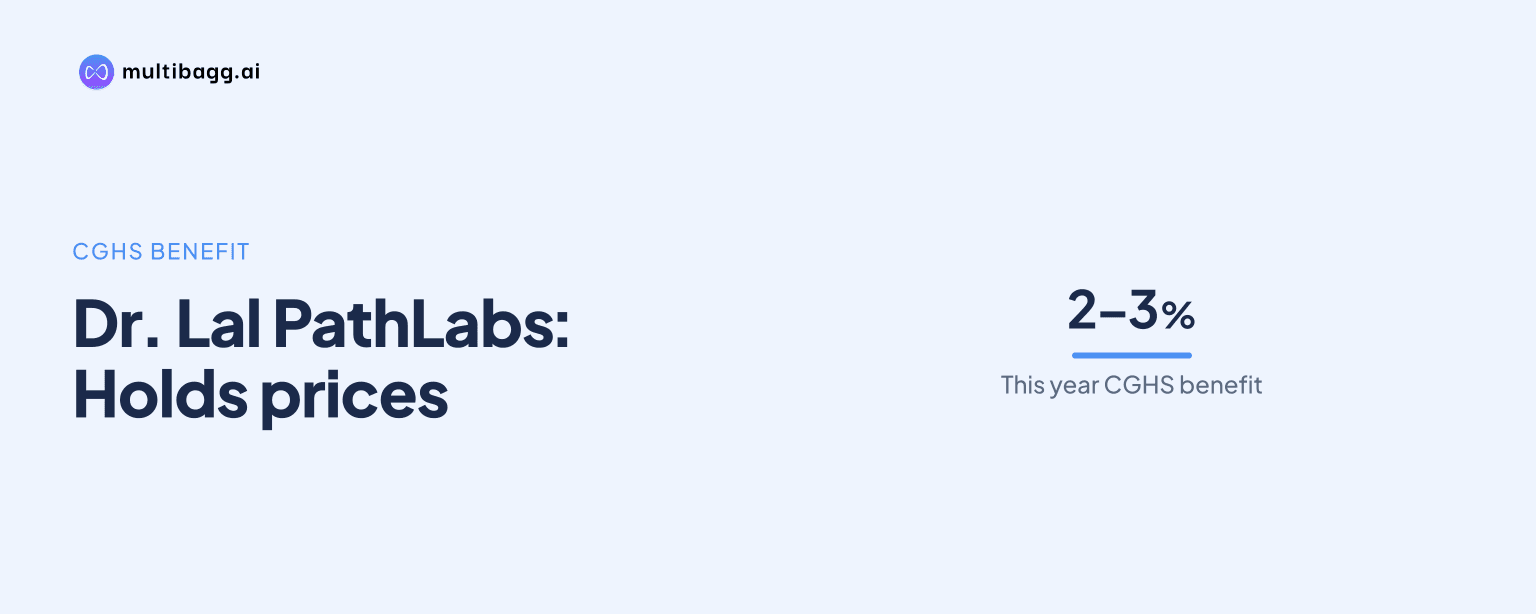
Dr. Lal PathLabs will not raise diagnostic prices immediately after more than four years without an increase, because a temporary 2% to 3% Central Government Health Scheme, or CGHS, pricing benefit is helping manage costs. Management said it will consider an increase only if cost pressures become unmanageable or market pricing benchmarks shift materially.
Know Dr Lal Pathlabs inside out
Results, valuation, peers and who's buying, in one view.
Why is Dr. Lal PathLabs keeping diagnostic prices unchanged?
Dr. Lal PathLabs is keeping prices unchanged because the CGHS rate increase is providing a 2% to 3% benefit this year, helping it manage costs without an immediate customer-price increase. Management said this benefit is temporary and will disappear from comparisons after four quarters, so it is not a permanent replacement for pricing action.
Dr. Lal PathLabs said it has not taken a price increase for more than four years, but stressed that it is not philosophically opposed to doing so. Management said it deliberately avoided increases after COVID because it wanted to keep competitive pressure on unorganised laboratories, which it identified as the diagnostics sector's largest competitive group.
Management's longer-term growth framework does not require a routine broad price increase. Dr. Lal PathLabs expects patient volumes to rise by about 6% to 7% and geography and test-mix realisation to add another 6% to 7%, supporting mid-teen organic revenue growth in management's view. Patient volumes were slightly above 8% in both the current and previous quarter, above that longer-term volume expectation.
What would make Dr. Lal PathLabs raise prices?
Dr. Lal PathLabs said two conditions could prompt a price increase: cost pressures it cannot absorb and a material move in market price benchmarks. Management has not fixed a quarter, a percentage increase, a test portfolio or a regional scope, and said it would reassess timing and quantum over the next one or two quarters.
The cost trigger includes inflationary factors identified on the call, including dollar movements, geopolitical conditions, minimum-wage changes, provident fund and gratuity-related regulatory changes, and transportation and logistics costs. Management cautioned that gross-margin improvement over the past four quarters should not be assumed to continue at the same rate as these costs develop.
The market-benchmark trigger is tied to Dr. Lal PathLabs' competitive position against unorganised laboratories. Management said it would act if market pricing moved sharply enough for its price-quality equation to work against it, but not simply to increase revenue growth. It added that any eventual increase would be below inflation on a compound annual growth rate, or CAGR, basis, to limit room for unorganised competitors to match prices.
Got a follow-up? Ask IRIS
How are margins supporting Dr. Lal PathLabs' pricing decision?
Dr. Lal PathLabs said margins are ahead of expectations, providing room to hold prices and reinvest in growth. Management expects full-year earnings before interest, tax, depreciation and amortisation, or EBITDA, to be slightly above the 27.2% reported for the previous full year, while saying the company may increase investment in the second half.
Management attributed gross-margin gains to double-digit volume growth, test mix including Swasthfit and routine testing, and internal cost-optimisation programmes. An analyst pointed to a sequential gross-margin increase of 50 basis points, or 0.5 percentage points, despite Swasthfit representing a lower share of revenue; management cited operating leverage and mix as contributors.
Infrastructure expansion is increasing absolute costs, even as management said other expenses have not risen as a share of revenue. Dr. Lal PathLabs opened 32 laboratories over the past two years and expects to open about 15 to 18 more this year. Management also linked potentially higher second-half investment to sustaining revenue growth, rather than preserving all current margin outperformance.
How does competition influence Dr. Lal PathLabs' pricing strategy?
Dr. Lal PathLabs says unorganised laboratories, rather than only metro-based organised chains, are its key competitive reference point. Management said competitive intensity remains high in both urban markets and smaller towns, and that holding prices can support the shift of testing demand from unorganised providers to organised networks.
Volume trends are management's evidence that this approach is supporting demand. Sample volume has grown at double-digit rates for several quarters, while patient volume was slightly above 8% in the current and previous quarter. Those figures exceed management's 6% to 7% longer-term patient-volume expectation, although it did not quantify current-quarter market-share gains.
Tier 3 towns and below accounted for close to 39% to 40% of revenue in the last year, according to management. Dr. Lal PathLabs said it is gaining share in these markets and does not see a need for an additional strategy beyond its current expansion and penetration model. Management also said growth is broad-based, western-region growth has improved, and Suburban has returned to double-digit growth.
Dr. Lal PathLabs makes its full test menu available across geographies, including advanced genomics tests, although turnaround times differ between markets. It is also piloting radiology as a patient-service extension in core markets where CT and MRI prescriptions have increased after COVID. Management said radiology is intended to retain patients within its network rather than be assessed as a stand-alone investment.
Conclusion
Dr. Lal PathLabs is using current operating conditions to defer a price increase, rather than ruling one out. The temporary 2% to 3% CGHS benefit, patient volumes slightly above 8% for two quarters, and a full-year EBITDA outlook slightly above 27.2% give management room to prioritise volume growth, network expansion and competition with unorganised laboratories.
The next decision point is management's stated review over the next one or two quarters of cost inflation and market pricing benchmarks. Investors can also watch whether the CGHS comparison benefit fades after four quarters, whether planned openings of about 15 to 18 laboratories proceed this year, and whether higher second-half investment changes the revenue-growth and margin trajectory.