










DreamFolks non-lounge services exceed one-third of revenue
Key highlights
- DreamFolks said non-airport-lounge services contribute more than one-third of topline.
- DreamFolks offers more than 20 premium travel and lifestyle services.
- DreamFolks reported more than 6,000 touchpoints across more than 100 countries.
- DreamFolks’ ecosystem includes 5 card networks, 20+ banks or card issuers and 50+ enterprises.
powered by IRIS
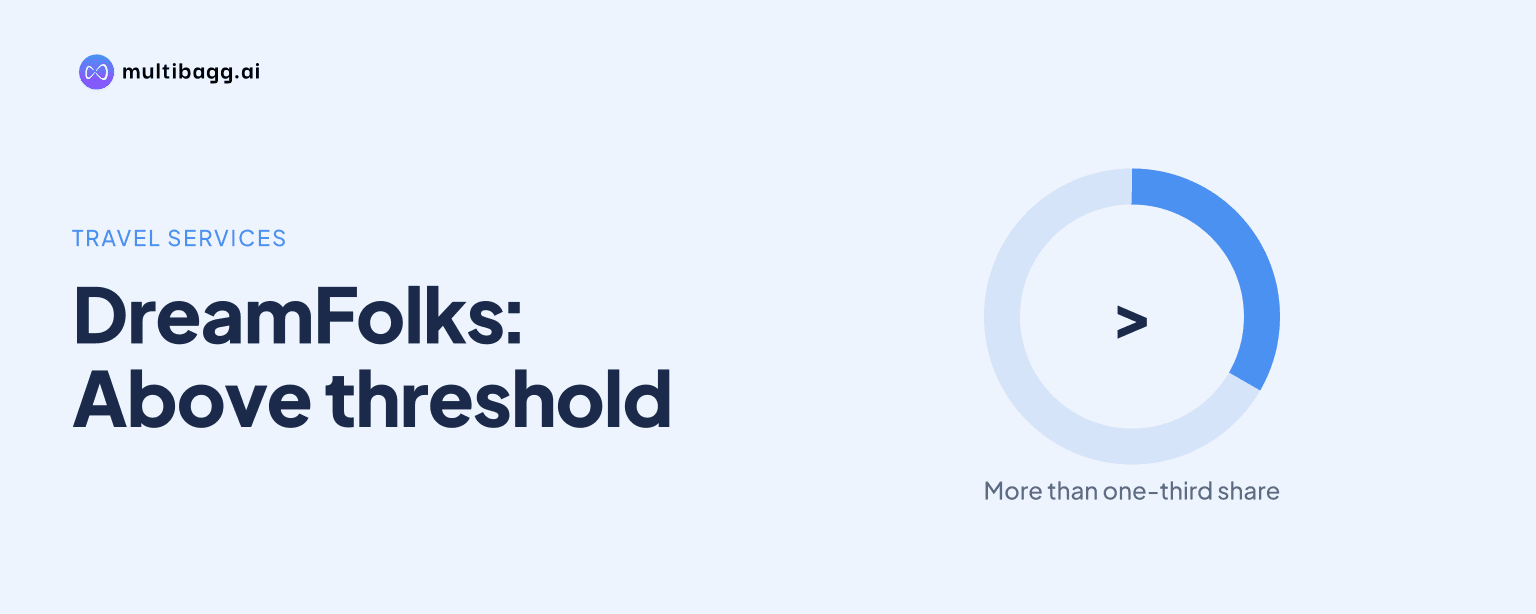
DreamFolks said in its Q2 FY27 update that non-airport-lounge services contribute more than one-third of topline, showing a broader revenue mix beyond its core lounge business. The company offers more than 20 premium travel and lifestyle services and reported a network spanning more than 6,000 touchpoints across more than 100 countries.
Know Dreamfolks Services inside out
Results, valuation, peers and who's buying, in one view.
What services is DreamFolks using to broaden revenue?
DreamFolks is using more than 20 premium travel and lifestyle services as cross-selling opportunities for clients. Its travel services include airport and railway lounges, airport transfers, meet and assist, highway dining, flight cancellation for any reason, and travel SIM services. The company said these services can be tailored to different client requirements while it continues to strengthen its lounge offering through organic and inorganic strategic initiatives.
DreamFolks’ lifestyle range includes private-club memberships, golf games and lessons, coffee, premium-hotel room upgrades and buffets, spa, beauty and wellness, and healthcare. The company said non-airport-lounge services now generate more than one-third of topline, but did not disclose the exact percentage, revenue amount or category-wise contribution. In Q2 FY27, it made coffee and member-only club access live for multiple banking clients.
DreamFolks also launched DreamFolks Club at Nagavalli Wilderness Estate in Q2 FY27 as a members-only private club. It reported healthy growth in club membership sign-ups, without providing the number of sign-ups or their revenue contribution. Separately, the company added a railway lounge at Nashik and said it maintained 100% railway-lounge coverage.
How does DreamFolks distribute its expanded services?
DreamFolks distributes services through an omni-channel hybrid model that includes DreamFolks Card, self-check-in kiosks, issuer websites, issuer physical cards, the DreamFolks app, issuer apps and web check-in. Its client groups include card issuers, card-network providers, airlines, online travel agencies and enterprises. This model allows a client programme to offer multiple travel and lifestyle services through existing consumer access channels.
DreamFolks said its in-house proprietary technology provides technology solutions, multiple access options, client-specific products and deeper client integration. The company lists ISO/IEC 27001 information-security certification, Payment Card Industry Data Security Standard version 4, SOC 1 Type 2, SOC 2 Type 1 and SOC 2 Type 2 among its certifications. It also lists LEED Gold certification.
The company presents the wider catalogue as a way to increase wallet share across services with clients. However, DreamFolks does not disclose transaction volumes, average pricing, utilisation rates or a cross-selling rate for the more than 20 services. The disclosed mechanism is distribution through client programmes rather than direct reporting of revenue by product line.
Where is DreamFolks expanding its service network?
DreamFolks reported presence across more than 100 countries and more than 6,000 touchpoints. Its disclosed network includes more than 1,100 global airport-lounge and related touchpoints, more than 3,500 social clubs, more than 860 golf courses outside India, and Fastrack at more than 50 touchpoints. These categories extend the reported network beyond airport-lounge locations.
DreamFolks said it has covered major locations across Asia Pacific and the Middle East and is actively expanding into more regions. It also reported onboarding multiple clients in the SEA region, but did not disclose the number of clients, countries, programme launches or revenue from those relationships. The presentation provides no prior-period touchpoint total, so the pace of network expansion cannot be calculated.
The network mix gives DreamFolks access points for both airport-focused and lifestyle services. More than 3,500 social clubs and more than 860 overseas golf courses form the largest disclosed non-airport categories, compared with more than 1,100 global airport-lounge and related touchpoints. The company does not state how many of these locations are live under individual client programmes.
Got a follow-up? Ask IRIS
How is DreamFolks reducing customer concentration?
DreamFolks said it is seeking to reduce customer concentration by increasing its non-banking enterprise share and diversifying its existing client base. Its ecosystem includes 5 card networks, more than 20 banks or card issuers, and more than 50 enterprises. The company noted that this list is not exhaustive, making these client counts a stated minimum rather than a complete client total.
DreamFolks said various clients and programmes were added in the last one year, which it described as steady onboarding momentum each quarter. It also said each new client expands user reach and utilisation of its airport and travel offerings. The presentation does not disclose enterprise revenue share, customer retention, revenue concentration among major clients or the number of programmes added.
The company is building a dedicated team for enterprise clients, with management citing agile execution, personalised support and stronger relationship management as its aims. DreamFolks also referred to deeper integration with top digital brands and additions across travel, technology and loyalty segments. It did not name the clients or disclose a numerical target for enterprise-client growth.
What do DreamFolks’ financials show alongside diversification?
DreamFolks reported revenue from operations of Rs 70.1 crore in H1FY27, down from Rs 554.5 crore in H1FY26. Gross profit fell to Rs 6.1 crore from Rs 75.7 crore, while adjusted earnings before interest, tax, depreciation and amortisation, adjusted for non-cash expenses, moved to a loss of Rs 25.2 crore from a profit of Rs 46.1 crore. The presentation does not attribute these changes to its diversification programme.
Profit after tax was a loss of Rs 24.6 crore in H1FY27, compared with a profit of Rs 32.5 crore in H1FY26. Net worth as of 30 September was Rs 290.1 crore in H1FY27, compared with Rs 333.5 crore a year earlier. The quarterly figures show that Q2 FY27 losses narrowed from Q1 FY27, although revenue declined sequentially.
Q2 FY27 revenue of Rs 31.1 crore was lower than Rs 39 crore in Q1 FY27 and Rs 205.5 crore in Q2 FY26. Gross profit changed from a Rs 0.9 crore loss in Q1 FY27 to a Rs 7 crore profit in Q2 FY27, while the adjusted EBITDA loss narrowed by Rs 7.6 crore sequentially to Rs 8.8 crore. Cash balance and investments declined by Rs 5.5 crore from Q1 FY27 to Rs 187.8 crore.
Conclusion
DreamFolks is broadening its service mix through more than 20 travel and lifestyle offerings, with non-airport-lounge services now contributing more than one-third of topline. Its disclosed footprint of more than 6,000 touchpoints, including more than 3,500 social clubs and more than 860 overseas golf courses, supports distribution beyond airport lounges, while its client base includes 5 card networks, more than 20 banks or card issuers and more than 50 enterprises.
What to watch next is whether DreamFolks discloses revenue, client or usage metrics for its non-airport-lounge services and enterprise programme. Management has said it is expanding into more regions, building a dedicated enterprise team and pursuing organic and inorganic initiatives for lounges, but the presentation gives no timetable, acquisition details or numerical targets for those plans.