










DreamFolks Q2 revenue fell 85% as loss hit Rs 10.74 crore
Key highlights
- DreamFolks’ Q2 FY27 revenue from operations was Rs 31.06 crore, down from Rs 205.52 crore in Q2 FY26.
- DreamFolks reported a Rs 10.74 crore loss after tax in Q2 FY27, compared with a Rs 11.23 crore profit a year earlier.
- Net cash from operating activities was Rs 35.85 crore for the period ended September 30, 2026, supported by a Rs 71.58 crore working-capital movement.
- Trade receivables fell to Rs 62.71 crore on September 30, 2026, from Rs 134.36 crore on March 31, 2026.
powered by IRIS
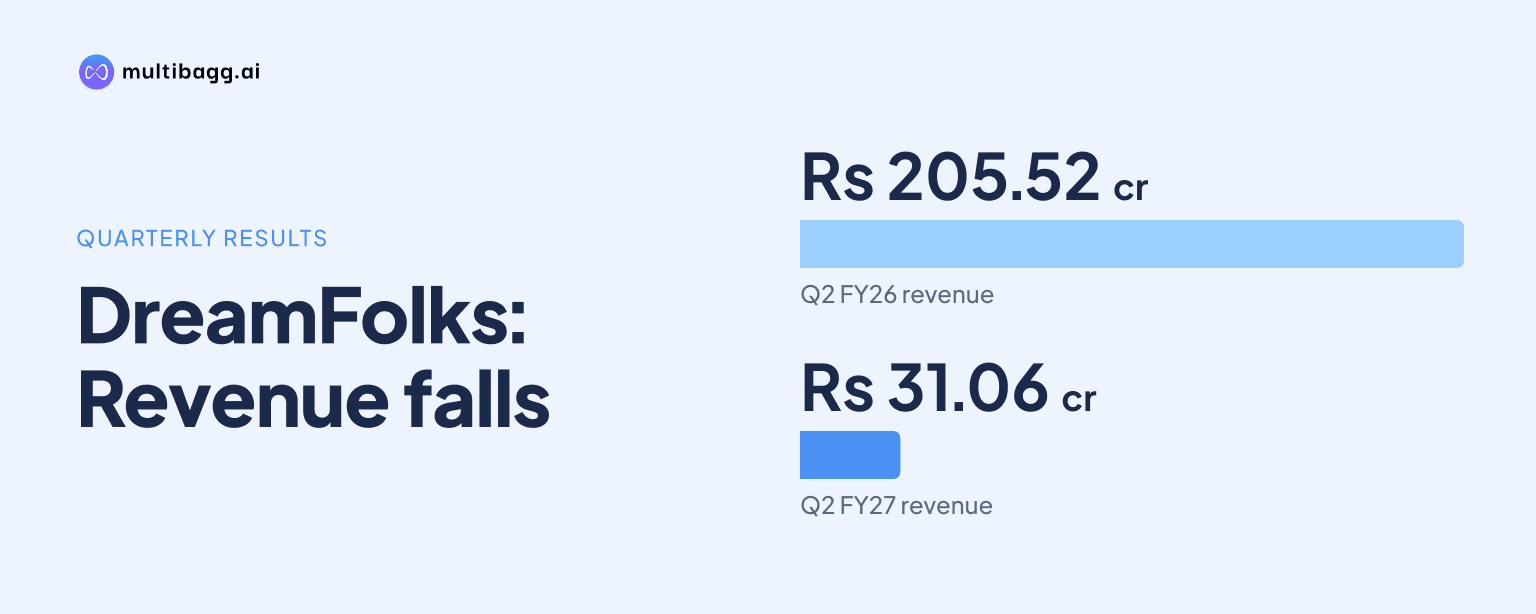
DreamFolks reported Q2 FY27 revenue from operations of Rs 31.06 crore, down 85% from Rs 205.52 crore a year earlier, while profit after tax reversed to a Rs 10.74 crore loss from a Rs 11.23 crore profit. Net cash from operating activities was Rs 35.85 crore for the period labelled year ended September 30, 2026.
Know Dreamfolks Services inside out
Results, valuation, peers and who's buying, in one view.
What do DreamFolks’ Q2 FY27 results show?
DreamFolks’ Q2 FY27 revenue from operations was Rs 31.06 crore for the quarter ended September 30, 2026, compared with Rs 205.52 crore in Q2 FY26 and Rs 39.01 crore in Q1 FY27. The year-on-year reduction was Rs 174.46 crore, or 85% when rounded, while revenue fell Rs 7.95 crore from the preceding quarter. Total income, including other income, was Rs 33.81 crore, versus Rs 209.63 crore a year earlier and Rs 42.73 crore in Q1 FY27.
DreamFolks recorded a Rs 10.74 crore loss after tax in Q2 FY27, compared with a Rs 11.23 crore profit after tax in Q2 FY26. The loss narrowed from Rs 13.83 crore in Q1 FY27. Profit before tax was a Rs 13.56 crore loss, against a Rs 15.03 crore profit in the September 2025 quarter and a Rs 18.30 crore loss in the June 2026 quarter.
How did DreamFolks’ costs change during Q2 FY27?
DreamFolks’ cost of services declined to Rs 24.07 crore in Q2 FY27 from Rs 176.33 crore in Q2 FY26 and Rs 39.89 crore in Q1 FY27. However, employee benefits expense was Rs 12.11 crore and other expenses were Rs 7.07 crore. Together with cost of services, these three expense lines totalled Rs 43.25 crore, above the quarter’s Rs 31.06 crore revenue from operations.
Adjusted earnings before interest, tax, depreciation and amortisation, or adjusted EBITDA, was a Rs 8.84 crore loss in Q2 FY27. DreamFolks defines this measure as adjusted for non-cash employee stock option plan expense and one-off impairment charges. The adjusted EBITDA loss narrowed from Rs 16.37 crore in Q1 FY27 but reversed from adjusted EBITDA of Rs 15.60 crore in Q2 FY26.
The cost of services reduction of Rs 152.26 crore year on year was smaller than the Rs 174.46 crore revenue reduction. Employee benefits expense increased by Rs 0.87 crore from Rs 11.24 crore in Q2 FY26, while other expenses rose Rs 1.08 crore from Rs 5.99 crore. The presentation does not provide management’s explanation for the revenue decline or these cost movements.
Why was DreamFolks’ operating cash flow positive despite a loss?
DreamFolks generated Rs 35.85 crore of net cash from operating activities for the period labelled year ended September 30, 2026, despite a Rs 31.87 crore loss before tax for that period. Operating profit before working-capital changes was negative Rs 32.27 crore. A positive Rs 71.58 crore change in working capital then resulted in Rs 39.31 crore of cash generated from operating activities before tax payments.
After net income taxes paid of Rs 3.46 crore, net operating cash flow was Rs 35.85 crore, compared with Rs 8.31 crore for the year ended March 31, 2026. The reported working-capital movement was therefore the mechanism that offset the pre-tax loss in the cash-flow statement. DreamFolks does not identify the individual receivable, payable, inventory or other balance-sheet movements behind the Rs 71.58 crore figure.
DreamFolks reported Rs 34.48 crore of net cash used in investing activities and Rs 1.23 crore used in financing activities for the period ended September 30, 2026. Cash and cash equivalents consequently increased by Rs 14 lakh to Rs 11.23 crore from Rs 11.10 crore at the beginning of the period. The reconciliation also includes a negative foreign-exchange difference of Rs 10 lakh.
Got a follow-up? Ask IRIS
What changed in DreamFolks’ balance sheet by September 2026?
DreamFolks’ total assets stood at Rs 367.19 crore on September 30, 2026, down from Rs 383.71 crore on March 31, 2026. Current assets fell to Rs 297.01 crore from Rs 344.38 crore, led by trade receivables declining Rs 71.65 crore to Rs 62.71 crore. Other current assets fell to Rs 23.29 crore from Rs 42.72 crore, while current investments increased to Rs 144.48 crore from Rs 102.56 crore.
Non-current assets increased to Rs 70.18 crore from Rs 39.33 crore over the same period. DreamFolks recorded Rs 11.65 crore of non-current investments at September 30, where none was listed at March 31, while right-of-use assets increased to Rs 19.67 crore from Rs 9.03 crore. Deferred tax assets, net, rose to Rs 14.46 crore from Rs 6.59 crore.
Total equity declined to Rs 294.58 crore from Rs 319.55 crore, including other equity falling to Rs 279.48 crore from Rs 303.13 crore. Current liabilities were broadly unchanged at Rs 48.89 crore versus Rs 49.36 crore. Combined current and non-current lease liabilities rose to Rs 21.24 crore from Rs 9.46 crore, while combined borrowings increased to Rs 4.46 crore from Rs 2.88 crore.
What expansion and industry indicators does DreamFolks disclose?
DreamFolks lists a Vadodara railway lounge, coverage of more than 1,000 global lounges, a boarding pass-based benefits programme and DreamFolks Club Nagavalli in its 2026-and-beyond timeline. These are product and network developments, not financial guidance. The presentation gives no revenue target, profitability target or financial contribution timetable for these initiatives.
DreamFolks also lists its 2024-25 entry into Malaysia, The DreamFolks Club 2.0, Highway Dining and Coffee, a members-only club and the acquisition of Ten 11 Hospitality. It says the Easy To Travel acquisition was announced, but does not disclose purchase consideration, completion timing or financial effect. The unresolved transaction details remain relevant alongside Q2 FY27 revenue of Rs 31.06 crore.
Reserve Bank of India data cited by DreamFolks show 125.3 million credit cards in circulation at the end of Q2 FY27, up 10.5% year on year from 113.4 million in Q2 FY26. Average spend per credit card rose to Rs 54,400 from Rs 53,600, a 1.6% increase. Those industry measures increased while DreamFolks’ revenue fell 85% year on year, and the presentation does not state a causal link between the trends.
Conclusion
DreamFolks’ Q2 FY27 results show a material earnings reversal, with revenue from operations falling to Rs 31.06 crore from Rs 205.52 crore and profit after tax moving from a Rs 11.23 crore profit to a Rs 10.74 crore loss. Its Rs 35.85 crore of operating cash flow was supported by a Rs 71.58 crore positive working-capital movement, while operating profit before working-capital changes was a Rs 32.27 crore loss.
Next, investors can watch whether DreamFolks’ stated 2026-and-beyond plans, including more than 1,000 global lounges and the boarding pass-based benefits programme, are followed by disclosed revenue or profitability progress. The presentation also leaves the completion timing and financial impact of the announced Easy To Travel acquisition unresolved, while trade receivables had fallen to Rs 62.71 crore by September 30, 2026.