










EID Parry cuts volume 39% as contribution margin reaches 2.25x
Key highlights
- EID Parry's total sweeteners volume fell 39% to 32,915 MT in H1 FY27 from 53,980 MT in H1 FY26.
- EID Parry's realisation increased to Rs 54.1 per kg in H1 FY27 from Rs 44.1 per kg a year earlier.
- EID Parry's value-added portfolio saliency rose to about 28% in H1 FY27 from about 16% in H1 FY26.
- EID Parry's premium-white volume rose to 4,892 MT in H1 FY27 from 2,619 MT in H1 FY26.
powered by IRIS
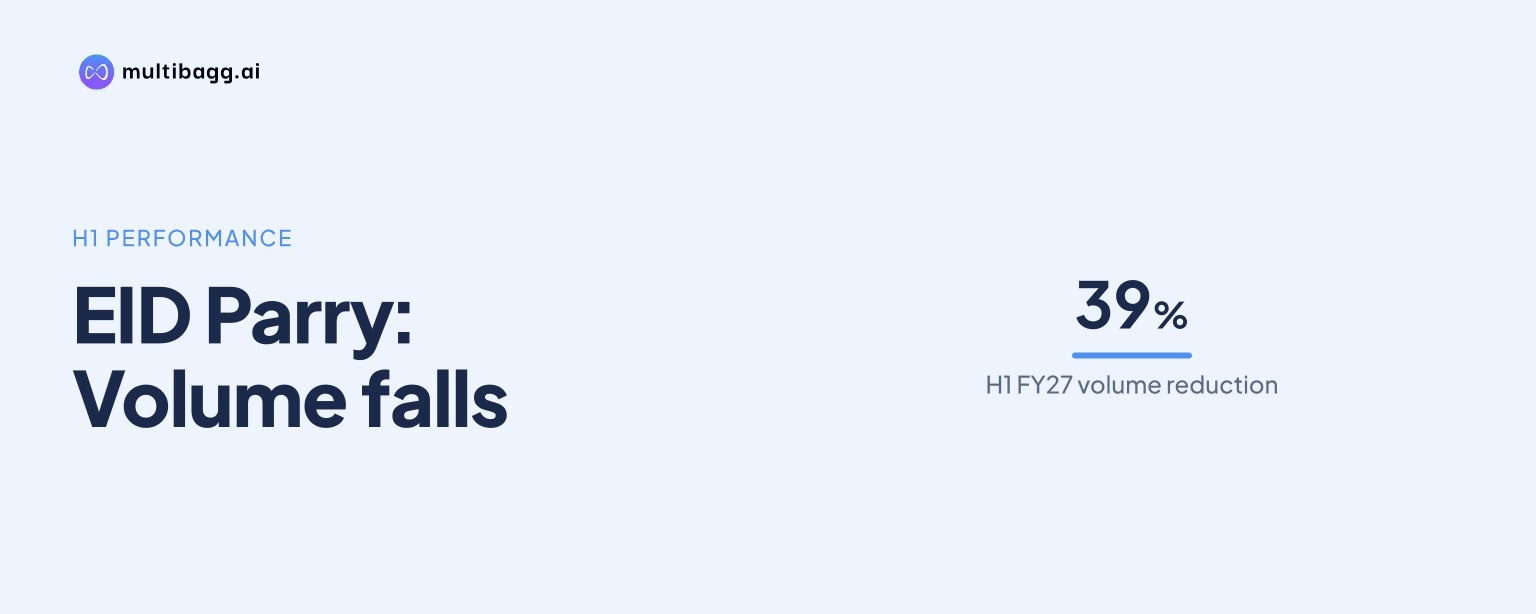
In H1 FY27, EID Parry (India) Limited cut total sweeteners volume 39% to 32,915 metric tonnes while absolute contribution margin increased to about 2.25 times the prior-year level. EID Parry shifted away from lower-contribution bulk categories, raised prices and increased value-added portfolio saliency to about 28% from about 16% in H1 FY26.
Know EID Parry (India) inside out
Results, valuation, peers and who's buying, in one view.
Why did EID Parry's sweeteners volume decline in H1 FY27?
EID Parry's total sweeteners volume declined from 53,980 metric tonnes (MT) in H1 FY26 to 32,915 MT in H1 FY27, a reduction of 39%. The principal change was in bulk packs, whose volume fell from 11,425 MT to 2,215 MT, while consumer-pack volume declined from 42,555 MT to 30,700 MT. Management describes the consumer-pack reduction as a conscious outcome of channel corrections and price increases intended to strengthen brand equity.
The volume decline coincided with a lower reported sweeteners value of Rs 178.0 crore in H1 FY27, compared with Rs 238.2 crore in H1 FY26. That decline was smaller than the volume reduction because realisation rose from Rs 44.1 per kg to Rs 54.1 per kg. The Rs 10 per kg increase shows that pricing and product mix offset part, but not all, of the effect of lower volumes.
How is EID Parry changing its product mix?
EID Parry is moving to a value-added, brand-led portfolio centred on jaggery and other sweeteners, while de-focusing rice and pulses categories where initial scale-up did not meet expectations. Value-added portfolio, or VAP, saliency increased from about 16% in H1 FY26 to about 28% in H1 FY27. Consumer-pack saliency also increased from about 74% to about 87% over the same period, reducing the role of bulk business in the mix.
Within consumer packs, EID Parry's premium whites grew from 2,619 MT in H1 FY26 to 4,892 MT in H1 FY27, an increase of about 87%. This contrasts with white consumer packs, which fell from 35,383 MT to 21,497 MT, and browns, which moved from 4,553 MT to 4,311 MT. The data show that the mix shift was not a broad consumer-pack expansion: EID Parry accepted lower white-sugar volume while increasing premium-white sales.
Which sweetener categories support EID Parry's premiumisation plan?
EID Parry participates in value-added categories with higher stated growth rates than the core sugar category. The presentation places EID Parry in sugar, jaggery powder, brown sugar, superfine sugar and low-glycaemic-index sweeteners. Jaggery powder has a stated business-to-consumer market size of Rs 178 crore and a 28% to 30% compound annual growth rate, while brown sugar is Rs 222 crore with a 25% to 30% growth rate.
By comparison, the Rs 40,004 crore sugar category is projected to grow at 0% to 1%, although it remains the largest category in the displayed opportunity set. EID Parry also has a presence in superfine sugar, a Rs 44 crore category growing at 10% to 12%, and low-glycaemic-index sweeteners, a Rs 27 crore category growing at 15% to 20%. It has no listed presence in jaggery blocks, icing sugar, molecule sweeteners, stevia or half-calorie sweeteners.
Got a follow-up? Ask IRIS
How will channels and innovation support EID Parry's strategy?
EID Parry assigns different roles to each sales channel in FY27. Modern trade and e-commerce are intended to drive premium products and new-category adoption, while general trade is intended to convert consumers from unbranded to branded products. EID Parry plans to expand its general-trade touchpoints to about 60,000 outlets by the end of FY27 through targeted programmes for high-performance outlets.
The channel allocation aligns with market trends identified in the presentation. Modern trade and e-commerce are stated to be growing above 20%, compared with 5% for general trade, while private labels from operators such as Big Basket and Reliance are growing at 20% to 25%. EID Parry also notes that the organised sugar market, currently at 8%, is expected to reach about 15% over the next four to five years, making branded conversion a stated route to category growth.
EID Parry has set up a research and development facility to support innovation and launched dessert mixes in select channels during H1 FY27. Other launches are in the innovation pipeline, with new products focused on value-added sweeteners. Management is also evaluating ethnic snacking and culinary convenience as adjacencies, rather than presenting them as operating categories with reported sales or profit figures.
What does the larger retail-sugar market imply for EID Parry?
EID Parry's presentation estimates India's branded retail sugar market at Rs 5,000 crore to Rs 5,500 crore in 2025 and Rs 7,750 crore to Rs 8,250 crore by 2030. It attributes the projected increase chiefly to greater branded penetration, estimated to add Rs 1,700 crore to Rs 1,800 crore, and premiumisation, estimated to add Rs 700 crore to Rs 800 crore. Inflation is estimated to contribute a further Rs 400 crore to Rs 450 crore.
The presentation expects branded penetration to rise to 12% to 13% by FY30, from an indicated 8% to 10% currently. Consumption-led volume growth is expected to add only Rs 100 crore to Rs 150 crore, based on a 0.5% to 1% increase in per-capita sugar consumption that is moderated by health awareness. This market framing is consistent with EID Parry's decision to prioritise consumer-pack premiumisation and niche sweeteners over high-volume bulk categories.
Conclusion
EID Parry's H1 FY27 results show a deliberate trade-off between scale and mix. Total sweeteners volume dropped 39% and reported value declined from Rs 238.2 crore to Rs 178.0 crore, but realisation increased by Rs 10 per kg, VAP saliency rose by about 12 percentage points and absolute contribution margin increased to about 2.25 times the H1 FY26 level. Premium whites, at 4,892 MT, were the clearest volume growth area within consumer packs.
The next disclosed milestones are expansion to about 60,000 general-trade outlets by the end of FY27, further value-added sweetener launches and progress in dessert mixes across selected channels. Management's evaluation of ethnic snacking and culinary convenience remains unresolved, while the presentation does not disclose a revenue, profit or market-share target for those potential adjacencies.