










EID Parry sugar revenue rose Rs 248 crore in H1 FY27
Key highlights
- Parry's sugar revenue increased by approximately Rs 248 crore in H1 FY27.
- Parry's sugar sales rose to 172.2 thousand metric tonnes in H1 FY27 from 118.8 thousand metric tonnes a year earlier.
- Parry's average sugar realisation rose to Rs 42.4 per kg from Rs 40.8 per kg.
- Parry's cash fixed costs declined to Rs 147 crore in H1 FY27 from Rs 157 crore in H1 FY26.
powered by IRIS
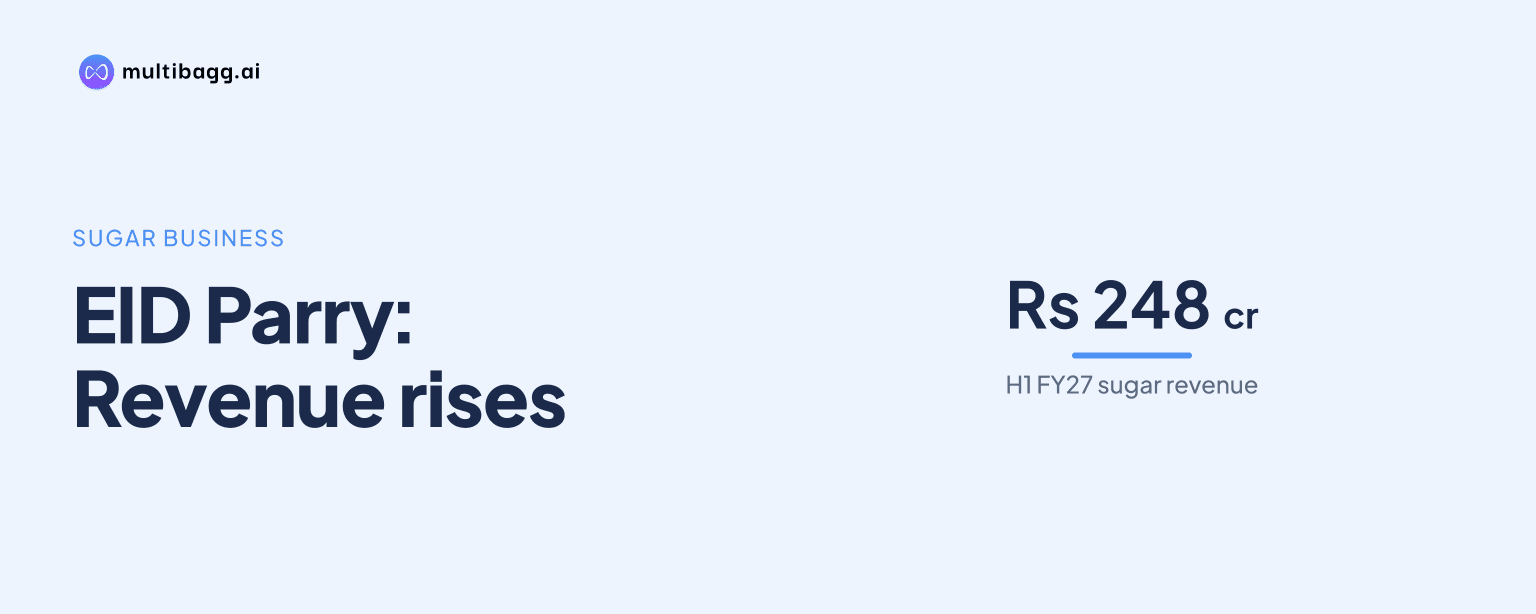
EID Parry reported an approximately Rs 248 crore increase in sugar revenue in H1 FY27, driven by sugar sales rising to 172.2 thousand metric tonnes and average realisation increasing to Rs 42.4 per kg, despite cane crushed declining to 5.5 lakh metric tonnes and gross recovery falling to 7.8%.
Know EID Parry (India) inside out
Results, valuation, peers and who's buying, in one view.
What drove Parry's sugar revenue increase in H1 FY27?
Parry's sugar revenue rose by about Rs 248 crore in H1 FY27 because both sugar sales volume and average realisation increased. Sugar sales rose from 118.8 thousand metric tonnes in H1 FY26 to 172.2 thousand metric tonnes in H1 FY27, while average realisation rose from Rs 40.8 per kg to Rs 42.4 per kg.
The 53.4 thousand-metric-tonne rise in sales occurred even though the sugar mills processed less cane during H1 FY27. This shows that the reported revenue increase was associated with higher sales and pricing rather than increased cane processing or recovery. The presentation gives the approximately Rs 248 crore increase as a sugar-business update and does not disclose the segment's revenue base for either half-year.
India's projected closing sugar stock was 3.7 million metric tonnes in SY26, down from 5.0 million metric tonnes in SY25, according to the presentation's domestic sugar-balance table. It also shows projected SY26 sugar production of 31.0 million metric tonnes, consumption of 28.5 million metric tonnes and exports of 0.8 million metric tonnes; management said the pricing outlook dynamics appeared positive.
How did Parry's cane crushing and recovery change?
Parry's cane crushed declined to 5.5 lakh metric tonnes in H1 FY27 from 5.8 lakh metric tonnes in H1 FY26, while gross recovery fell to 7.8% from 8.0%. The 0.3 lakh-metric-tonne reduction in cane crushed and 0.2-percentage-point recovery decline contrast with the increase in sugar sales to 172.2 thousand metric tonnes.
Cane crushed is the volume processed by the mills, and gross recovery is the proportion of sugar recovered from cane. The H1 FY27 movements in both production measures were lower year on year, whereas sugar realisation increased by Rs 1.6 per kg. The supplied presentation does not provide sugar production, closing inventory or capacity-utilisation figures for Parry's mills to explain the difference between processing and sales.
Parry's said it had intensified farmer-engagement programmes across operating regions to enhance cane yield and recovery. Management expects benefits to reflect in cane yields and recovery, but its FY27 update does not disclose a yield target, recovery target or specific delivery date for those benefits.
Did Parry's sugar and bio-fuel business report a quarterly profit?
The supplied H1 FY27 pages do not report a quarterly profit, loss, margin or profit before interest and tax for Parry's sugar and bio-fuel business. They report an approximately Rs 248 crore sugar revenue increase, an approximately Rs 27 crore distillery revenue decrease, and cash fixed costs of Rs 147 crore in H1 FY27.
Parry's did report positive free cash flow in Q2 FY27, which it attributed to continued cost discipline, improved inventory management and collections. However, the presentation does not state the free-cash-flow amount, and a cash-flow outcome is not a disclosed quarterly operating-profit measure. The supplied material therefore cannot substantiate a loss-to-profit transition or quantify any quarterly segment profit.
The available operating evidence nonetheless identifies the main H1 FY27 changes. Sugar sales increased by 53.4 thousand metric tonnes and realisation rose by Rs 1.6 per kg, while cane crushed fell by 0.3 lakh metric tonnes and recovery declined by 0.2 percentage points. Establishing segment profitability would require a reported profit measure or a fuller cost base, neither of which appears on the supplied pages.
Got a follow-up? Ask IRIS
What changed in Parry's distillery business in H1 FY27?
Parry's distillery revenue decreased by about Rs 27 crore in H1 FY27 because of product mix, according to management. Extra neutral alcohol, or ENA, sales increased from 327 lakh litres to 350 lakh litres, but ethanol sales declined from 497 lakh litres to 459 lakh litres and blended realisation fell from Rs 67.6 per litre to Rs 63.8 per litre.
The ethanol mix changed across feedstocks in H1 FY27. B-heavy ethanol sales increased from 216 lakh litres to 247 lakh litres, while C-heavy ethanol declined from 73 lakh litres to 46 lakh litres, syrup ethanol fell from 28 lakh litres to 6 lakh litres, and grain ethanol decreased from 179 lakh litres to 160 lakh litres.
The presentation says the government prohibited diversion of syrup and B-heavy molasses for ethanol in ethanol supply year, or ESY, 2026-27. In the preceding SY25-26, diversion for ethanol was 31 lakh metric tonnes of sugar, compared with 35 lakh metric tonnes in SY24-25. It also states that sugar contributed 30% of supplies to oil marketing companies in ESY25-26, compared with 70% from grain.
How is Parry's managing costs, cash and expansion in FY27?
Parry's cash fixed costs declined by about 6% to Rs 147 crore in H1 FY27 from Rs 157 crore in H1 FY26. The presentation says the comparison excludes one-off expenses of Rs 11 crore and places the reduction within its FY27 objective of improving operational efficiencies.
Management linked the positive Q2 FY27 free cash flow to cost discipline, inventory management and collections, without providing a free-cash-flow amount, inventory balance or collection metric. Its FY27 strategic focus also includes maximising revenue across sugar, co-generation and distillery operations, alongside better working-capital and cash-flow management.
A new jaggery facility in Karnataka is under construction for retail, institutional and export markets. Parry's expects commissioning in Q4 FY27, after the schedule shifted by one quarter because of statutory-approval delays. The presentation does not disclose the facility's capacity, capital expenditure or expected revenue contribution.
Conclusion
Parry's H1 FY27 sugar update points to a revenue-led improvement rather than higher mill throughput. Sugar sales increased to 172.2 thousand metric tonnes and realisation reached Rs 42.4 per kg, producing an approximately Rs 248 crore revenue increase, while cane crushed fell to 5.5 lakh metric tonnes and gross recovery declined to 7.8%. The Rs 10 crore reduction in cash fixed costs added a separate cost-control element.
What to watch next is the Q4 FY27 commissioning target for the Karnataka jaggery facility, following the one-quarter delay in statutory approvals, and whether farmer-engagement programmes improve cane yield and recovery. Future disclosures will also be needed to assess the sugar and bio-fuel business's profitability directly, as the supplied H1 FY27 pages do not provide a segment profit figure.