










Electrosteel targets 700,000 tonnes as JJM pipeline opens
Key highlights
- Electrosteel sees approximately 2.5 million tonnes of JJM orders opening from Q4 through H1 FY29.
- Management said Electrosteel should hit 700,000 tonnes of dispatches in FY28.
- Electrosteel’s current order book is about 300,000 tonnes, including 60,000 to 70,000 tonnes of JJM orders.
- Q2 FY27 pipe and fittings sales were 121,000 tonnes, versus 120,000 tonnes in Q1 FY27.
powered by IRIS
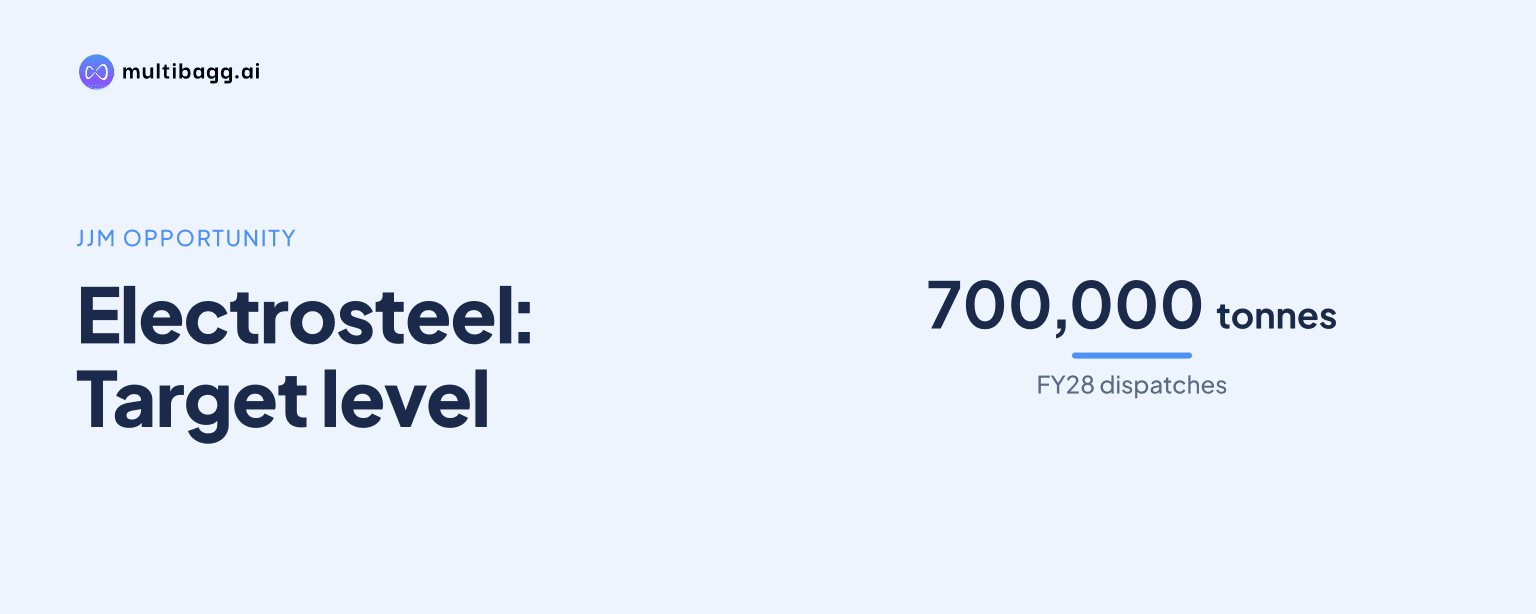
Electrosteel Castings Limited expects approximately 2.5 million tonnes of unexecuted Jal Jeevan Mission, or JJM, pipe orders to start opening from Q4, and management said Electrosteel should reach 700,000 tonnes of dispatches in FY28. The recovery has been delayed by roughly three to six months, but management expects demand momentum to build through FY28 and the first half of FY29.
Know Electrosteel Castings inside out
Results, valuation, peers and who's buying, in one view.
How large is Electrosteel’s JJM opportunity?
Electrosteel sees approximately 2.5 million tonnes of JJM order book either already awarded or yet to be tendered that has not turned into dispatches. Management said this pipeline should start opening in Q4, with most orders expected to play out during FY28 and H1 FY29. This is materially larger than Electrosteel’s current total order book of about 300,000 tonnes.
Within the existing 300,000-tonne order book, JJM accounts for approximately 60,000 to 70,000 tonnes, or about one-fifth to nearly one-quarter of the total. Management distinguished this immediate backlog from the broader 2.5 million-tonne JJM opportunity, which includes orders on contractors’ books and fresh tenders rather than only pipe volumes currently scheduled for Electrosteel.
The funding backdrop has improved, according to management, but the effect on pipe dispatches has lagged. The FY27 Union Budget allocated Rs 67,670 crore to JJM, while central sanction orders had reached approximately Rs 16,487 crore at the time of the call, compared with Rs 10,344 crore at the previous call. Management said much of the recent allocation was used to clear contractors’ long-overdue payments before translating into new procurement.
When does Electrosteel expect pipe demand to recover?
Electrosteel expects a progressive recovery in H2 FY27, but management said the more substantial improvement should arrive in the next financial year. It described H2 FY27 volumes as likely to be marginally better than H1 FY27, rather than a sharp acceleration. The timing reflects a delay in JJM fund-flow implementation, which management had expected in Q2 but now sees in Q3.
Management said the JJM demand increase has shifted by around three to six months because the central government was putting processes and systems in place. That revision explains why Electrosteel moved its expectation for a return to higher margins from Q3 FY27 to the next financial year. The company said it now needs roughly four to six months more than the timeline indicated during its Q1 call to reach those levels.
Reported pipe volumes show why the company is waiting for a broader demand pickup. Sales of ductile iron, or DI, pipes and fittings and cast-iron pipes were 121,000 tonnes in Q2 FY27, compared with 120,000 tonnes in Q1 FY27, an increase of only 1,000 tonnes quarter on quarter. Management nevertheless said operations had improved over the past two quarters compared with H2 of the prior financial year.
Can Electrosteel reach 700,000 tonnes in FY28?
Electrosteel said 700,000 tonnes of FY28 dispatches is a level it should hit, while management did not commit to the analyst’s higher 700,000-to-800,000-tonne range. The statement is based on the anticipated release of the 2.5 million-tonne JJM pipeline from Q4 through FY28 and H1 FY29. It is a management target rather than reported FY28 guidance.
The current order position provides a shorter-term bridge but does not itself establish the FY28 target. Electrosteel said its approximately 300,000 tonnes of orders represent about six to six-and-a-half months of manufacturing capacity, although the orders are expected to be dispatched over around nine months. Management said that timing leaves room for new orders booked at revised prices to enter the dispatch mix during Q3 and Q4.
Management also expects river-linking projects to become a demand contributor from the next financial year. It said smaller projects related to river linking already exist, but these are supplementary and not directly part of the main programme. The company therefore did not quantify river-linking volumes or include a specific dispatch target linked to that programme.
Got a follow-up? Ask IRIS
What could FY28 mean for Electrosteel’s margins and utilisation?
Electrosteel said it is hoping to return to an EBITDA margin of 12% in the next financial year, supported by improved markets and diversification. EBITDA means earnings before interest, tax, depreciation and amortisation. This would compare with reported consolidated EBITDA margin of 8.9% in Q2 FY27 and 9.2% in H1 FY27.
The margin recovery is not expected to be immediate because management said higher coking-coal costs will have their main impact in Q3 and Q4 FY27. Electrosteel said it had passed through around 60% to 70% of the cost increase and was working to pass on more, with the full effect expected around the end of Q4. Management expects H2 FY27 margins to be similar to, or slightly above, H1 FY27 levels rather than near 12%.
Electrosteel also said industry capacity utilisation of 75% to 80% over the next two years is feasible based on JJM demand outlay and central and state government spending. Management’s view was that this utilisation range could be achieved without excessive price cutting solely to fill capacity. The company did not provide an industry capacity figure or its own expected utilisation rate.
How do exports and contract terms affect the recovery?
Electrosteel said exports have slowed slightly, particularly because Europe, described as a major market, is experiencing a slowdown. Management said export margins had improved by shifting attention toward high-value destinations instead of high-volume destinations. Despite challenges in the Middle East and Europe, it said exports remained above 20% of the company’s contribution and that it expects to maintain that level.
Saudi Arabian anti-dumping duties have created what management called a mild setback because Electrosteel’s duty is lower than that faced by some other Indian manufacturers. Management said Electrosteel would retain some Saudi presence and had opened other markets that could partly offset volume lost elsewhere. It did not quantify Saudi shipments, export revenue or the new markets’ expected volumes.
On raw-material exposure, management said export orders are fixed-price, while government orders representing about 5% to 7% of the domestic order book are also more directly fixed-price. For most other domestic orders, Electrosteel said it can discuss the effect of a dramatic cost change with customers. Management expects new Q3 and Q4 orders at higher rates to help recover at least half of the increased cost through dispatches in those quarters.
Conclusion
Electrosteel’s FY28 dispatch aspiration rests on a delayed but large JJM pipeline: approximately 2.5 million tonnes of awarded or forthcoming orders that management expects to begin opening in Q4. The contrast with 121,000 tonnes of Q2 FY27 pipe and fittings sales shows that the expected recovery depends on tender conversion and contractor procurement, not merely the company’s existing 300,000-tonne order book.
The next checkpoints are H2 FY27 volumes and margins, the pace of JJM tender releases from Q4, and whether FY28 demand supports management’s 700,000-tonne target and hoped-for 12% EBITDA margin. Electrosteel also expects its Indian valve factory to commence operations by the end of FY27 and the first 1,000-kilolitre phase of its paints project to be commissioned by March 2027.