










Electrosteel targets 50% pipes share through diversification
Key highlights
- Electrosteel aims to reduce pipes and fittings from about 75%-80% to 50% of revenue.
- Electrosteel targets Rs 800 crore of valve revenue by 2030, with 60%-65% expected from overseas.
- Electrosteel expects 1,000 KL of external coatings capacity by March 2027 to add Rs 80 crore to Rs 100 crore of revenue.
- Electrosteel expects about 7 lakh tonnes of dispatches in the next financial year.
powered by IRIS
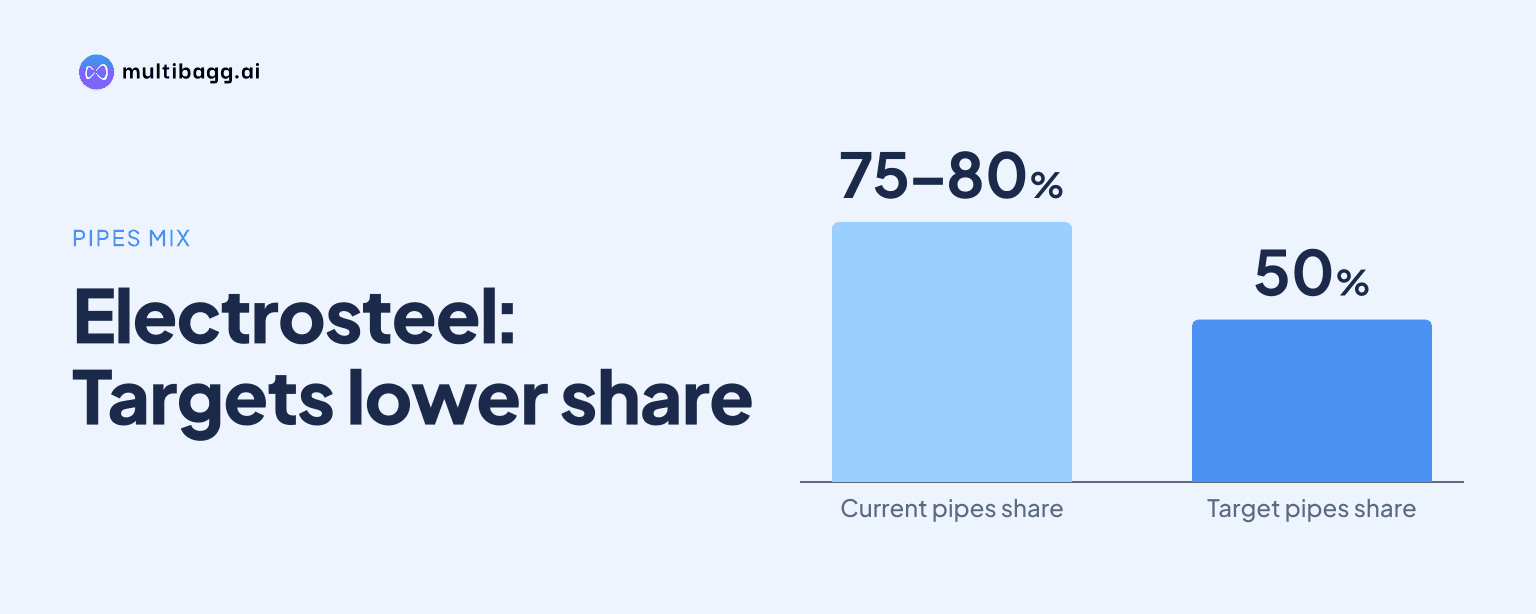
Electrosteel plans to reduce pipes and fittings from roughly 75%-80% to 50% of revenue by expanding water valves and industrial coatings, with management targeting Rs 800 crore of valve revenue by 2030 and 1,000 kilolitres of external coatings capacity by March 2027. The plan is intended to reduce dependence on swings in pipe demand.
Know Electrosteel Castings inside out
Results, valuation, peers and who's buying, in one view.
How will Electrosteel reduce pipes' revenue share?
Electrosteel intends to reduce pipes and fittings to 50% of revenue from about 75%-80% by building water-valve and industrial-paints businesses. Management said it wants diversified products together to eventually contribute as much as the ductile-iron, or DI, pipe business, rather than remain small additions to pipe-related sales.
The plan does not assume a retreat from pipes. Electrosteel expects about 7 lakh tonnes of dispatches in the next financial year, after reporting close to 2.5 lakh tonnes in the first half and forecasting second-half volume broadly similar to, or slightly above, the first half. A recovery in the core business would therefore provide the cash flow and customer base alongside which valves and coatings are being developed.
Management linked the need for diversification to delayed water-infrastructure execution. It said Jal Jeevan Mission, or JJM, fund flows expected in the second quarter were delayed as the central government implemented processes and systems, pushing demand by about three to six months. It consequently moved its expectation of returning to 12%-13% earnings before interest, tax, depreciation and amortisation, or EBITDA, margins to the next financial year.
What is Electrosteel's water-valve revenue plan?
Electrosteel is targeting Rs 800 crore of water-valve revenue by 2030, with India expected to contribute about Rs 250 crore to Rs 300 crore and overseas markets accounting for the remaining 60%-65%. Management clarified that the Rs 800 crore objective is not confined to India, although it described the Indian valve market as about Rs 2,000 crore.
The domestic valve plant is expected to commence by the end of the current financial year, so management expects the material domestic contribution to begin only after that point. It named AVK, Hawle and VAG as international valve operators in India, and IVC and Jupiter Valves as private Indian players. Electrosteel did not disclose current valve revenue, profitability or market share.
Management described water valves as a high-value, high-precision product adjacent to its water-infrastructure operations. It also pointed to an existing largely overseas business of about Rs 400 crore when explaining its export reach. Because more than half of the valve target is planned from outside India, overseas sales development is central to the revenue objective.
How much revenue could coatings add for Electrosteel?
Electrosteel expects 1,000 kilolitres, or KL, of external industrial-coatings capacity to be commissioned by March 2027, potentially adding Rs 80 crore to Rs 100 crore of revenue in the following financial year. That external capacity is distinct from about 4,200 KL of existing capacity, which also meets captive requirements for pipe operations.
Management said the first phase is planned to reach about 4,000 KL and could generate Rs 250 crore to Rs 300 crore once commissioned, which it associated with 2028-2029. The business will focus on industrial paints and protective coatings rather than retail paint. Electrosteel cited coatings already made in-house for pipes sold into France and Germany as evidence of its technical manufacturing capability.
The coatings expansion can be funded entirely from internal accruals, according to management. It also said existing working-capital lines have sufficient room for at least the next two to three years following optimisation of inventory, overdue balances and trade receivables. Management did not quantify funding required for a later expansion phase.
Got a follow-up? Ask IRIS
What export base can support Electrosteel's new businesses?
Electrosteel said exports remain above 20% of its business despite a temporary European slowdown and import-duty pressure in certain markets. Management described about 50% of exports as coming from the United Kingdom and Europe, with the other 50% spread across the Middle East, Africa, the United States and Southeast Asia.
The company said it has shifted its export focus toward higher-value destinations rather than higher-volume destinations. Management expects export volumes to grow over the FY 2026 base, although it acknowledged a small volume impact from Saudi Arabian duties and earlier duty increases in Europe. Those markets matter for valves because 60%-65% of the Rs 800 crore target is expected from overseas.
Electrosteel invested in Singardo in the previous financial year to access Southeast Asia and recently invested in Oman-based trading company Arabian Water Tech. Management said the two investments open opportunities in their respective geographies. It also plans to use its global financial, physical and administrative network to increase exports of industrial paints and protective coatings.
What could delay Electrosteel's diversification timetable?
A slower recovery in pipe demand could delay the cash generation and customer activity supporting Electrosteel's diversification timetable. Management said around 2.5 million tonnes of JJM orders are either already on books or yet to be tendered, with most expected to play out from FY 2028 through the first half of FY 2029. It said the JJM implementation delay and coal-cost variation caused the four-to-six-month postponement of its margin expectation.
Management expects industry capacity utilisation of 75%-80% over the next two years to be achievable without excessive price cutting, based on JJM and central and state government spending. Its current order book is about 3 lakh tonnes, including about 60,000 to 70,000 tonnes associated with JJM. The company also said it has about six to 6.5 months of orders against manufacturing capacity, with those orders expected to play out over about nine months.
River-linking projects are another potential demand source, but management said their direct pipe effect is still developing. It identified Ken-Betwa between Uttar Pradesh and Madhya Pradesh as the near-term project with on-ground preliminary work, while saying pipe demand has not materialised yet. Management expects River Link to start affecting demand by the next financial year.
Conclusion
Electrosteel has set measurable diversification objectives rather than only a broad expansion ambition. It wants pipes and fittings to fall from 75%-80% to 50% of revenue, targets Rs 800 crore of water-valve sales by 2030 and expects the initial 1,000 KL external coatings capacity to add Rs 80 crore to Rs 100 crore of revenue after its March 2027 commissioning. The strategy combines adjacent technical products with an export network that already contributes more than 20% of business.
The next disclosed milestones are the domestic valve plant's start by the end of the current financial year, the March 2027 commissioning of external coatings capacity and the planned 7 lakh tonnes of pipe dispatches in the next financial year. Management also expects JJM orders to begin opening from the fourth quarter, while the pace of fund flows, coal costs and early demand from river-linking projects remain unresolved factors.